
The AI Bubble Theory and the Big Tech Response
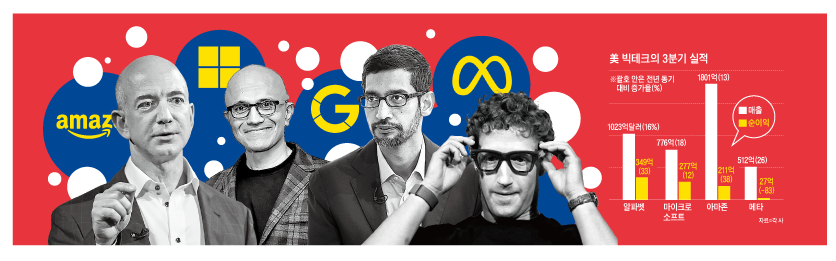
As the ‘AI bubble theory’—which suggests that the value and demand for artificial intelligence (AI) technology have been overestimated—gains traction, major tech companies such as Microsoft, Amazon, Meta, and Alphabet announced their third-quarter results. These firms, often referred to as the ‘Magnificent 7 (M7)’ and central to the AI bubble debate, attracted significant market attention with their recent earnings reports and executive statements.
A survey by Bank of America revealed that the AI bubble is now considered the biggest potential risk factor in financial markets, surpassing concerns like inflation and trade disputes. In this context, industry analysts have examined the key issues surrounding the AI bubble theory and the corporate and market responses from these four companies.
Surging AI Investments Despite Bubble Concerns
One argument against the AI bubble theory is that AI companies are overly focused on external growth, leading to a ‘chicken game’ scenario. While big tech firms continue to make large-scale capital expenditures (Capex) in AI investments, there are doubts about whether they are generating commensurate profits. Capital expenditure refers to funds spent by a company to acquire or improve land, buildings, equipment, etc., for production activities.
Despite skepticism, during this earnings announcement period, big tech companies collectively raised their capital expenditure forecasts for this year. According to Bloomberg’s forecast, the four companies’ total capital expenditure for this year will reach 400 billion dollars, and is expected to exceed 420 billion dollars next year.
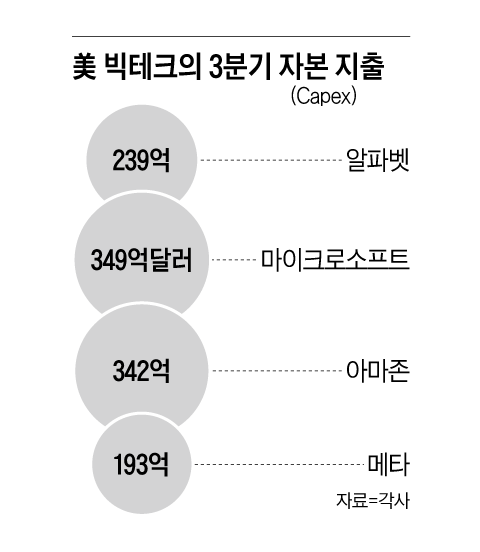
Amazon, the global No. 1 cloud provider, announced on the 30th of last month that it would raise its capital expenditure forecast for this year from 118 billion dollars to 125 billion dollars, continuing its most aggressive investment. Amazon stated, ‘Capital expenditure will increase further next year.’
Microsoft, the No. 2 cloud service provider, announced on the 29th of last month that its capital expenditure in the previous quarter was 34.9 billion dollars, an increase of more than 45% from the previous quarter. It stated that due to a surge in customer demand for data center-based services, it plans to double the size of its data centers within the next two years. Microsoft’s CFO Amy Hood said, ‘Computing power was insufficient amid increasing demand,’ and ‘We need to increase spending.’
Alphabet also raised its capital expenditure for this year to 91–95 billion dollars. This is the second upward revision following the increase from 75 billion dollars to 85 billion dollars in the summer. Alphabet’s CFO Anat Ashkenazi said, ‘We expect capital expenditure to increase significantly in 2026 as well.’
Meta also raised the lower end of its capital expenditure forecast for this year by 4 billion dollars to 70–72 billion dollars, from the previous 66–72 billion dollars.
Mixed Evaluations Based on Cloud Presence
While all four big tech companies publicly stated they would increase AI investments, market evaluations were mixed. Meta recorded a net profit of 2.7 billion dollars in the third quarter, an 83% decrease compared to the same period last year, causing its stock price to plummet 11.3% after the earnings announcement. It was the only company among the four to see a net profit decline.
Additionally, it was pointed out as a problem that Meta’s massive investments have not yielded definite profits from AI. Unlike the other three companies, which generate leasing revenue by building data centers through capital expenditure while running cloud businesses, Meta’s data center investments are solely used to utilize AI within its own platforms. In other words, the massive investments are criticized for being used only to improve internal efficiency.
In response, Meta CEO Mark Zuckerberg said, ‘AI provides enormous opportunities for new product development and strengthening advertising and content recommendation systems,’ and ‘What we need to do now is accelerate investment.’ He explained that better targeting using AI will enhance the performance of the digital advertising business. However, the market continued to give a poor evaluation, with Oppenheimer analysts lowering the stock’s investment rating from ‘Buy’ to ‘Hold.’
On the other hand, Amazon, Microsoft, and Alphabet, which run cloud businesses, seem to have temporarily quelled the AI bubble theory by monetizing through leasing revenue from data centers built via capital expenditure. Amazon reported that its Amazon Web Services (AWS) sales in the third quarter increased by 20% to 33 billion dollars. Microsoft stated that its cloud service ‘Azure’ sales increased by 40%, and Google’s cloud sales rose by 34% to 15.15 billion dollars.
Circular Deal Controversies
Another concern surrounding the AI bubble theory is the ‘circular deals’ structure between AI companies. According to a recent report by Morgan Stanley, six key industry companies, including OpenAI, NVIDIA, Microsoft, Oracle, AMD, and CoreWeave, are intertwined in a circular investment structure where they invest in each other’s shares and purchase products and services. Anthropic, an AI startup known to have received a 3 billion dollar investment from Google, also signed a contract with Google last month to expand cloud usage. Anthropic, which received a large-scale investment from Google, is again spending a huge amount of money to use Google’s chips and services.
This creates an illusion that demand and sales are being self-generated within the AI ecosystem. This circular deal structure has been compared to a replay of the dot-com bubble that occurred in the 2000s. It is pointed out that this is similar to the behavior during the dot-com bubble, when emerging tech companies artificially inflated sales by clicking on each other’s banner ads.
Startup Investments as Variables
Amid this tangled investment structure, the corporate value and performance of AI startups invested in by each company also acted as variables in the big tech firms’ recent quarterly earnings. As the corporate value of Anthropic, which was invested in by Alphabet and Amazon, increased, the performance of both companies improved. Anthropic raised funds worth 13 billion dollars in September, tripling its corporate value compared to six months ago. Alphabet, which holds about 14% of Anthropic’s shares, recorded a net profit of 10.7 billion dollars from equity securities in the third quarter. Amazon’s third-quarter results also included a net profit of 9.5 billion dollars due to the increase in Anthropic’s value, as it invested about 8 billion dollars in the company.
In contrast, Microsoft’s net profit increased only slightly compared to the same period last year, as profits decreased by about 3.1 billion dollars due to OpenAI’s losses this quarter. Its stock price fell 2.9% after the earnings announcement. The analysis suggests that anxiety about OpenAI’s profits relative to excessive investment in AI infrastructure affected the stock price.