
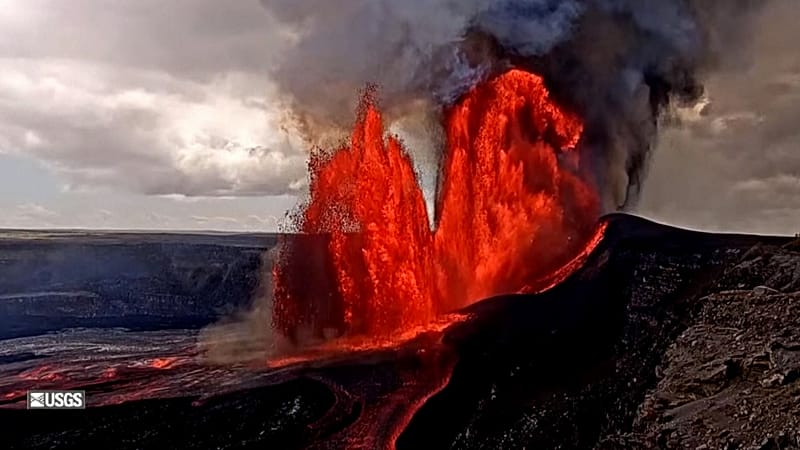
Hawaii’s Kilauea Volcano experienced another eruption on Sunday, releasing a towering plume of lava and gas into the sky. This marks the 36th eruption since December 2024, continuing a pattern of activity that has kept scientists and residents closely monitoring the situation. According to the U.S. Geological Survey, the volcano emitted lava for approximately five hours, with some fountains reaching heights of up to 330 meters. The event was notable for its intensity and duration, drawing attention from both experts and local communities.
An orange aviation alert remained in effect as molten rock continued to flow within the summit crater of Hawaii Volcanoes National Park. This alert is part of a system designed to keep pilots and air traffic controllers informed about potential hazards caused by volcanic activity. Despite the ongoing eruption, officials emphasized that the lava remained confined to the crater area, posing no immediate threat to nearby residential areas. The consistent containment of the lava flow has been a key factor in ensuring public safety during this period of heightened activity.
Kilauea, one of the most active volcanoes in the world, has maintained a regular pattern of eruptions over the past year. Each event follows a similar underground pathway, allowing scientists to gather valuable data about the volcano’s internal structure and behavior. These eruptions provide an opportunity for researchers to study the processes that drive volcanic activity and improve predictive models for future events. The consistency in the eruption patterns also helps in understanding how magma moves beneath the surface and what triggers these periodic outbursts.
The recent eruption has added to the growing body of knowledge about Kilauea’s long-term behavior. Scientists are particularly interested in how the volcano responds to changes in pressure and temperature within the Earth’s crust. By analyzing the composition of the lava and the timing of each eruption, experts can gain insights into the broader geological forces at play. This information is crucial not only for scientific research but also for developing strategies to mitigate the risks associated with volcanic activity.
In addition to its scientific significance, the eruption has drawn visitors to the area, who come to witness the natural spectacle. However, park officials have urged caution, reminding visitors to stay within designated safe zones and follow all guidelines provided by authorities. The presence of active lava flows and the potential for sudden changes in volcanic activity mean that even minor disruptions can pose risks to those in the vicinity.
Looking ahead, scientists will continue to monitor Kilauea closely, using advanced technology such as seismic sensors and satellite imagery to track any changes in the volcano’s behavior. These tools allow for real-time data collection, enabling experts to respond quickly to any developments. As the eruption continues, the focus remains on ensuring the safety of both the public and the environment while maximizing the opportunities for scientific discovery.
Overall, the recent activity at Kilauea highlights the dynamic nature of our planet and the importance of ongoing research in understanding and managing natural phenomena. With each eruption, new questions arise, and new answers are sought, contributing to a deeper appreciation of the forces that shape our world.