
Addressing the Plight of Undocumented Children in South Korea
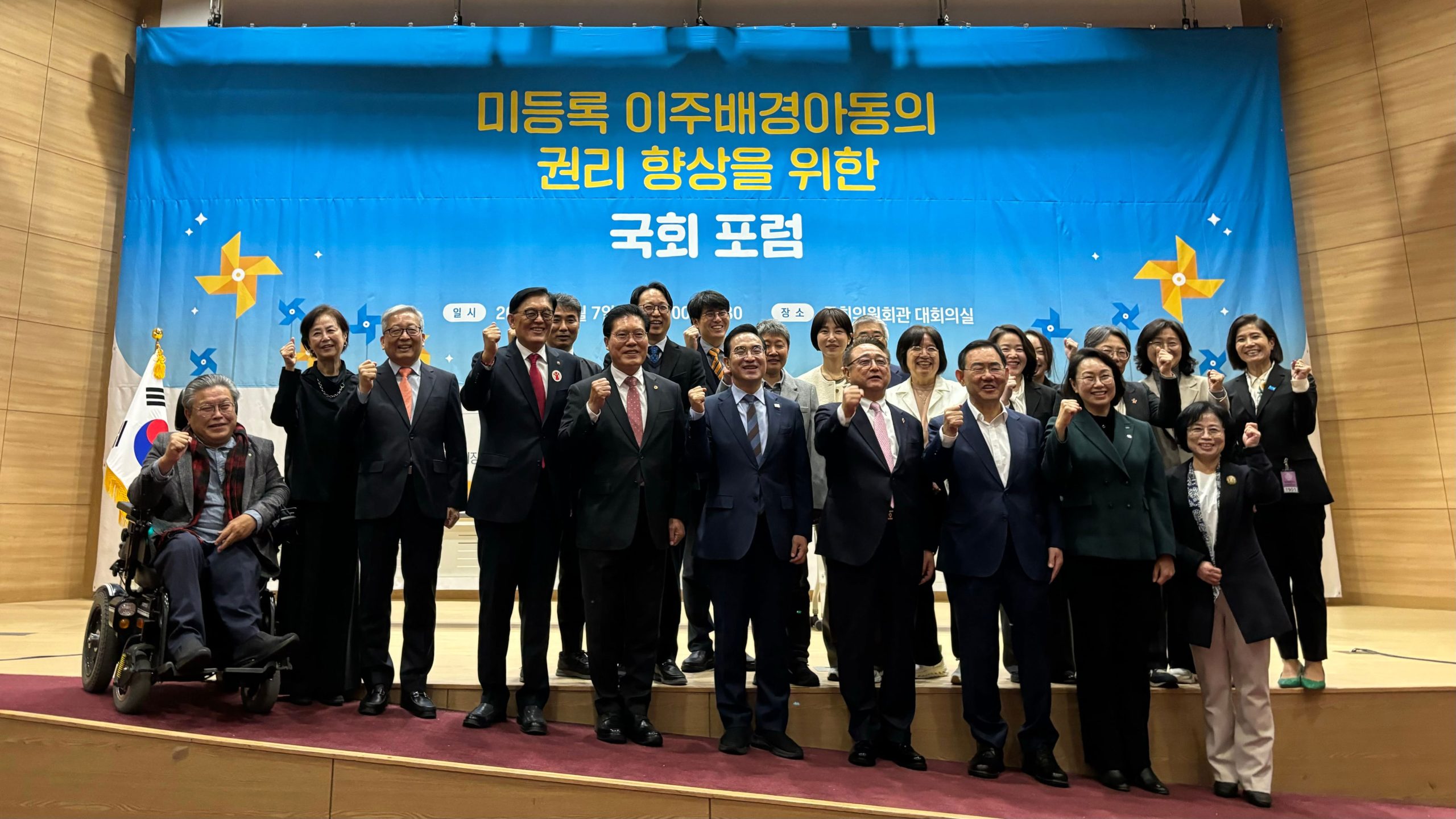
On the morning of the 7th, a significant event took place at the National Assembly Members’ Office in Yeongdeungpo-gu, Seoul. The “National Assembly Forum for Improving the Rights of Undocumented Children with Migrant Backgrounds” was held, bringing together various stakeholders to discuss the challenges faced by undocumented children. This forum was co-hosted by Vice Speakers Joo Ho-young and Lee Hak-young, along with several representatives from the Democratic Party of Korea and the Rebuilding Korea Party. Additionally, the Undocumented Hope Forum, comprising organizations such as the Christian Methodist Church Mission Office, Undocumented Children Support Center, Save the Children, UNICEF Korea Committee, and UNHCR, played a pivotal role in organizing the event. Chung Moo-sung, chairman of the Hyundai Motor Chung Mong-koo Foundation, served as the moderator.
The primary objective of the forum was to explore legislative and institutional improvements aimed at ensuring that undocumented children, often referred to as “shadow children,” can grow up fully in an era marked by low birthrates and population decline. These children, who are foreign-born but lack nationality due to the inability to register their births in South Korea, face numerous challenges. Under current laws, children born to foreign parents cannot register their births in South Korea, even if they are born there. This is because the family relations registration system is exclusively for South Korean nationals. Without resident registration numbers, these children encounter difficulties accessing basic public services such as education, childcare, and healthcare. They are also at higher risk of crimes like illegal adoption and human trafficking.
To address these issues, the government has implemented a “birth notification system” since last July. This system automatically informs local governments when a child is born in a hospital. However, foreign children remain excluded from this notification system, leaving a significant blind spot. According to the Board of Audit and Inspection, an estimated 4,025 undocumented foreign children were not registered at birth between 2015 and 2022.
Vice Speaker Joo Ho-young emphasized the importance of addressing the issue, stating, “There are children who are excluded from medical, educational, and welfare opportunities without even having their births recorded.” He added, “Regardless of nationality or parents’ status, the National Assembly will strive to improve systems so that all children can have their existence recognized and guaranteed.”
Rep. Park Hong-geun highlighted the challenges faced by children who cannot receive medical and educational opportunities due to lack of birth registration. He stressed the need for “legal mechanisms to universalize birth registration, strengthen access to medical and educational services, and guarantee residency rights.”
Eun Hee-gon, representative of the Undocumented Hope Forum, described undocumented children as “children who exist but are not recognized,” emphasizing the need for absolute support from society. She urged, “It is urgent to design systematic institutions to fill legal blind spots and allow them to live proudly as members of our society.”
In July, five organizations—Christian Methodist Church Mission Office, Undocumented Children Support Center, Save the Children, UNICEF Korea Committee, and UNHCR—signed a business agreement to support children with migrant backgrounds. They launched the Undocumented Hope Forum, promoting the introduction of a “birth registration system” as a key task. Their aim is to allow all children born in South Korea to register their births regardless of their parents’ nationality or residency status.
Meanwhile, the Ministry of Justice is pushing to enact the Foreigner Birth Registration Act as one of the “10 major bills for people’s livelihood and safety” during this regular National Assembly session. On the 6th, Justice Minister Jung Sung-ho visited the National Assembly to request Kim Byung-kee, Democratic Party of Korea floor leader, and Choo Mi-ae, chairperson of the Legislative and Judiciary Committee, to expedite the passage of the bill. If enacted, children born to foreign parents will be able to undergo registration procedures from birth.