
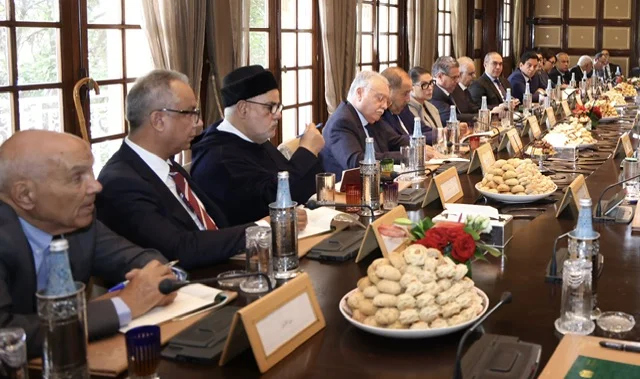
The King’s Inclusive Approach to the Sahara Autonomy Plan
In a significant move, King Mohammed VI of Morocco convened a meeting with his advisors to update and refine the autonomy plan for the Sahara. This initiative has been met with positive responses from various political party leaders, who have praised the monarch’s inclusive approach towards addressing the issue.
Commitment from Political Leaders
Aziz Akhannouch, president of the National Rally of Independents (RNI), affirmed his party’s commitment to formulating a forward-looking vision for the national cause, in line with UN Security Council Resolution 2797. This resolution is seen as a crucial step in the ongoing dialogue regarding the Sahara region.
Fatima-Zahra Mansouri, national coordinator of the Authenticity and Modernity Party (PAM), said her party fully supports this collaborative process, which encourages collective reflection while reaffirming Moroccan sovereignty. The PAM emphasizes the importance of maintaining national unity and territorial integrity.
Nizar Baraka, Secretary-General of the Istiqlal Party (PI), noted that the meeting focused on deepening and modernizing the autonomy proposal under Morocco’s sovereignty. The PI believes that the autonomy plan must reflect the current realities and aspirations of the people in the region.
Driss Lachgar, First Secretary of the Socialist Union of Popular Forces (USFP), stressed that political parties should develop a detailed and updated vision of the initiative, drawing inspiration from Morocco’s experience with advanced regionalization. This approach aims to ensure that the autonomy plan is both practical and sustainable.
Mohamed Ouzzine, Secretary-General of the Popular Movement (MP), highlighted the importance of the king’s consultative and participatory approach. The MP sees this as an opportunity for all stakeholders to contribute to the development of a comprehensive strategy for the Sahara.
Inviting Perspectives
Mohamed Nabil Benabdellah, Secretary-General of the Party of Progress and Socialism (PPS), added that parties have been invited to submit written memoranda presenting their detailed perspectives on the autonomy plan. This step ensures that a wide range of views and ideas are considered in the final formulation of the plan.
Abdelilah Benkirane, Secretary-General of the Justice and Development Party (PJD), said the meeting seeks to involve all political forces in shaping a national vision for updating the autonomy initiative under Moroccan sovereignty. The PJD believes that a unified national approach is essential for the success of the autonomy plan.
Nabila Mounib, MP for the Unified Socialist Party (PSU), emphasized that the Sahara issue has entered a new phase following the adoption of the UN resolution, calling for an integrated national strategy that also serves the broader Maghreb region. This perspective highlights the need for a cooperative approach among neighboring countries.
Continuing the Dialogue
This participatory process will continue on Tuesday with a meeting at the Ministry of the Interior, bringing together leaders of parties not represented in Parliament. This step is aimed at ensuring that all voices are heard and that the autonomy plan reflects the diverse interests and concerns of the population in the Sahara region.
The ongoing discussions and meetings demonstrate the commitment of the Moroccan government and its political allies to find a sustainable and inclusive solution for the Sahara. As the process continues, it is expected that the final autonomy plan will be a result of broad consensus and careful consideration of all relevant factors.