
A Historic Ceremony at Manhyia Palace
At exactly 2:10 p.m., the ancient rhythms of the fontomfrom drums and the piercing calls of nkokronya, ntahera, nkofe, and durugya (traditional flutes) echoed through the grand hall of the Osei Tutu II Jubilee Hall at Manhyia Palace. This moment was more than just a ceremony — it was the heartbeat of a nation witnessing history. For the first time in its nearly three-decade history, the Ghana Journalists Association (GJA) held its prestigious awards ceremony outside the capital, Accra. And not just anywhere — but at the spiritual and cultural seat of the Asante Kingdom.
Walking side by side into the hall were two of Ghana’s most revered figures: President John Dramani Mahama and the Asantehene, Otumfuo Osei Tutu II. Their synchronized entrance was more than protocol — it was a powerful gesture of unity between state and tradition, modern governance and traditional authority.
The Asantehene, patron of the event, brought more than royal presence — he brought soul. His involvement infused the ceremony with a sense of rootedness, reminding all present that journalism, too, has a cultural duty to preserve, to reflect, and to honor.
The Acting Chief Justice, Baffoe Bonnie, in a speech, put it perfectly that the “Manhyia Palace is not just a mere palace but a living bank of culture.”
Inside the about 3,000-capacity hall, the air was thick with anticipation and pride. Among the dignitaries were Inspector General of Police, Christian Tetteh Yohonu; Head of Government Communications, Felix Kwakye Ofosu; and COP (rtd) Kofi Boakye, now Head of Security at the Presidency.
Others were COP Michael Nketia Frempong, Director General, Finance; Mrs Bawa Mogtari, Presidential Aide; Acting Chief Justice, Baffoe Bonnie; and Minister of Information and National Orientation under Kufour’s administration, Stephen Asamoah Boateng.
But beyond the titles and uniforms were stories of journalists who braved floods, disease outbreaks, and political tension to tell the truth.
The ceremony was under the theme:”Safeguarding Ghana’s Future: The Role Of The Media In Promoting Peace, Security, and the Fight against Galamsey.”
In all, there were 34 awards, comprising individuals and institutions. Among the award winners was The Ghanaian Times’ Abigail Annoh, who took home the Health Category Award.
The afternoon was not just about awards — it was an affirmation that journalism matters. According to the President of the Private Newspaper and Online Publishers Association of Ghana (PRINPAG), David Tamakloe, “culture and truth-telling are not mutually exclusive — that the palace and the press can share a stage and a purpose.”
Mr. Albert Kwabena Dwumfour, President of the GJA, paid glowing tribute to the Asantehene for his remarkable contributions to democracy, peace, and the fight against illegal mining (galamsey) in Ghana.
He noted that the Asantehene’s efforts have been instrumental in raising awareness about the dangers of illegal mining and promoting sustainable development in the country.
The GJA, he mentioned, was happy that Otumfuo had destooled some chiefs under his kingdom solely due to their involvement in illegal mining.
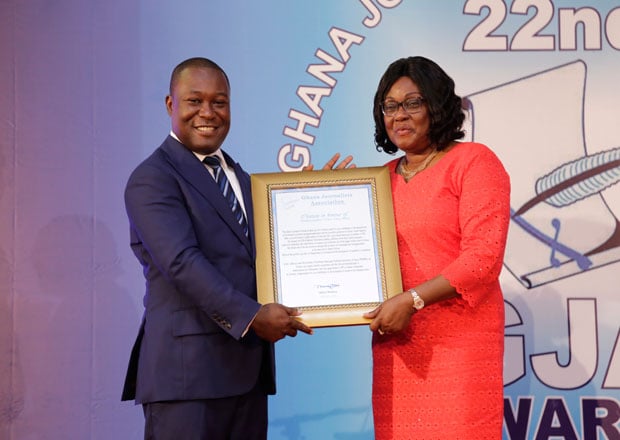
The GJA bestowed an honour upon the Asante Monarch. In a special citation, the GJA expressed its profound gratitude to Otumfuo for hosting the prestigious awards ceremony, which brought together prominent members of society, including President John Dramani Mahama.
The citation was presented to Otumfuo by President Mahama.
A Dazzling Showcase of Culture and Contemporary Glamour
This historic event marked a significant milestone in Ghana’s media landscape. It was a celebration of both heritage and progress, where the past met the present in a vibrant display of cultural pride and journalistic excellence.
The ceremony highlighted the critical role of the media in shaping public discourse and promoting national unity. With the theme focused on safeguarding Ghana’s future, the event underscored the importance of responsible reporting and the need for the media to act as a watchdog for the public interest.
The presence of high-profile officials and respected journalists emphasized the significance of this occasion. It was a reminder that journalism is not just about reporting news, but about upholding values, fostering dialogue, and contributing to the democratic process.
As the evening drew to a close, the energy in the hall remained high. The audience left with a renewed sense of purpose, inspired by the power of the press and the enduring legacy of the Asante Kingdom.