
Heated Debate Over Morocco’s 2026 Finance Bill
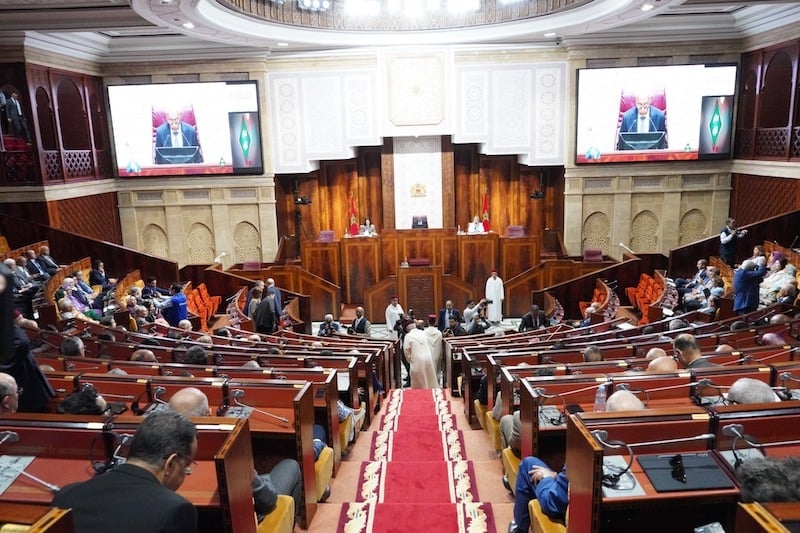
Lawmakers from across Morocco’s political spectrum engaged in a heated debate over the government’s draft 2026 Finance Bill, with the ruling coalition emphasizing strong fiscal performance while the opposition criticized it for social and regional imbalances.
During a plenary session of the House of Representatives, Mohamed Chouki, head of the National Rally of Independents (RNI) parliamentary group, highlighted the government’s efficiency by pointing to the auditing of tax revenues and public wage bills between 2021 and 2025. He noted that tax revenues increased significantly, rising from 167 billion dirhams in 2021 to nearly 289 billion dirhams in 2025—a 73 percent increase over four years. This growth, he attributed to improved collection systems and fiscal reforms that enhanced state efficiency.
Chouki also pointed out that the national budget saw substantial growth, increasing from 128 billion dirhams to 216 billion dirhams during the same period. Additionally, he mentioned that revenues allocated to local governments nearly doubled, reflecting progress in financial decentralization. Wage expenditures in the general budget grew from 140 billion to more than 190 billion dirhams, a 28 percent increase.
“This growth in revenues allowed the government to meet its social and financial commitments while maintaining fiscal balance,” Chouki stated.
Coalition Parties Highlight Economic Performance
Adil Al-Baytar, a lawmaker from the Authenticity and Modernity Party (PAM), emphasized that the current coalition had achieved one of Morocco’s strongest economic performances in the past 25 years. He cited GDP growth from $115 billion in 2020 to $160 billion in 2024, with an expected $165 billion in 2025. The average annual growth rate was 3.7 percent during this time.
Al-Baytar contrasted this with the situation before the coalition took office, when the economy was contracting by 7 percent in 2020 and public debt reached 72 percent of GDP.
Opposition Criticizes Uneven Development and Weak Delivery
Opposition groups argued that the budget deepens inequality and fails to deliver on key promises. Abderrahim Chahid, head of the Socialist Union of Popular Forces (USFP) group, said economic growth remains uneven, with three regions—Casablanca-Settat, Rabat-Salé-Kénitra, and Tangier-Tetouan-Al Hoceima—accounting for 58 percent of national output.
He accused the government of failing to create one million jobs, raise women’s participation above 30 percent, or reduce regional inequality. Chahid added that the administration has become “bureaucratic and politically exhausted.”
Idriss Sentissi, leader of the Popular Movement (MP) group, said the government was “fortunate” to benefit from record revenues but questioned whether that had translated into better living conditions. “Billions in revenue have not improved the lives of millions in rural and mountain areas,” he said, citing protests by teachers, doctors, and youth.
Sentissi called for faster decentralization and targeted support for women, stating that the government had failed to improve women’s economic participation, which remains below 19 percent.
Budget Minister Defends Policy Direction
Responding on behalf of the government, Budget Minister Faouzi Lekjaa said Morocco’s fiscal health was “a collective national achievement” built over decades. He emphasized that the 2026 Finance Bill aligns with King Mohammed VI’s social vision, noting that the government has transitioned 11 million people from the RAMED welfare system to mandatory health insurance at a cost exceeding 10 billion dirhams.
Lekjaa stated that direct social assistance now exceeds 35 billion dirhams annually, alongside reforms to unemployment compensation and retirement schemes. On the budget’s priorities, he defended allocating 140 billion dirhams to health and education, calling it “a clear political choice.”
He also insisted that Morocco’s tax reform—including a wider application of source-based deductions—has improved fairness and efficiency. Lekjaa maintained that the government’s fiscal discipline, with a 3 percent deficit target and 3 percent growth, is key to maintaining debt sustainability.
“The social progress we see today is the result of steady, structural reform,” Lekjaa said. “Preserving these achievements requires shared responsibility across government and opposition alike.”