
Rastriya Swatantra Party Considers Electoral Alliances for Upcoming Elections
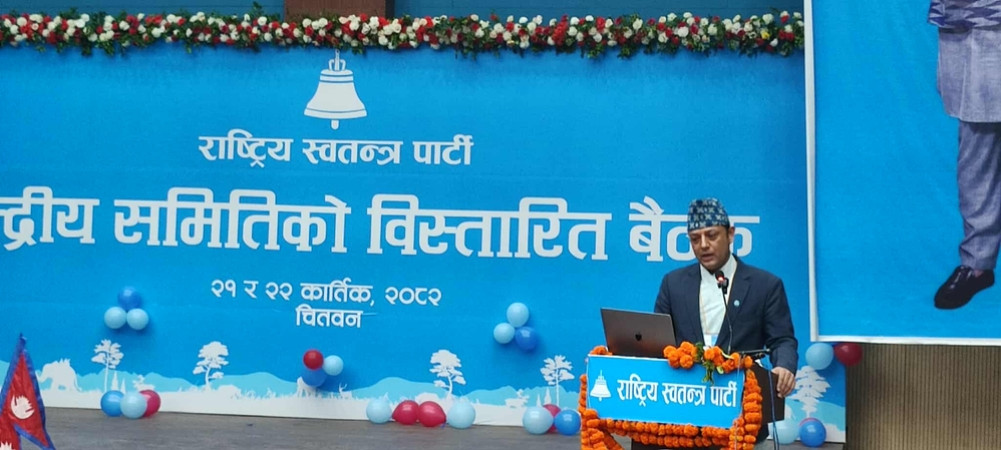
Kathmandu, Nov. 7 — The Rastriya Swatantra Party (RSP) has left the door open for forming an electoral alliance ahead of the parliamentary elections scheduled for March 5. This possibility was highlighted during the ongoing extended central committee meeting in Sauraha, Chitwan, where DP Aryal, the party’s acting chairman, presented a political dossier.
The report, which spans 48 pages, outlines various aspects of the party’s strategy and positions. While it does not specify which parties or political forces could be involved in such alliances, it emphasizes that any collaboration must not undermine the party’s unique identity. “The party remains open to cooperating and forming alliances with independent individuals, groups, and political parties that share similar fundamental values during and after the election,” the report states. “However, the party’s identity will not be compromised while forming any alliance.”
Focus on Coordination with New Political Forces
Party leaders indicated that the decision to consider alliances is primarily aimed at coordinating with newly emerging political forces. Despite criticism of traditional parties for their coalition practices, the RSP has opted to follow a similar approach. The report underscores the importance of maintaining the party’s distinct identity even as it explores potential partnerships.
The document also addresses the Gen Z movement, the party’s stance on the current government, and its future plans. It calls for an independent and fair analysis of the events that took place on September 8 and 9, expressing concern over the premeditated nature of some incidents on September 9. The report highlights that the misuse of state power on September 8 led to the violence on the following day and demands an impartial investigation to hold those responsible accountable.
Deliberations and Organisational Reports
The party is currently deliberating on the report, dividing its representatives into seven groups. Participants include office bearers, central committee members, central commission officials, provincial committee leaders, district and electoral constituency committee chairs, and party chiefs from municipalities. A total of 512 members are expected to attend the meeting.
During the session, general secretary Kabindra Burlakoti presented the organisational report. Meanwhile, vice-chair Swarnim Wagle will seek suggestions for the election manifesto. The meeting will also discuss candidacy calls for the proportional representation system and the selection procedures.
Key Areas of Focus
- The RSP’s political dossier covers a wide range of topics, including its position on the Gen Z movement and the current government.
- The report calls for a fair and independent analysis of the events of September 8 and 9, highlighting concerns about the premeditated nature of some incidents.
- The party stresses the need for an impartial probe into the misuse of state power on September 8, which led to subsequent violence.
- The extended central committee meeting is a critical step in shaping the party’s strategy for the upcoming elections.
- The discussions involve a broad spectrum of party representatives, ensuring diverse input and perspectives.
- The organisational report and manifesto development are key components of the meeting, focusing on the party’s future direction.
As the RSP continues its preparations for the parliamentary elections, the focus remains on balancing strategic alliances with the preservation of its core values and identity. The party’s approach reflects a careful consideration of both internal and external political dynamics in the lead-up to the elections.