
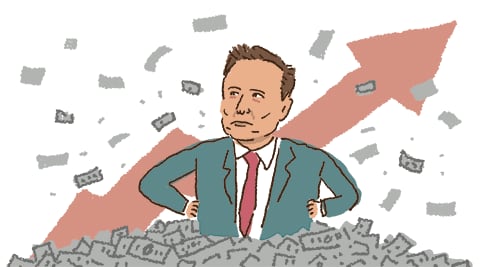
The Unprecedented Compensation Plan of Elon Musk
Elon Musk, the CEO of Tesla, has received approval for a performance-based compensation plan worth $1 trillion. This decision was made with 75% support during the company’s shareholder meeting. The amount is so significant that it surpasses the GDP of countries like Sweden and Argentina, placing it at the 21st position globally. It is even higher than the GDP of Saudi Arabia, which stands at around $1.24 trillion. In addition, this sum exceeds the U.S. defense budget of approximately $890 billion. No individual in history has ever been granted such an amount.
Historical Comparisons and Current Context
Historically, figures like Roman Emperor Augustus and China’s Qin Shi Huang were among the wealthiest individuals of their time. However, their wealth was derived from tax collection rights and territorial control. Similarly, Saudi Crown Prince Mohammed bin Salman’s Public Investment Fund (PIF) holds assets exceeding 1,000 trillion won, but these are owned by the royal family rather than an individual. For Musk to receive the full $1 trillion bonus, Tesla’s market capitalization must reach $8.5 trillion—six times its current value. In 2018, Musk agreed to a $56 billion bonus if he could grow Tesla’s market cap from $60 billion to over $650 billion within a decade. He achieved this in less than six years, outperforming Apple CEO Tim Cook’s $370 million stock option package. While Wall Street initially dismissed it as “fantasy,” Musk proved them wrong.
Musk’s Vision and Control Over Tesla
Musk claims his pursuit of the “$1 trillion” reward is not for personal gain. Instead, he has stated that he needs sufficient equity to maintain control over Tesla’s AI and robotics initiatives. His goal is to ensure “unquestionable management control” over future technologies. Musk’s threat to leave the company if the plan failed was both a form of coercion and an irresistible offer to the board and shareholders. If Musk receives the $1 trillion bonus in stock, his current 13% stake in Tesla would increase to 25%.
The Voting Process and Investor Sentiment
The voting process itself was intriguing. Institutional investors, including Norway’s sovereign wealth fund, opposed the plan, calling it “absurd.” However, retail investors, whose fortunes are closely tied to Tesla’s stock price, showed enthusiastic support. The fan sentiment that “Musk equals stock price” overwhelmed institutional rationality. These investors seem to view Musk as their savior for wealth growth. Tesla, which had seen its stock price decline recently, rebounded in after-hours trading following the news. The market, for now, cheered this gamble.
The Broader Implications
In the AI era, a single genius can reshape humanity’s wealth. A single vision can influence the lives of hundreds of millions. In such a time, it’s worth asking: What is the limit of appropriate performance-based compensation? Is Musk’s $1 trillion the pinnacle of merit-based rewards, or a bubble born of market hysteria? Only time will tell.