
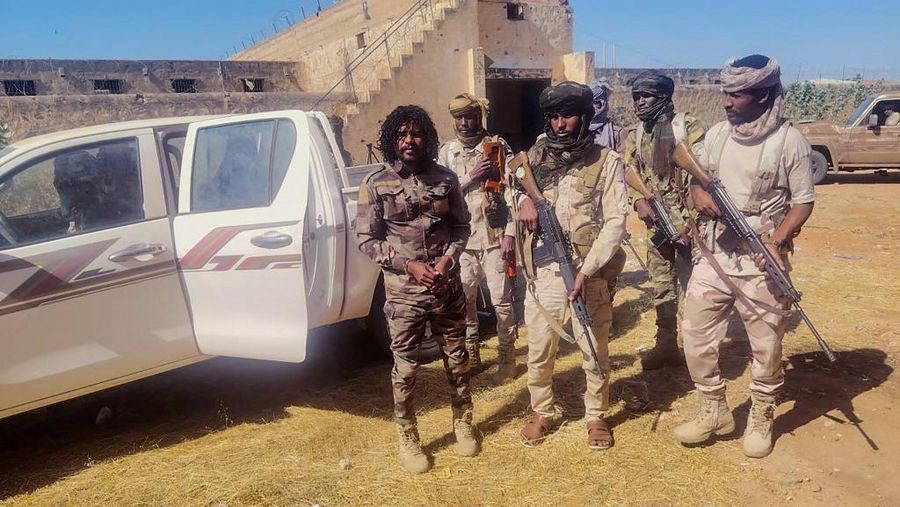
Sudan’s Rapid Support Forces Agree to Humanitarian Truce
The Rapid Support Forces (RSF), a rebel group in Sudan, have announced their agreement to a humanitarian truce proposed by the United States, Egypt, the UAE, and Saudi Arabia. This decision was made public through a statement released on Thursday, highlighting the group’s commitment to addressing the needs of the Sudanese people.
The RSF and the Sudanese Armed Forces have been engaged in conflict for nearly two years. Despite several attempts at ceasefire agreements, none have managed to bring lasting peace to the region. In their latest statement, the RSF emphasized that they are aligning with the aspirations of the Sudanese population by accepting the truce proposal from the so-called “Quad countries.”
This announcement comes shortly after the RSF took control of el-Fasher, a city in the western region of Darfur, which has been suffering from severe famine. The situation in Darfur has become increasingly dire, with reports of widespread violence and human rights abuses.
A History of Conflict and Violence
The conflict between the RSF and the Sudanese Armed Forces has led to significant loss of life and displacement. According to the World Health Organization, the RSF has been responsible for the deaths of over 450 individuals at a local hospital, as well as house-to-house killings and sexual assaults. These atrocities have raised serious concerns about the safety and well-being of civilians in the region.
A recent report by Yale University researchers revealed new satellite imagery that shows signs of activity consistent with mass graves. This evidence could support the numerous allegations of human rights violations reported in Darfur.
Humanitarian agencies have also expressed alarm over the deteriorating conditions in the region. Islamic Relief warned that community kitchens, which many families depend on for food, are at risk of collapse. Meanwhile, the Sudan’s Doctors Network reported that humanitarian conditions are worsening in displacement camps located in the cities of Tawila, Kurma, and Golo.
Escalating Displacement and Crisis
The cities of Tawila, Kurma, and Golo have seen a significant increase in the number of displaced people fleeing the conflict. Recent data indicates that the number of displaced individuals has exceeded 36,000 in a short period. This surge has placed additional strain on already limited resources and infrastructure.
Despite the RSF’s announcement of a humanitarian truce, the Sudanese Armed Forces have not yet commented on the development. In a recent statement, army chief Abdel Fattah al-Burhan stated that his forces are striving for the defeat of the enemy, indicating that the conflict may continue for some time.
The Role of International Advisors
Earlier this week, Massad Boulos, an advisor to former President Donald Trump on Africa, stated that both sides had shown openness to a three-month humanitarian ceasefire. However, without a clear response from the Sudanese Armed Forces, the future of the truce remains uncertain.
The humanitarian crisis in Darfur continues to escalate, with reports of increasing violence, displacement, and suffering among the civilian population. As the situation unfolds, the international community is closely monitoring developments and urging all parties to prioritize the well-being of the people affected by the conflict.