
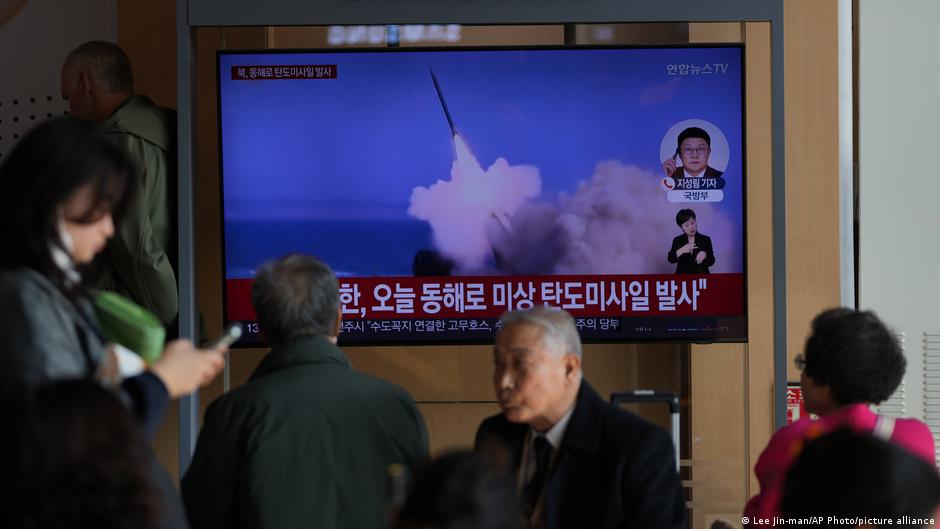
Escalation of Weapons Testing in North Korea
North Korea has been significantly increasing the frequency of its weapons testing in recent weeks, drawing attention from international observers and analysts. This surge in activity is believed to be a response to South Korea’s plans to construct a nuclear-powered submarine with assistance from the United States.
On Friday, North Korea launched what is suspected to be a short-range ballistic missile towards the eastern waters. According to the South Korean military, the missile traveled approximately 700 kilometers (434 miles) across the country after being fired from an inland area near the western county of Taekwan. The South Korean and U.S. intelligence agencies had already monitored the preparations for the launch and were currently analyzing the details.
Japanese Prime Minister Sanae Takaichi also mentioned that a missile, possibly ballistic, may have landed in the waters just outside Japan’s exclusive economic zone. However, North Korea did not immediately confirm the launch. This event occurred following two weeks of continuous missile launches, which came after U.S. President Donald Trump renewed efforts to engage in talks with Pyongyang.
Germany swiftly condemned the missile launch, stating that it posed a threat to regional and global stability. The German Foreign Office expressed concern and urged North Korea to cease its unlawful development, testing, and transfer of ballistic missiles, as outlined in multiple United Nations Security Council resolutions.
North Korea’s Perspective on Regional Tensions
North Korea has been intensifying its weapons testing in recent weeks, including the firing of purported hypersonic and cruise missiles last month. These actions are claimed to enhance its nuclear capabilities. From North Korea’s perspective, the potential for sudden attacks from the East Sea could be a source of anxiety, according to Ahn Chan-il, a defector-turned-researcher at the World Institute for North Korea Studies.
“If South Korea acquires a nuclear-powered submarine, they would be able to enter North Korean waters and preemptively monitor or intercept weapons such as submarine-launched ballistic missiles (SLBMs),” Ahn explained.
Trump recently announced that South Korea would build a nuclear-powered submarine in the U.S., where the technology is closely guarded. This development has raised concerns among North Korean officials, who view it as a potential threat to their security.
Stalled Diplomatic Talks
Despite repeated expressions of interest from Trump in meeting North Korea’s Supreme Leader Kim Jong Un, no such meeting has taken place. During Trump’s visit to South Korea on the sidelines of a summit, there was an opportunity for dialogue, but it remained unfulfilled.
North Korea has previously indicated that it would consider resuming talks with the U.S. if Washington ceased demanding the denuclearization of Pyongyang. On Thursday, North Korea’s foreign ministry accused the Trump administration of “antagonizing” it by imposing sanctions on its officials and institutions over allegations of money laundering.
This ongoing tension highlights the complex nature of diplomatic relations between North Korea and the international community. As both sides continue to navigate these challenges, the situation remains volatile and closely watched by global observers.