
The Rise of Antibody-Drug Conjugates (ADCs) in the Anticancer Market
Antibody-drug conjugates (ADCs) have emerged as a revolutionary platform in the anticancer drug market, offering a more targeted and effective approach to cancer treatment. These drugs are designed to deliver potent chemotherapy agents directly to cancer cells, minimizing damage to healthy tissues. As a result, ADCs are gaining significant traction in the global pharmaceutical industry.
A comprehensive analysis report on the ADC industry, released by Grosse Research, highlights the evolving landscape of this sector. The report titled “ADC Industry Reorganization: From Technology Competition to Production Competition” explores various aspects, including technological advancements, global supply chain adjustments, and opportunities for domestic companies.
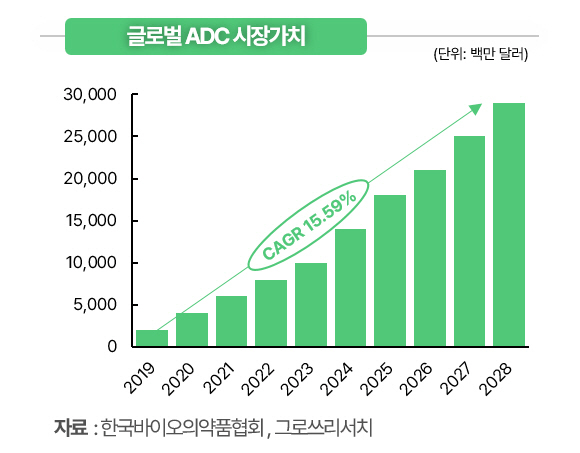
According to the report, ADCs represent a “precision toxicity” approach, which significantly reduces side effects compared to traditional chemical anticancer drugs. Their application is expanding beyond breast and blood cancers to include lung and solid tumors. The global ADC market is projected to grow from approximately $14 billion in 2024 to over $30 billion by 2028, indicating a strong upward trajectory.
Shift in Industry Focus: From Technology to Production
The report identifies a notable shift in the keywords defining the ADC industry, moving from technology to production and ultimately to the supply chain system. In the past, competition centered around antibody, linker, and payload design technologies. However, the current focus has shifted to large-scale manufacturing capabilities, DAR homogeneity, and regulatory response abilities, which now play a critical role in determining corporate value.
This change is driven by major players in the pharmaceutical industry making substantial strategic investments. For example, Daiichi Sankyo’s collaboration with AstraZeneca, Pfizer’s acquisition of Ciagen for about $43 billion, and the expansion of Lonza and Merck’s production lines illustrate the growing importance of production and supply chain efficiency.
AstraZeneca is investing $1.5 billion to build a dedicated ADC production base in Singapore, while global CDMOs are expanding their production capacities based on HPAPI (high-potency API). These developments underscore the industry’s move towards a more integrated and efficient production model.
Impact on the Korean Market
The ADC industry is also undergoing significant changes in South Korea. Samsung Biologics is actively securing ADC production capacity and expanding its global orders. Similarly, Lotte Biologics is establishing a commercial production response system. Riga Chembio and ABLbio are accelerating their global technology exports and clinical progress, leveraging their ConjuALL platform technology and dual antibody-based ADC strategies, respectively.
Grosse Research emphasizes that the ADC industry is no longer just about new drug development but is shaped by platform competition, production efficiency, and global partnerships. This transformation presents an opportunity for Korean companies to establish a strategic position in the global supply chain, utilizing their platform and CDMO capabilities.
Strategic Importance of ADCs
CEO Han Yong-hee of Grosse Research stated that ADCs represent a treatment platform emblematic of the precision cancer era. He highlighted that ADCs are a national strategic industry that combines R&D, manufacturing, and global technology transfer. A value chain is forming, allowing domestic technology-based companies and CDMOs to grow together.
As the ADC market continues to evolve, the focus on production efficiency, technological innovation, and global partnerships will be crucial for companies aiming to stay competitive. The future of cancer treatment may well depend on the ability of these companies to navigate and lead in this dynamic landscape.