
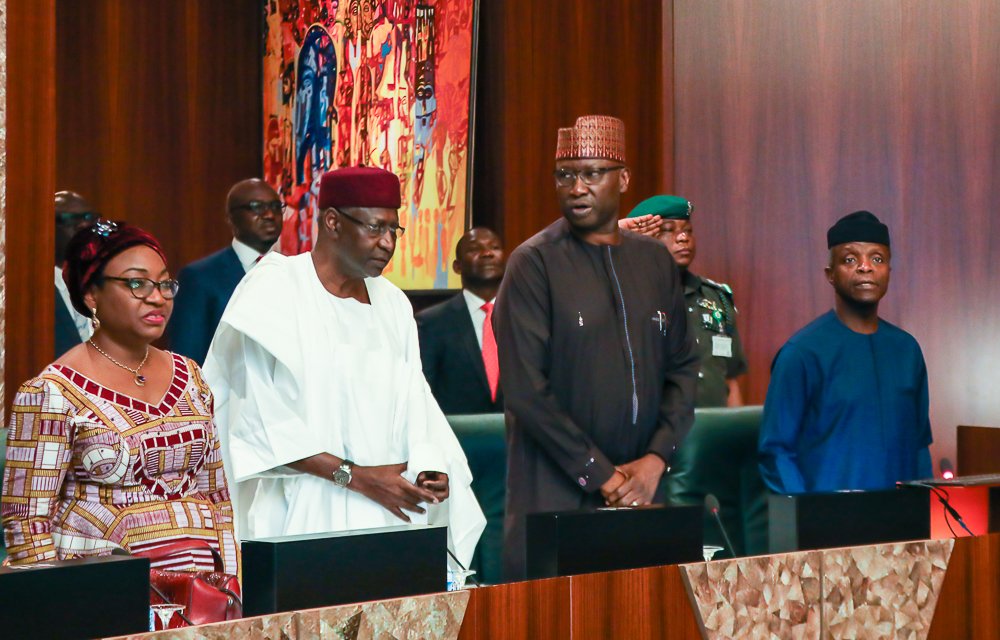
Federal Executive Council Approves Over N43 Billion for Lagos–Ibadan Expressway Completion
The Federal Executive Council (FEC) has approved over N43 billion for the completion of Phase II, Section II of the Lagos–Ibadan Expressway. This development marks a significant step in the ongoing efforts to improve critical road infrastructure across Nigeria.
During a briefing for journalists following Thursday’s meeting at the State House, Abuja, the Minister of Works, Dave Umahi, outlined several key updates on ongoing and newly approved contracts aimed at accelerating the pace of major road projects.
Key Projects and Updates
One of the highlighted projects is the East–West Road, which the President Bola Tinubu administration inherited with a budget of N156 billion. This project includes two carriageways, three flyovers, and two bridges. According to Umahi, the project has been restructured to ensure timely completion amid heavy traffic and a redesigned pavement structure.
“This project was awarded about five years ago but didn’t take off. When Mr President came in, FEC terminated the earlier contract. Now, we’ve re-awarded Phase II, Section II for N43 billion. It includes underpasses, concrete pavement, ramps, and adjoining roads,” Umahi said.
Work has been completed on one carriageway and 30 per cent of the second. New flyovers at Abuloma and Refinery Junctions in Rivers State will be presented for fresh approval before the end of the month. The revised contract also captures additional infrastructure—such as flyovers, underpasses, and link roads—that were omitted from earlier designs.
Cost Adjustments and New Contracts
The Council also approved a cost review for the Mushin–NNPC Junction–Apapa–Oshodi Expressway dualisation, originally awarded in 2022 for N11 billion but now adjusted to ₦19.09 billion. This adjustment reflects the impact of inflation and escalating construction material costs. The 14.4km stretch is expected to improve access to Lagos ports and industrial zones.
In addition, the FEC awarded the third section of the 1,068km Sokoto–Badagry Superhighway, covering the Badagry–Ogun–Oyo border segment (162.97km). The section will be built with reinforced concrete pavement at N3.39 billion per kilometre.
For the Ilorin–Omu Aran–Egba Road (206.7km), the project has been divided into phases for easier funding. Phase I (31km) was approved at ₦43 billion, with subsequent sections to be executed as funds allow.
On the Enugu–Onitsha Road (OP Junction–Ukehe–Okatu–Abu Udi–Oji–Anambra border), Phase I (35.1km) is valued at N28.47 billion, out of which ₦21 billion has been paid, leaving a balance of N7 billion.
Infrastructure Revisions and Challenges
In Ota–Idiroko, Ogun State, Section I (14km) of the project saw its cost revised from N43 billion to N98 billion due to a change from flexible to rigid pavement and the discovery of high underground water levels. The 509-metre flyover with dual ramps was similarly adjusted from N17 billion to N23 billion.
FEC also approved Phase II (42km) of the Wasasa–Turunku–Mararaba Road in Kaduna State at N30.23 billion, building on the earlier N18 billion approved for the first 7.8km section.
Another notable project is the Ijebu Igbo–Etapa–Owoyen Road, linking Ogun and Oyo States. Initially awarded for N13 billion (30km), it has now been extended by 7km and revalued to N53 billion, featuring reinforced concrete and upgraded subgrade designs.
Factors Behind Cost Increases
Umahi attributed the series of cost adjustments to “design enhancements, tough terrain, and inflationary pressures,” pointing out that the price of reinforcement steel has risen to over ₦1.1 million per tonne.
He further disclosed that the governors of Edo, Delta, and Abia States have taken over the funding and execution of select federal roads within their states, in an effort to ease the financial load on the federal government and speed up completion timelines.
“The revised approvals reflect our commitment to durable, concrete-based infrastructure that can withstand decades of use while ensuring value for money,” Umahi said.
Cabinet Changes and Leadership
Earlier today, Tinubu administered the oath of office to Dr. Bernard Doro and Dr. Kingsley Udeh as ministers, officially inducting them into the Federal Executive Council. The ceremony was held inside the Council Chamber of the State House, Abuja, just moments before the start of the first FEC meeting since July 2025.
With their swearing-in, Plateau and Enugu states now regain representation in the federal cabinet after several weeks without ministerial presence.