
Key Messages
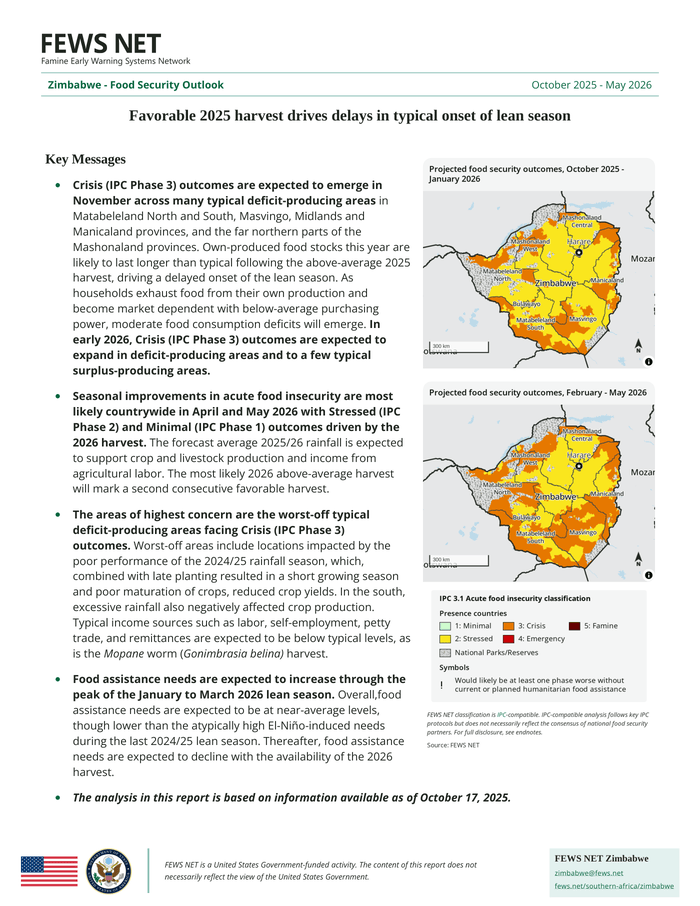
The anticipated outcomes of a Crisis (IPC Phase 3) are expected to occur in November across several areas known for producing food deficits, including Matabeleland North and South, Masvingo, Midlands, and Manicaland provinces, as well as the far northern parts of the Mashonaland provinces. The current year’s own-produced food stocks are likely to last longer than usual due to the above-average harvest of 2025. This will lead to a delayed start of the lean season. As households deplete their own food supplies and become more reliant on the market, they will face below-average purchasing power, resulting in moderate food consumption deficits.
By early 2026, the Crisis (IPC Phase 3) outcomes are expected to expand not only in typical deficit-producing areas but also in some surplus-producing regions. Seasonal improvements in acute food insecurity are most likely to be observed nationwide in April and May 2026, with Stressed (IPC Phase 2) and Minimal (IPC Phase 1) outcomes driven by the 2026 harvest.
The forecasted average 2025/26 rainfall is expected to support both crop and livestock production, as well as income from agricultural labor. The most probable above-average harvest in 2026 will signify the second consecutive favorable harvest. However, the areas of highest concern remain the worst-off typical deficit-producing regions, where Crisis (IPC Phase 3) outcomes are expected.
Worst-off areas include locations that were affected by the poor performance of the 2024/25 rainfall season. This led to late planting, a shortened growing season, and poor crop maturation, which resulted in reduced yields. In the southern regions, excessive rainfall also had a negative impact on crop production. Typical income sources such as labor, self-employment, petty trade, and remittances are expected to be below normal levels, as is the harvest of Mopane worm (Gonimbrasia belina).
Food assistance needs are expected to increase during the peak of the January to March 2026 lean season. Overall, food assistance needs are projected to be at near-average levels, although lower than the unusually high needs caused by the El-Niño phenomenon during the previous 2024/25 lean season. Afterward, food assistance needs are expected to decline as the 2026 harvest becomes available.