
Government Unveils Ambitious Plans to Revitalize Science and Technology
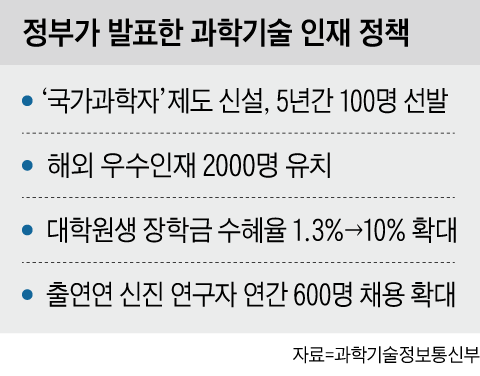
The government has announced a comprehensive strategy to invest approximately 1.2 trillion Korean won by 2030, aiming to attract 2,000 overseas outstanding and emerging researchers while establishing a ‘National Scientist’ system to support domestic science and technology scholars. This initiative comes in response to growing concerns over the ‘brain drain’ of domestic talent abroad, prompting a cross-ministerial effort to address the talent shortage crisis.
On the 7th, President Lee Jae-myung, along with the Ministry of Science and ICT, Ministry of Education, and Ministry of Trade, Industry and Resources, held a national reporting session titled ‘Dreaming Again of Science and Technology Professionals: A Report to the People of the Republic of Korea’ at the National Science Museum in Daejeon. The event unveiled strategies to attract talent and innovate the research and development (R&D) ecosystem.
National Scientist System
One of the key components of the plan is the designation of about 100 researchers with world-class achievements as ‘National Scientists’ over five years, selecting around 20 annually. These National Scientists will receive a ‘Presidential Certificate’ and 100 million Korean won in annual research support. They will participate in R&D and national science and technology policy design. The system mirrors China’s ‘Academician’ title for top scientists. Earlier, Deputy Prime Minister and Minister of Science and ICT Bae Kyung-hoon stated in an interview that a ‘Korean-style Academician system’ would be introduced to prevent domestic scholars from leaving abroad.
R&D Investment and Innovation
The government also aims to expand R&D investment to 5% of total government spending annually. It emphasized selecting innovative R&D projects over safe, guaranteed outcomes and properly evaluating results. President Lee Jae-myung criticized, “How absurd is it that South Korea’s R&D success rate exceeds 90%? Only by tolerating failure can proper R&D thrive, and the nation will prosper.”
Cultivating Ambidextrous Talent
The government plans to cultivate ‘ambidextrous talent’—integrating AI with science and technology—outside the capital region. This includes establishing and expanding science gifted schools and strengthening ties with science and technology institutes to reduce medical school concentration.
Scholarship rates for graduate students in science and engineering will rise from 1.3% in 2025 to 10% by 2030. Government-funded research institutions will also increase hiring of emerging researchers by 600 annually.
Criticisms and Challenges
Critics argue the government’s measures lack innovation, rehashing past policies. For instance, the National Scientist system is nearly identical to the ‘National Scholar’ program (2005–2008), which aimed to nurture Nobel Prize-level talent by providing up to 2 billion Korean won annually (200 million for theoretical fields) over five years.
The plan to spend 1.2 trillion Korean won over five years to attract overseas talent—70% of whom are domestic researchers abroad—has also drawn criticism. As global competitors vie to retain talent fleeing U.S. research funding cuts, South Korea’s approach is seen as overly passive.
Conclusion
While the government’s initiatives aim to address the brain drain and foster a more robust R&D environment, they face challenges in proving their effectiveness and differentiating themselves from previous efforts. The success of these plans will depend on their implementation, adaptability, and ability to create a sustainable ecosystem for scientific and technological innovation.