
European Commission Unveils Ambitious Plan for High-Speed Rail Network
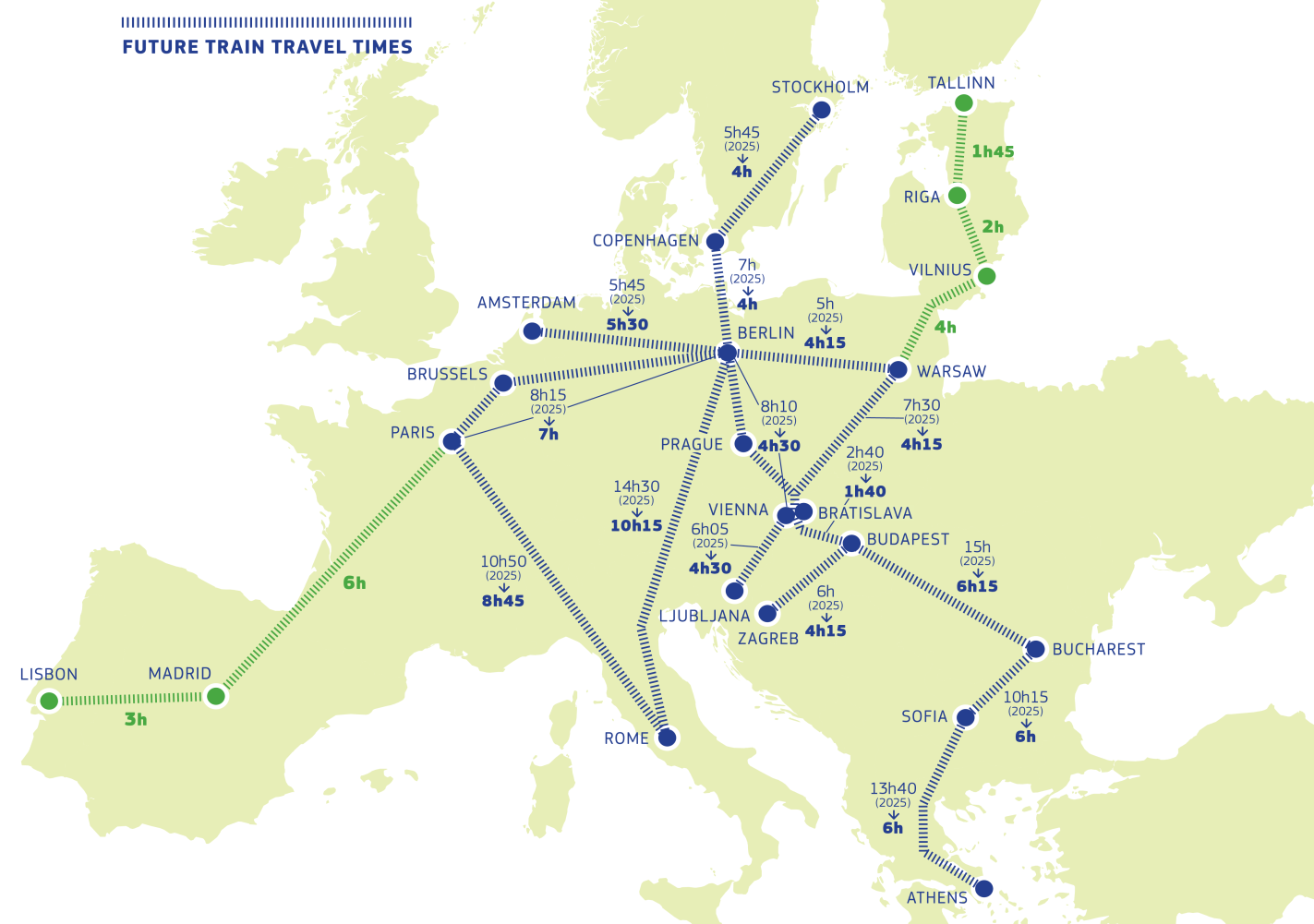
The European Commission has unveiled a bold initiative to construct high-speed railway lines connecting major European capitals. This plan, announced on Wednesday, November 6, includes routes such as Bucharest to Budapest, with the goal of achieving speeds of at least 200 kilometers per hour by 2040. The project aims to modernize and expand the continent’s rail infrastructure, making travel more efficient and sustainable.
Key Routes and Travel Time Reductions
The proposed network will feature high-speed sections on several key routes, including:
- Budapest – Bucharest
- Berlin – Copenhagen
- Berlin – Vienna – Prague
- Paris – Madrid – Lisbon
- Munich – Rome
- Between the Baltic states
These upgrades are expected to significantly reduce travel times. For instance, passengers traveling between Berlin and Copenhagen will be able to complete the journey in just 4 hours, down from the current 7 hours. Similarly, the trip between Sofia and Athens will be cut to 6 hours, representing a reduction of over 50% compared to current travel times.
A journey between Bucharest and Budapest is also set to be shortened to just over 6 hours, compared to the current 14–16 hours. These improvements are not only about convenience but also about enhancing mobility across the continent.
Benefits Beyond Travel Times
The Commission highlighted that these modifications would lead to traffic decongestion and improve military mobility opportunities. By shifting some of the freight and passenger traffic from roads to railways, the plan aims to reduce congestion and enhance the efficiency of transport networks.
In addition to rail infrastructure, the Commission has also outlined plans for supporting the development of “clean” aviation fuel. A budget of nearly EUR 3 billion is allocated for this purpose by 2027, with an estimated EUR 100 billion expected to be invested by 2035. This move is part of a broader strategy to reduce the environmental impact of air travel.
Enhancing Ticketing and Rolling Stock Markets
Another important aspect of the proposal involves improving ticket purchasing options. The goal is to encourage the use of trains over short-distance flights, thereby reducing environmental pollution. This initiative aligns with the EU’s commitment to sustainability and carbon neutrality.
Furthermore, the plan includes new legislation to support the development of a second-hand market for rolling stock. The Commission will propose measures in 2027 to ban anticompetitive scrapping of functioning and safe rolling stock. It also aims to establish transparent conditions for the resale and operation of such equipment across all Member States.
Vision for a Sustainable Future
Commissioner for Sustainable Transport and Tourism, Apostolos Tzitzikostas, emphasized the broader significance of the high-speed rail initiative. He stated, “High-speed rail is not just about cutting travel times; it is about uniting Europeans, strengthening our economy, and leading the global race for sustainable transport. We are turning ambition into action: breaking down barriers, mobilising investments for modern infrastructure, and making cross-border rail the backbone of a carbon-neutral, competitive, and secure Europe.”
Funding and Current Projects
To date, the EU has supported 804 rail infrastructure projects across the EU with a total investment of EUR 34.4 billion through the Connecting Europe Facility (CEF). This accounts for 68.76% of the total CEF investment. These projects are critical for building a cohesive and efficient rail network that meets the needs of both citizens and businesses.