
Rising Mental Health Concerns in South Korea
South Korea has seen a significant increase in the number of patients receiving treatment for mental disorders over the past five years. Last year alone, approximately 2.83 million individuals were treated for mental health issues, representing an increase of nearly 40%—or 780,000 more people—compared to 2019. This means that six out of every 100 citizens received treatment for mental disorders last year, highlighting a growing concern in the country.
The rise in mental health cases is attributed to various factors, including increased levels of depression among the population. Analysts suggest that the stress of modern life, coupled with social and cultural changes, has contributed to this trend.
National Mental Health Status Report Highlights
According to the ‘National Mental Health Status Report’ released by the National Mental Health Center under the Ministry of Health and Welfare, the number of patients diagnosed with mental disorders, classified under the disease classification code (F-code), reached 2,828,076 last year. This figure excludes dementia patients. Notably, 98% of these patients, or 2,773,027 individuals, were outpatients rather than inpatients receiving treatment at hospitals.
Types of Mental Disorders
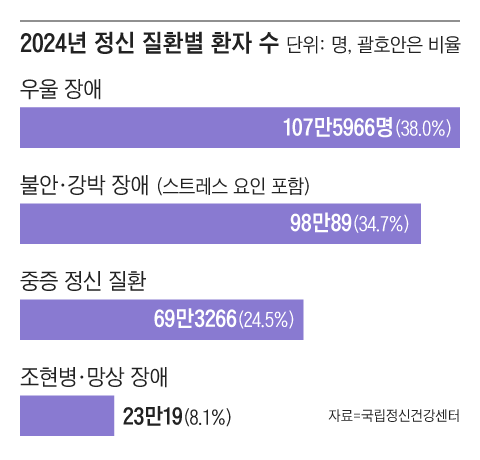
When categorized by type of mental disorder, depressive disorder was the most common, affecting 1,075,966 individuals (38%). This was followed by anxiety and obsessive-compulsive symptoms caused by stress or psychological factors, which affected 980,089 people (34.7%). Severe mental disorders accounted for 693,266 cases (24.5%), while delusional disorders such as schizophrenia affected 230,019 individuals (8.1%).
The sharp increase in cases of depression and anxiety has driven the overall rise in mental health treatment demand. Compared to five years ago, the number of patients with depressive disorders surged by 40.2%, while those with anxiety and obsessive-compulsive symptoms due to stress or psychological factors increased by 38.3%.
Regional Variations in Mental Health Cases
The prevalence of mental disorders varied across different regions. When calculating the number of depressive disorder patients per 100,000 people, Seoul recorded the highest figure at 3,275.8, followed by Sejong (3,117.8), Busan (3,075.8), and Daegu (2,682.7).
Age Group Trends
The prevalence of mental disorders also varied by age group. Depressive disorders were most common among individuals in their 20s, with a rate of 3,020.7 per 100,000. This was followed by those in their 30s (2,700.5) and 10s (2,589.9). Bipolar disorder, commonly referred to as ‘manic depression,’ was also most prevalent among those in their 20s (502.6 per 100,000), followed by their 30s (407.7) and 10s (311.6).
Expert Insights on Mental Health Trends
Professor Hong Jin-pyo from the Department of Psychiatry at Samsung Medical Center commented on the global increase in depression and anxiety disorders. He noted that the rise is partly due to individualistic culture and the influence of social media. Additionally, he highlighted that reduced stigma surrounding psychiatry has led to more proactive treatment compared to the past.
These findings underscore the importance of addressing mental health concerns through increased awareness, improved access to care, and continued research into the underlying causes of mental disorders. As the number of individuals seeking treatment continues to grow, it is essential for healthcare systems and communities to adapt and support those in need.