
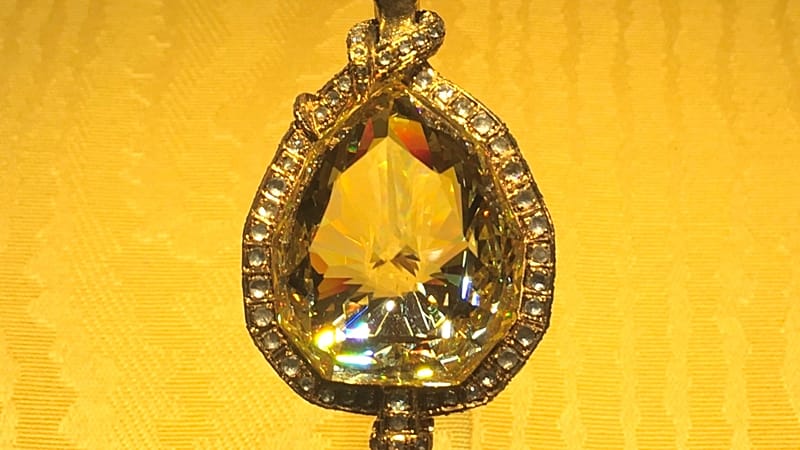
The Resurfacing of a Legendary Gem
The legendary “Florentine” diamond, a 137-carat yellow pear-shaped jewel once belonging to Austro-Hungary’s imperial Habsburg family, has made a remarkable return after being missing for over a century. This rare gem, which had long been the subject of speculation and mystery, was recently revealed to have been hidden in a Canadian bank vault for decades, as per the orders of Empress Zita.
This unexpected reappearance coincides with renewed interest in historical thefts, particularly following the recent daring royal jewel theft at the Louvre in Paris. The incident has sparked conversations about other famous stolen or missing artifacts, including the Florentine diamond, which has now come back into the public eye.
A Legacy of Mystery
The Florentine diamond has long been shrouded in mystery. While its exact origin remains uncertain, it is believed to have belonged to Florence’s Medici family before coming into the possession of the Habsburgs. Some historians speculate that the gem may have originally been crafted for Charles the Bold, the last Duke of Burgundy. However, no definitive records confirm this theory.
The diamond disappeared during the turbulent times of World War I when Emperor Charles I fled Vienna in search of asylum abroad around 1918. At the time, some jewelry was reportedly transported to Switzerland for protection, leading many to assume that the Florentine had vanished during this period.
A Hidden Treasure
Recent revelations from the Habsburg descendants have shed light on the diamond’s fate. According to reports, the gem was never lost but rather concealed in a Canadian bank vault throughout the 20th century. This decision was made by Empress Zita, the widow of Charles I, who wished to protect the family’s treasures from potential threats.
Empress Zita kept the location of the diamond a closely guarded secret, revealing its whereabouts only to her sons, Robert and Rodolphe. She requested that they maintain this secrecy for security reasons until 100 years after Charles I’s death in 1922. The brothers passed this information on to their own children before passing away, ensuring the family’s legacy remained intact.
Three Habsburg relatives confirmed the story to the New York Times. Now that the centenary vow has been fulfilled, descendants such as Karl Habsburg-Lothringen, the last emperor’s grandson, along with cousins Lorenz von Habsburg-Lothringen and Simeon von Habsburg, have decided that the private collection should be made public.
A Public Display
In gratitude for Canada’s role in sheltering the former monarch’s family during World War II, the collection will remain there. The Florentine diamond and other pieces of jewelry could potentially be exhibited publicly, allowing the world to witness this extraordinary gem.
The 137-carat stone is notable for its unique pear shape and striking yellow gold color, making it one of history’s most significant gems. Its reappearance has resolved one of the 20th century’s greatest artefact mysteries.
A New Chapter
The recent theft at the Louvre has brought attention to the importance of preserving and protecting historical treasures. As the Florentine diamond reemerges, it serves as a reminder of the rich and complex history behind these precious artifacts.
With its return, the diamond not only adds to the legacy of the Habsburg family but also highlights the enduring fascination with historical mysteries and the stories behind them.