
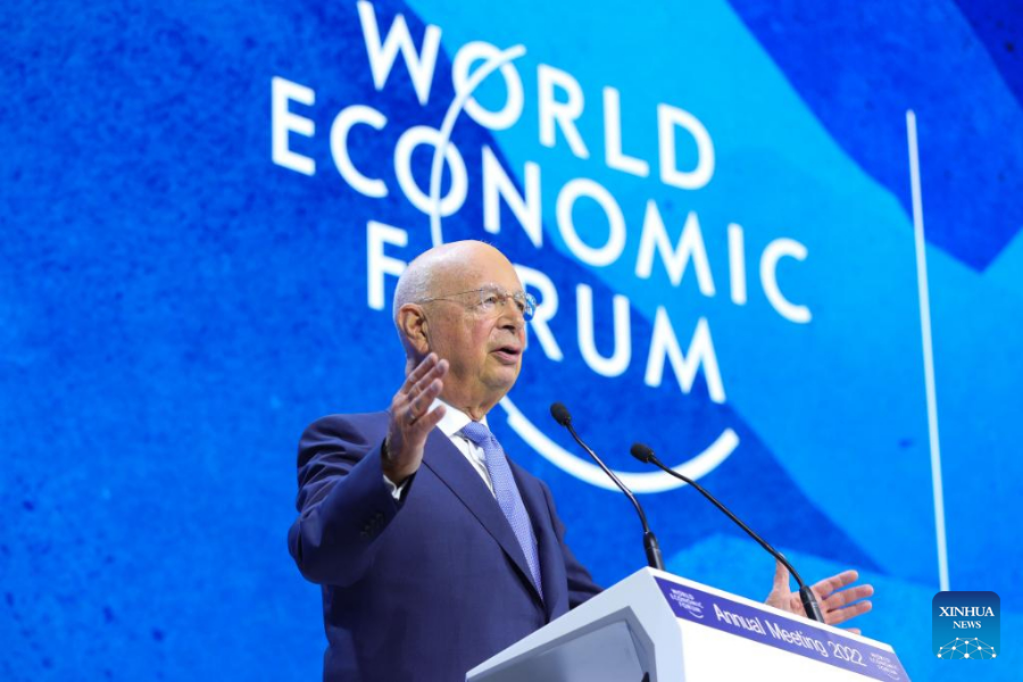
Global Financial Concerns and Technological Shifts
President of the World Economic Forum (WEF), Borge Brende, has raised concerns about three potential financial bubbles in global markets as technology stocks face significant declines. During his visit to São Paulo, Brazil’s financial hub, Brende outlined areas of concern: cryptocurrency, artificial intelligence (AI), and government debt.
“We could possibly see bubbles moving forward. One is a crypto bubble, second an AI bubble, and the third would be a debt bubble,” Brende told reporters. He emphasized that current levels of government debt are at their highest since 1945, highlighting the risks associated with such high borrowing.
Brende, whose organization hosts the annual Davos meetings where global leaders discuss worldwide challenges, pointed out both the opportunities and risks tied to AI technology. While AI offers the potential for significant productivity improvements, he warned it could threaten many white-collar jobs, potentially creating a “Rust Belt” in cities with large back-office operations that can be easily replaced by AI and increased productivity.
He cited recent job cuts by companies like Amazon and Nestle as examples of this growing trend. According to Brende, massive investments in AI and cryptocurrencies may lead to the development of bubbles.
“There is definitely a geopolitical disorder … But even in the situation of geopolitical disorder, the global economy has been incredibly resilient – not necessarily in Europe but in India, China and the U.S.,” Brende said during an interview with Deutsche Presse-Agentur. He attributed this resilience to investments in new technologies like AI.
“This year has seen $500 billion of investments in AI alone. So, what we can be worried about is that there may be bubbles developing, be it a bubble on crypto or an AI bubble,” Brende said. He urged investors to be patient with these investments, noting that frontier technologies would be the new drivers of growth.
Brende stated, “We will also need to make sure that the new technologies and the benefits trickle down. We could even see productivity gains of 10 per cent in the coming decade. And productivity is prosperity.” He described the new technologies as “a big paradigm shift” and predicted breakthroughs in medicine, synthetic biology, space, and energy, adding that “AI can accelerate processes so quickly.”
Despite the concerns, Brende acknowledged the historical pattern that technological advances ultimately boosted productivity, which he described as “the only way over time to increase prosperity.”
Geopolitical Challenges and Economic Uncertainty
Brende also expressed concern about global crises and conflicts. “There is definitely a geopolitical disorder: the world order we had is not there anymore. What is the next world order? Hopefully not the law of the jungle,” he said. With reference to current U.S. tariff policy, he noted that uncertainty was the highest tariff.
“One of my worries is that global investments are going down. We need to re-establish an environment for investments,” he said. The current competition between the U.S. and China, Brende said, was “basically a competition for hegemony or dominance in technology.”
He predicted that “the country that leads in new technologies – be it quantum, superintelligence, AI, autonomous vehicles, or synthetic biology – will also be the most powerful nation coming out of this century.”
Brende called for multilateral action to deal with “problems that don’t travel with a passport,” including pandemics and cybercrime. He expressed concern that the world was becoming more complicated with different groups forming, pointing to a G4 of the U.S., China, Europe, and India, followed by fast-growing economies like Indonesia, Malaysia, Nigeria, and Brazil.
He predicted, “It’s going to be a renaissance for mega-regional, so-called plurilateral deals. But the world is going to be more complicated. There will be more suboptimal, not necessarily cost-effective solutions. There is going to be more friend shoring,”