

Weather Conditions and Track Challenges
The upcoming Brazilian Grand Prix is set to present unique challenges for Formula 1 teams, primarily due to the weather conditions in Sao Paulo. The past few days have been marked by cool and damp temperatures, with the ambient temperature expected to reach a maximum of 20°C on Sunday. This is seven degrees lower than typical springtime temperatures in the region, and there is little chance of sunshine, although heavy showers are not anticipated.
These conditions mean that the track will be cold and “green,” making it difficult for the hard tyre compound to perform optimally. The C2 compound is considered too hard for the race, as highlighted by Pirelli’s motorsport director, Mario Isola, who emphasized that the hard tyre is not a viable option for the race.
Strategic Considerations for Teams
Despite these challenges, there may still be room for strategic variation. Isola suggested that both one-stop and two-stop strategies could be feasible. He noted that a one-stop strategy using soft and medium compounds could be the fastest on paper but comes with a margin of wear that teams need to consider.
During the red-flagged 24-lap sprint race, most cars changed tyres during the interruption, and some sets of soft tyres were already at their limit after around 20 laps. This indicates that the soft compound might not be the best choice for the entire race.
Optimal Pit Stop Window
If teams decide to go with a one-stop strategy using soft and medium compounds, Isola estimated that the pit stop window should fall between lap 24 and 30. However, he warned that using the soft compound in the first stint could lead to significant wear, which teams must factor into their planning.
For teams unable to complete the race on a one-stop strategy, options like soft/medium/medium or soft/medium/soft are also viable. The soft/medium/medium strategy is slightly faster, but when accounting for traffic, it becomes slightly slower. Both options are close in performance, giving teams multiple choices for their race strategy.
Tyre Management and Race Pace
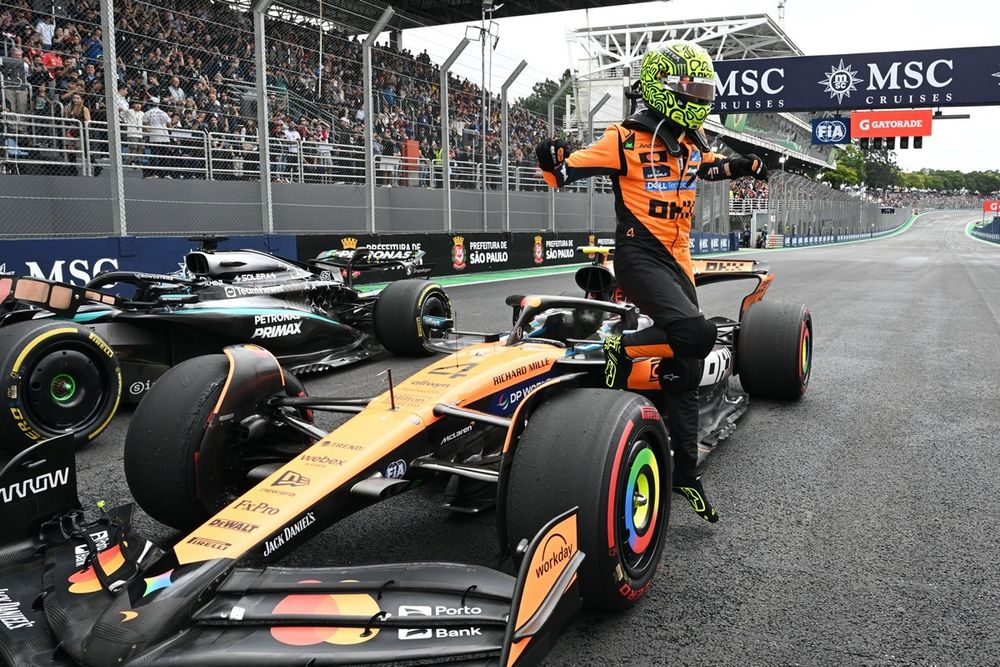
Tyre management is expected to be straightforward for the race. Isola mentioned that there were no issues with graining or abrasion, and the focus remains on thermal degradation and keeping the tyres within the working window.
The medium compound induces a two- to three-tenth gap in race pace compared to the softs, which is smaller than what Pirelli had hoped for. However, this gap is manageable, and teams can still make the most of the grooved track surface at the start, where grip is reduced.
Key Takeaways from the Sprint Race
In addition to the main race, teams also gained insights from the 2025 F1 Brazil GP sprint race and qualifying. These events provided valuable data on tyre performance under varying conditions and helped teams refine their strategies for the main event.
Conclusion
As the Brazilian Grand Prix approaches, teams are focusing on the softer compounds and adapting their strategies to the challenging weather conditions. With careful planning and effective tyre management, drivers can navigate the cold and green track to achieve strong results. The race promises to be an exciting test of strategy, skill, and adaptability.