
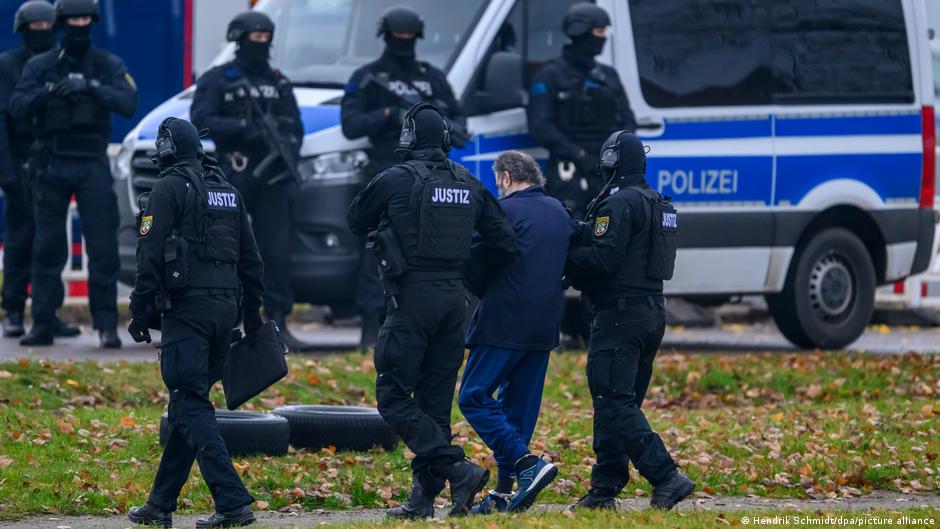
The Trial of Taleb A. Begins in Magdeburg
The trial of Taleb A., a 51-year-old doctor accused of ramming a car into a crowd at a Christmas market in Magdeburg last year, has commenced today. He is charged with six counts of murder and 338 counts of attempted murder, among other charges. The attack resulted in the deaths of five women and one child, while 338 others were injured. The incident shocked the nation and led to increased security measures at similar markets across Germany.
The trial, which will take place in a temporary court building set up to accommodate hundreds of participants, including witnesses, plaintiffs, and members of the press, will run for approximately 50 days until March 12, 2026. Taleb A. will be seated in a glass cage during proceedings for his own protection. The case is one of the largest in Germany’s post-war history, with some 180 victims and their relatives serving as co-plaintiffs.
Taleb A., originally from Saudi Arabia, had been living in Germany since 2006 and worked as a doctor in the town of Bernburg. He was detained shortly after the attack and has remained in custody since. Prosecutors allege that he was driven by a mix of “dissatisfaction and frustration,” expressing anger online and voicing criticism of Islam and what he perceived as Germany’s lax immigration policies. He also reportedly espoused various conspiracy theories.
Political Fallout and Security Concerns
The attack sparked immediate political fallout, particularly after it emerged that German security services had ignored a warning from Saudi Arabia about Taleb A.’s extremist views. Authorities had previously considered him a threat but never classified him as a far-right extremist. Despite his vocal support for the far-right Alternative for Germany (AfD) party online, the AfD used the attack to argue that Germany’s immigration system was too lenient, calling for anti-immigration rallies. This prompted then-Interior Minister Nancy Faeser to accuse them of exploiting the situation.
In a special security debate in the Bundestag, Faeser emphasized the challenges of identifying perpetrators like Taleb A., who did not fit the typical profiles of far-right, far-left, or religious extremists. She called for greater cooperation between security agencies. The attack also damaged the reputation of former Chancellor Olaf Scholz, who lost the federal election in February of this year.
Other National Developments
Meanwhile, the visit of former Taiwanese President Tsai Ing-wen to Berlin has been described as a “private” trip by Germany’s Foreign Ministry. Although no official meetings are scheduled, Tsai is expected to address the Berlin Freedom Conference, a democracy summit. Taiwan continues to seek stronger connections in Europe, despite pressure from mainland China, which opposes any form of recognition of Taiwanese independence.
In the Netherlands, the Dutch Consumer Association, Consumentenbond, has launched a class-action lawsuit against German automaker BMW over allegations of falsifying emissions data. The case involves approximately 100,000 vehicles sold between 2009 and 2019. BMW has not yet commented on the claim, though the company recently reported soaring profits in the third quarter of 2025.
German President Frank-Walter Steinmeier has also called on Algerian President Abdelmadjid Tebboune to pardon imprisoned novelist Boualem Sansal, whom he described as a “humanitarian gesture.” Sansal, a critic of the Algerian government, was sentenced to five years in prison for “damaging national unity.”
Housing and Migration Trends
Housing prices in Germany continue to rise, with property prices increasing by 3.8% in the third quarter of 2025 compared to the same period last year. Cities like Munich, Hamburg, Cologne, and Düsseldorf saw even higher increases, with prices rising by 5%. Rents have also climbed, particularly in Frankfurt, where they increased by 5%.
According to data from Germany’s Federal Statistical Office, German emigration to the United States decreased by 17.8% in the first nine months of 2025 compared to the previous year. Meanwhile, migration from the US to Germany rose by 3.4%. The decline in German travel to the US follows updated travel advisories issued by the German government after several high-profile detentions of German nationals by US authorities.
Conclusion
As the trial of Taleb A. unfolds, the nation remains focused on the implications of the attack, both in terms of security and political discourse. Alongside these developments, ongoing issues such as housing affordability, migration trends, and international relations continue to shape the national landscape.