
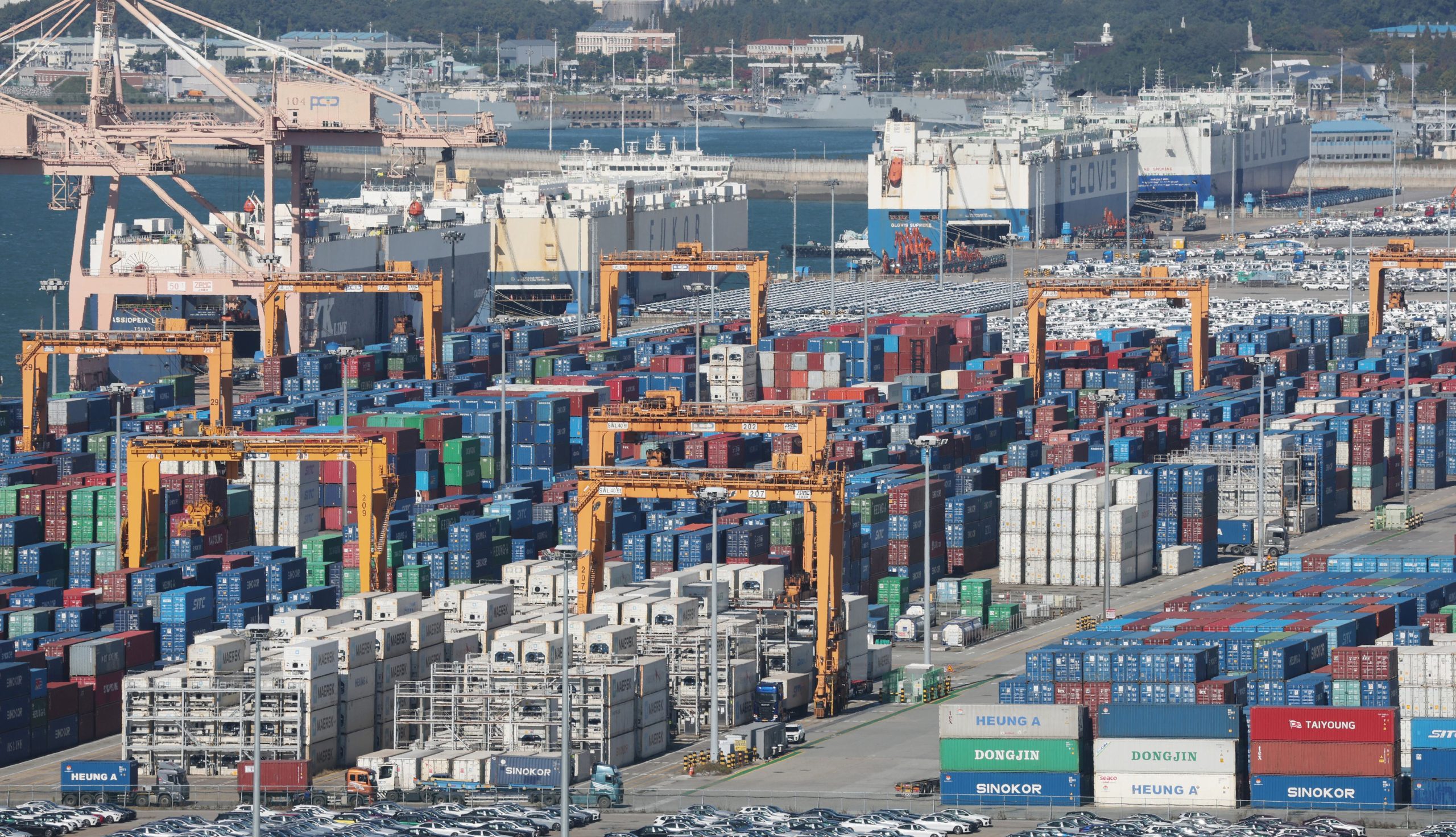
The South Korean economy is expected to experience a moderate growth of 2.1% in the next year, according to projections by the Korea Institute of Finance. This growth is primarily attributed to a recovery in domestic demand. However, the growth rate for exports is anticipated to remain below 1%, influenced by U.S. tariff policies and a general slowdown in global trade.
At the “2026 Economic and Financial Outlook Seminar” held at the Seoul Bankers Association Hall on the afternoon of the 11th, the Financial Research Institute presented its findings regarding South Korea’s economic trajectory. According to the institute, the country’s real gross domestic product (GDP) is expected to increase from 1% this year to 2.1% next year.
Kim Hyun-tae, head of the Macroeconomic Research Division, highlighted that the recovery of domestic demand is expected to be driven by simultaneous recoveries in private and government consumption. Additionally, construction investment is expected to see a slight rebound due to base effects, while equipment investment is projected to grow moderately. Despite these positive factors, net exports are expected to contribute less to economic growth due to reduced global trade volumes caused by tariffs.
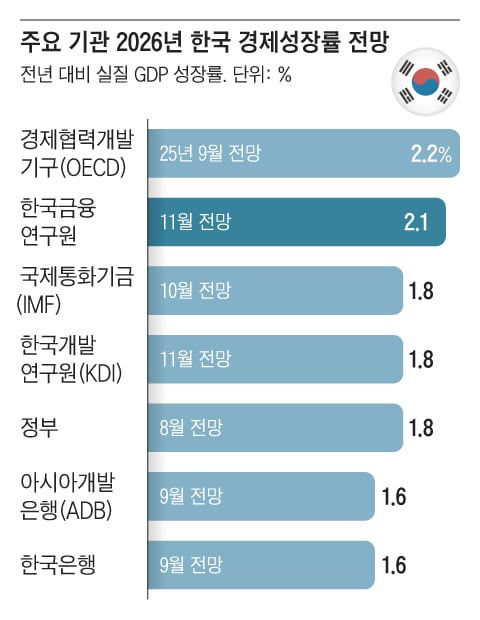
Private consumption growth is expected to improve from 1.3% this year to 1.6% next year. Analysts believe that the economy will continue to show a strong recovery trend through the first half of next year, supported by consumption coupons distributed this year and planned stimulus measures for the following year.
However, the pace of consumption recovery is likely to slow down over time. Construction investment growth is forecasted to recover from -8.9% this year to 2.6% next year as orders gradually rebound. Equipment investment is expected to decrease slightly from 2.4% growth this year to 2% next year. Nevertheless, demand for artificial intelligence (AI)-related semiconductors is expected to provide support for moderate growth in this sector.
The Financial Research Institute also forecasts that total export growth will decline from 4% this year to 0.8% next year, primarily due to a slowdown in global trade. Total import growth is expected to decelerate from 4% to 1.1%. As a result, the current account surplus is projected to decrease slightly from 111.5 billion dollars this year to 107.0 billion dollars next year.
Key Economic Trends
- Domestic Demand Recovery: The recovery of private and government consumption, along with a rebound in construction investment and moderate growth in equipment investment, is expected to drive domestic demand.
- Export Growth Challenges: Export growth is forecast to fall below 1% due to U.S. tariff policies and a slowdown in global trade, which could impact overall economic performance.
- Private Consumption Improvement: Private consumption growth is expected to rise from 1.3% to 1.6%, supporting continued economic expansion.
- Construction Investment Recovery: Construction investment is expected to grow from -8.9% to 2.6%, reflecting gradual order recovery.
- Equipment Investment Decline: Equipment investment is projected to decline slightly from 2.4% to 2%, but AI-related semiconductor demand may offset some of this decline.
- Import and Export Dynamics: Total export growth is expected to slow significantly, while import growth will also decelerate, affecting the current account balance.
Outlook for the Next Year
The South Korean economy is poised for a modest but steady growth in the coming year, driven largely by domestic factors. However, external challenges such as trade tensions and global economic conditions will play a critical role in shaping the country’s economic performance. Policymakers and economists are closely monitoring these trends to ensure sustained growth and stability.
With the implementation of stimulus measures and the continued focus on technological advancements, particularly in the AI sector, there is potential for South Korea to maintain a resilient economic outlook despite the headwinds it faces. The interplay between domestic demand and external trade will be key indicators to watch in the months ahead.