
South Korea’s Navy Conducts First Fleet-Level Maritime Mobility Drill
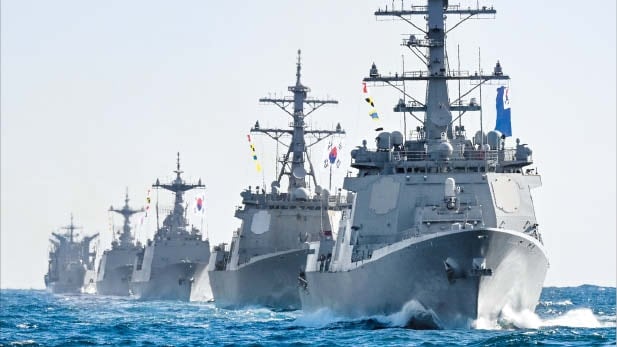
On the afternoon of the 10th, crew members aboard the 7,600-ton-class Aegis-guided missile destroyer Seoae Ryuseong-ryong, which was traveling 70 km east of Pohang, entered combat readiness. This followed a simulated scenario involving the detection of multiple aircraft and guided missiles. The Seoae Ryuseong-ryong participated in the first fleet-level maritime mobility drill since the establishment of the Navy Mobile Fleet Command under the command of the Jeju Naval Base in February of last year. The exercise took place from the 9th to the 11th in the South and East Seas and was directly commanded by Commander Kim In-ho, Rear Adm, who boarded the Seoae Ryuseong-ryong.
Moments later, a radar detection officer reported an “unidentified aerial object on air defense radar.” After analyzing the object’s shape, course, speed, and altitude via radar, the ship determined it to be an enemy aircraft heading south. The Seoae Ryuseong-ryong then prepared to engage with SM-2 ship-to-air guided missiles to provide air defense support to nearby friendly forces. Upon receiving the tactical controller’s order to “engage with SM-2,” eight SM-2 missiles were launched, and the four enemy aircraft visible on radar screens disappeared—confirming their destruction.
Overview of the Navy Mobile Fleet Command
The Navy Mobile Fleet Command, marked by the “Geobukseon” emblem, is a core maritime unit of South Korea’s indigenous “3-axis system,” including the Kill-Chain, which preemptively detects and strikes North Korean missile launches. Unlike the Navy’s 1st, 2nd, and 3rd Fleets, which are responsible for the East Sea, West Sea (Yellow Sea), and South Sea respectively, the Mobile Fleet Command operates without a designated area and can be rapidly deployed to the front lines in emergencies. It also performs blue-water operations such as protecting maritime traffic routes and overseas deployments, aligning with the U.S.-desired “alliance modernization.” If nuclear-powered submarines are introduced to the South Korean Navy in the future, they are likely to be assigned to the Mobile Fleet Command.
During this drill, the commander and fleet staff were all deployed at sea to conduct combined training for anti-ship, anti-submarine, and air defense scenarios. The exercise aimed to enhance the coordination and readiness of the naval forces in response to potential threats.
Participation of Key Vessels and Aircraft
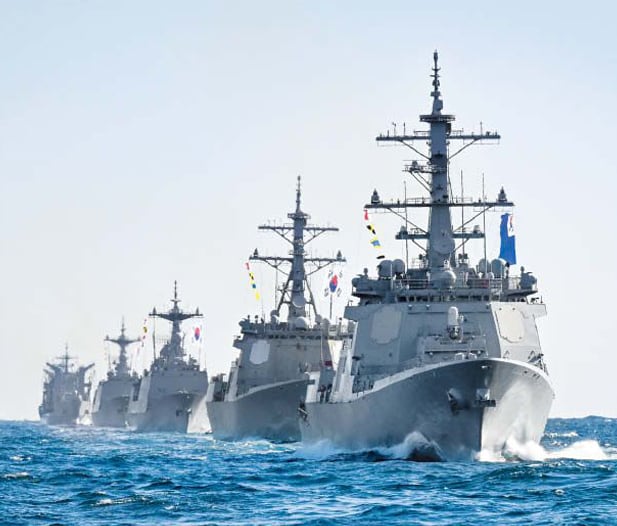
In addition to the Seoae Ryuseong-ryong, three of South Korea’s four domestically built Aegis-guided missile destroyers—excluding the King Sejong-class destroyer on a separate operation—gathered for the first time: the 8,200-ton-class King Jeongjo-class destroyer, the 7,600-ton-class Yulgok Yi I-class destroyer, and the Seoae Ryuseong-ryong. The 4,400-ton-class destroyers Wang Geon and Gang Gam-chan, the 4,200-ton-class logistics support ships Cheonji and Daecheong, and three aircraft also participated in the drill.
This gathering of key vessels and aircraft demonstrated the growing capabilities of South Korea’s navy and its commitment to maintaining a strong and flexible maritime defense force. The exercise provided valuable opportunities for the crews to practice and refine their skills in various combat scenarios, ensuring they are well-prepared for any potential challenges.
Strategic Implications and Future Developments
The participation of the Navy Mobile Fleet Command in this drill highlights its strategic importance in South Korea’s military planning. As the country continues to modernize its naval capabilities, the Mobile Fleet Command will play a crucial role in safeguarding national interests and contributing to regional stability. The integration of advanced technologies and the development of new operational doctrines are expected to further enhance the effectiveness of the fleet.
With ongoing efforts to strengthen the alliance with the United States and expand its maritime presence, South Korea is positioning itself as a key player in the region. The success of this drill underscores the importance of continuous training and preparedness in maintaining a robust defense posture. As the navy continues to evolve, the focus will remain on ensuring that its forces are equipped to handle a wide range of threats and challenges.