

Survey Reveals Pessimism About Social Mobility and Economic Prospects in South Korea
A recent survey has highlighted a growing sense of pessimism among South Koreans regarding the future of social mobility and financial stability. More than half of the country’s citizens believe that the next generation will have limited opportunities for upward social mobility, while 74% expect their household’s financial situation to remain unchanged or deteriorate in the coming year.
The Ministry of Data and Statistics released the 2025 Social Survey Results on the 11th, which included these findings. The survey was conducted between May 14 and 29 of this year, targeting approximately 34,000 individuals aged 13 and above from about 19,000 sample households across the nation.
Rising Concerns About Social Mobility
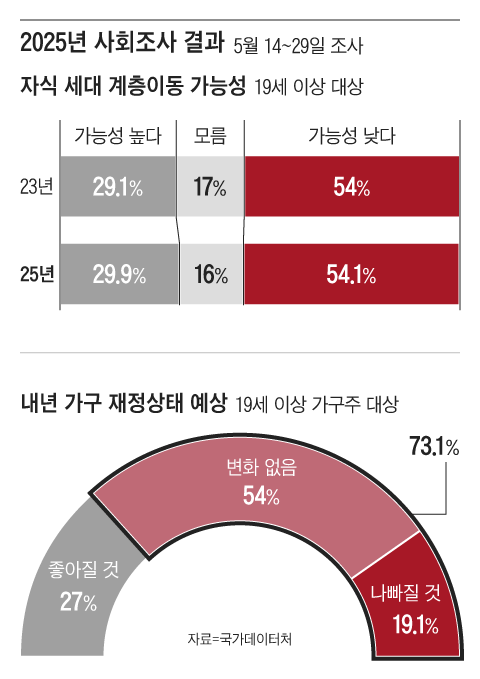
According to the survey, 54.1% of individuals aged 19 and older believe that the likelihood of upward social mobility for the next generation is “low.” This marks an increase of 0.1 percentage points compared to a similar survey conducted two years ago. Over half of the respondents expressed concerns about the prospects for the next generation. Meanwhile, only 29.9% of participants believed that social mobility would be “high,” and 16% said they were unsure.
The perception of social mobility appears to be influenced by individuals’ views of their own socio-economic status. Those who consider themselves part of a lower class are more likely to believe that the next generation will face limited opportunities. When categorized into upper, middle, and lower classes, 46.4% of the upper class responded that social mobility for the next generation is “low.” However, the figures were higher for the middle (53.4%) and lower (56.1%) classes.
Notably, the proportion of respondents who viewed social mobility as low increased across all groups when comparing data from 2021 and this year:
- Upper class: 44.5% → 46.4%
- Middle class: 53.1% → 53.4%
- Lower class: 55.6% → 56.1%
Experts suggest that this decline in expectations may be linked to factors such as widening wage gaps between regular and non-regular workers, slowing economic growth, and declining productivity.
Economic Outlook for Households
Despite some improvements in income levels, many South Korean households remain concerned about their financial future. Among household heads aged 19 and older, 21.5% reported an increase in income compared to a year ago, up by 0.2 percentage points from two years prior. However, 19% of respondents stated that their household income had decreased, marking a 0.1 percentage point rise from the previous survey. Two out of every ten households reported a decline in income.
The proportion of households reporting no change in income dropped by 0.4 percentage points compared to two years ago, reaching 59.5%.
Pessimistic Views on Future Financial Stability
Many South Koreans anticipate a worsening financial situation in the coming year. A staggering 73.1% of households expect their financial condition to either remain the same or improve compared to this year. When asked which expenses would be reduced if their financial situation worsened, the most common response was dining-out costs (67.2%). Other frequently cited areas for cuts included clothing expenses (43.1%), food expenses (40.4%), and cultural and leisure activities (39.6%).
These findings reflect a broader sense of uncertainty and anxiety about the future, particularly among those in lower and middle-income brackets. As economic challenges persist, the need for policy interventions to address inequality and support sustainable growth becomes increasingly urgent.