
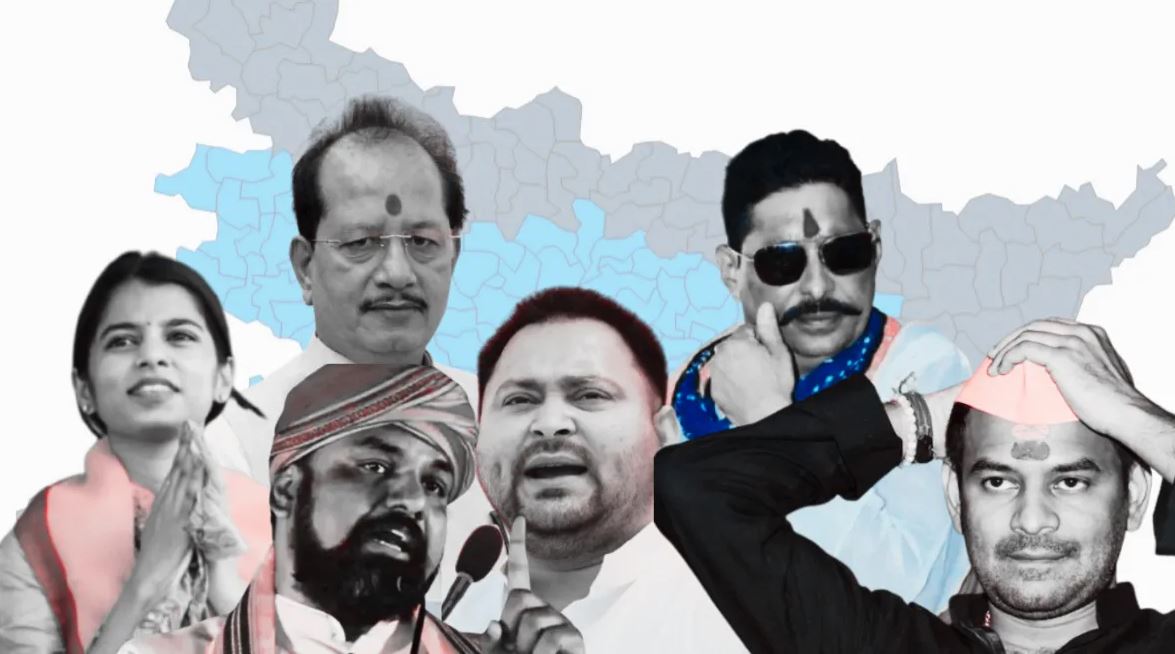
Key Battlegrounds in Bihar’s 2025 Election
Bihar is preparing for a significant political test in 2025. On November 6, voters across 121 Assembly seats in 18 districts will cast their votes to determine who will lead the state next. This marks the first phase of a two-phase election, with the remaining constituencies set to vote on November 11. The campaign season has been marked by loud rallies, sharp speeches, and high promises.
Both major political alliances understand the stakes involved. The National Democratic Alliance (NDA), led by the BJP along with its allies JD(U), LJP, HAM, and RLM, aims to maintain its grip on power, similar to its performance in 2020 when it secured 125 seats. Their opponents, the Mahagathbandhan, which includes the RJD, Congress, VIP, and Left parties, believe public sentiment has shifted. They came close in the last election, winning over 110 seats, and now seek to cross the finish line.
The first phase features 1,314 candidates, with several standing out as key figures shaping the political landscape. These include familiar faces, new challengers, celebrity entries, family rivalries, and local strongmen, making this round a high-voltage contest. Every speech has been sharper, every crowd larger, and every promise louder. Issues such as jobs, development, law-and-order, and dignity for young people have become central to the campaign.
Several seats are particularly significant, where history, emotion, and political futures converge.
Raghopur: Tejashwi Yadav Defends His Fortress
In Raghopur, all eyes are on Tejashwi Yadav, the RJD leader and face of the Opposition alliance. He is seeking to win the Chief Minister’s chair, with rivals including Satish Kumar from the BJP and Chanchal Kumar from the Jan Suraaj Party. Tejashwi is not just fighting for a seat but for credibility, promising one government job per family within 20 months. This has generated hope among young people, who make up a large portion of the population.
Raghopur carries the legacy of his father, Lalu Prasad Yadav, who turned this seat into a family stronghold in the mid-90s. Despite only once losing the seat in the last three decades, Tejashwi hopes to maintain this loyalty as he pursues bigger ambitions. However, the BJP is questioning his record and challenging whether promises alone are enough.
Tarapur: Samrat Choudhary Returns to the Field
Tarapur is witnessing the return of a seasoned politician, Samrat Choudhary, the BJP’s Deputy Chief Minister and key strategist. After a 15-year gap, he is back in the fray, facing Arun Shah of the RJD. This seat is known for its mix of caste strength, personality, local history, and regional pride. The voter base includes Yadavs, upper castes, Kushwahas, Sahs, Muslims, and Dalits, making the battle intense. Choudhary’s campaign has been robust, and the RJD is attacking aggressively.
Mahua: Tej Pratap Yadav Fights Alone
Mahua is home to one of the most personal battles of the election. Tej Pratap Yadav, the elder son of Lalu Prasad, is running without his family’s party after forming his own outfit, the Janshakti Janata Dal. His opponent is Mukesh Raushan of the RJD, who currently holds the constituency, and Sanjay Singh of the LJP is also in the race. Mahua has seen Tej Pratap as a sitting MLA before, and now he seeks to be viewed as a leader in his own right.
Alinagar: Maithili Thakur’s Cultural Pitch Meets Political Reality
In Alinagar, folk singer Maithili Thakur is making her political debut, hoping to leverage her cultural appeal. She faces Binod Mishra of the RJD and Biplaw Chowdhary from the Jan Suraaj Party. Alinagar has traditionally leaned towards the RJD, but recent shifts show that loyalties can change. Thakur’s campaign is emotional and symbolic, representing regional pride for some voters.
Lakhisarai: Vijay Kumar Sinha Seeks a Sixth Term
Lakhisarai has been loyal to Vijay Kumar Sinha, the BJP leader and Deputy Chief Minister, who is aiming for his sixth term. His challenger is Suraj Kumar of the Jan Suraaj Party. Sinha’s strong Bhumihar community base has helped him dominate this seat repeatedly. However, each election brings new voices and demands, with young voters seeking jobs and stability. Sinha believes his experience will reassure people, while the Opposition argues it is time for a change.
Arrah: A Seat That Keeps Swinging
Arrah has never been predictable, with power shifting between the BJP and the RJD over the last decade. This year’s race remains uncertain, with Sanjay Singh “Tiger” of the BJP facing Vijay Kumar Gupta of the Jan Suraaj Party and CPI-ML’s Quyamuddin Ansari. Voters are closely watching performance, focusing on development, security, and welfare schemes. Arrah rarely follows the same path twice, keeping every party on its toes.
Mokama: The Strongman’s Home Turf
Mokama is unique, shaped by Anant Kumar Singh, who has won here repeatedly despite switching parties. This year, he stands with the JD(U) after returning from legal troubles. The RJD puts forward Veena Devi to challenge his fortress. Mokama’s elections have always been dramatic, with discussions about loyalty, power, and influence. Singh’s recent arrest adds another layer of complexity to the race.
As Bihar votes, conversations circle back to critical questions. Will job promises shift young voters? Will the BJP’s organization and Nitish Kumar’s network help them hold firm? Are caste equations changing or adjusting? Is Bihar moving towards new leadership, or reaffirming the old?
For now, rallies have fallen silent, and microphones are off. It is the voter’s voice that will speak next. And Bihar waits.