
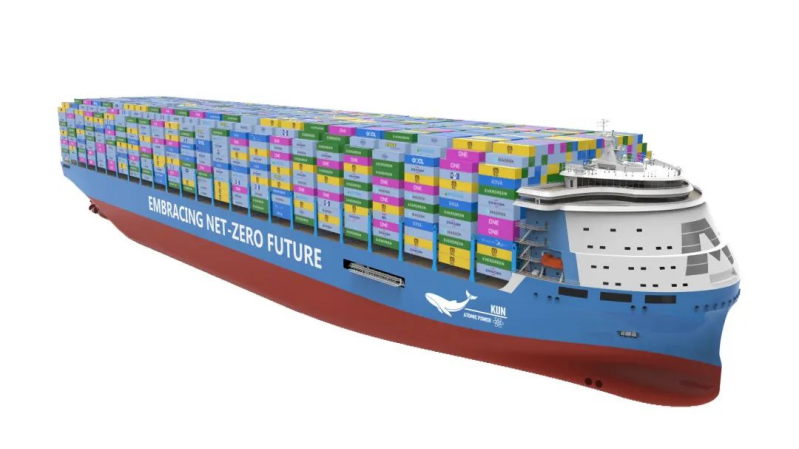
China’s Ambitious Entry into Nuclear-Powered Shipping
China has taken a significant step forward in the maritime industry by unveiling detailed specifications for the world’s largest nuclear-powered cargo ship. This vessel, capable of carrying 14,000 containers, is being developed by Shanghai Jiangnan Shipyard, a subsidiary of the state-owned China State Shipbuilding Corporation (CSSC). The construction plan was announced in 2023, marking a bold move by Beijing to enter the niche but potentially transformative field of nuclear-powered shipping.
While nuclear-powered cargo ships have been explored since the 1960s—particularly by the U.S.—they have never achieved full commercial success due to high costs and safety concerns. However, China is now aggressively pursuing this technology, signaling its intent to reshape global logistics and energy strategies.
Innovative Reactor Technology
The details of the nuclear-powered cargo ship were recently disclosed in an article by a chief engineer from Jiangnan Shipyard, published in the maritime and shipbuilding journalShip. According to the report, the vessel uses a thorium molten salt reactor (TMSR), which replaces traditional water-based cooling systems with salt. This design leverages thorium, a resource abundant in regions like Inner Mongolia, as a fuel source for large commercial ships.
By eliminating the need for cooling water, the reactor achieves a low-pressure, compact design, significantly reducing its size and noise. Additionally, the reactor includes contamination prevention devices that can immediately contain radioactive materials in case of a leak. The choice of thorium reflects a balance between safety and economic viability, according to the article.
Power and Efficiency
The ship’s reactor produces 200 megawatts (MW) of power, matching the output of reactors used in the U.S. Navy’s latest Seawolf-class nuclear submarines. Heat generated by the reactor is converted into electricity via a power generation system with an efficiency of 45–50%, surpassing the 33% efficiency of conventional steam-based reactors. The ship is also equipped with emergency diesel generators to ensure reliability.
Despite these advancements, nuclear-powered cargo ships are not yet economically viable. Conventional large container ships using fossil fuels can sail for over a month on a single tank, making refueling straightforward and cost-effective. Russia’s icebreaking container ship Sevmorput remains the only active civilian nuclear-powered vessel. Critics argue that nuclear-powered cargo ships are “unprofitable projects” due to their high initial construction costs, which are several times higher than those of conventional ships, along with additional expenses for insurance and radiation management.
Strategic Implications
Analysts suggest that Beijing is pursuing this technology to shift logistics paradigms, secure energy independence, and advance military capabilities. The project may also reflect China’s strategic competition with the U.S. and other Western nations in maritime technology.
Other players are also entering the market. HD Hyundai, in collaboration with U.S.-based TerraPower, plans to commercialize a 15,000 TEU-class cargo ship equipped with a small modular reactor (SMR) by 2030. Domestic nuclear power companies are expected to participate in this project, further indicating the growing interest in nuclear-powered shipping.
Future Prospects
While challenges remain, China’s investment in nuclear-powered cargo ships highlights its ambition to lead in advanced maritime technologies. As the global shipping industry seeks cleaner and more efficient alternatives, the development of nuclear-powered vessels could mark a turning point in the sector. Whether this technology will achieve widespread adoption remains to be seen, but the momentum is clearly building.