
Growing Interest in the Stock Market
On the morning of the 6th, employees at a securities firm’s PB center in Dogok-dong, Gangnam-gu, Seoul, were busy attending to walk-in customers. In addition to existing clients asking for forecasts on how high Samsung Electronics and Hyundai Motor shares might go, there were also many people looking to resume trading after a long time and inquiries about opening new accounts.
One customer shared, “When I opened the securities app, it indicated I was a long-term non-user, and after entering the password incorrectly five times, it became locked. I’m in a hurry; could you please help me?” Another client mentioned, “Following the SK Telecom hacking incident last time, I had non-face-to-face account openings blocked, so I can’t open an account online. How can I get this unblocked?”
These concerns highlight the challenges that some investors face when trying to access their accounts or open new ones. As more individuals seek to enter the stock market, the demand for assistance has increased significantly.
Record High Investor Deposits
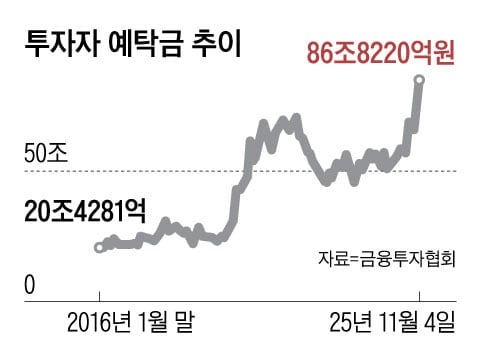
As the KOSPI index surpasses the 4,000-point mark, a full-scale “money move” from bank deposits to the stock market is underway. According to data compiled by the Korea Financial Investment Association on the 6th, investor deposits as of the 4th reached 86.822 trillion Korean won, setting a new record high. Investor deposits refer to funds customers have entrusted to securities accounts, serving as standby capital for the stock market. These deposits have increased by 19.814 trillion Korean won over the past three months. Typically, the scale tends to expand as stock investment sentiment improves.
A significant portion of the increased stock market funds is estimated to have flowed out of banks. As of the end of last month, the demand deposit balances of the five major banks—KB Kookmin, Shinhan, Hana, Woori, and NH Nonghyup Bank—stood at 647.8564 trillion Korean won, a decrease of 21.8675 trillion Korean won over the month. Demand deposits are deposits that can be withdrawn at any time, such as demand deposits, salary accounts, and similar instruments.
Rising Debt Investments
The balance of credit transaction loans, an indicator of “debt investment” (investing by borrowing), reached 25.5118 trillion Korean won as of the 4th, approaching the all-time high recorded in September 2021 (25.654 trillion Korean won). However, credit transaction loans carry interest rates starting from the mid-5% range annually even for a single day of borrowing, with rates rising to as high as 9% annually for longer borrowing periods. Entering the stock market despite bearing these interest costs signifies strong confidence in rising stock prices.
Director Sung Hyun-jung of NH Investment & Securities stated, “Far more clients are expressing anxiety about holding cash without investing in anything rather than fearing declines in the stock prices of their current holdings,” adding, “There is significant demand for investments in risky assets such as domestic stocks.”
Key Trends in the Market
- Increased Investor Activity:More individuals are moving money from savings accounts into the stock market, driven by optimism about future gains.
- Rising Deposits in Securities Accounts:Investor deposits have reached a record high, indicating a shift in investment behavior.
- Decline in Bank Deposits:Major banks have seen a drop in demand deposits, suggesting that funds are being redirected towards stock market investments.
- Growing Use of Credit Transactions:The increase in credit transaction loans shows that investors are willing to take on debt to participate in the stock market.
As the market continues to grow, it is clear that more individuals are seeking opportunities to invest and grow their wealth. This trend is likely to continue as long as the stock market remains attractive and accessible to a broader audience.