
A Global Recognition for a Korean Delicacy
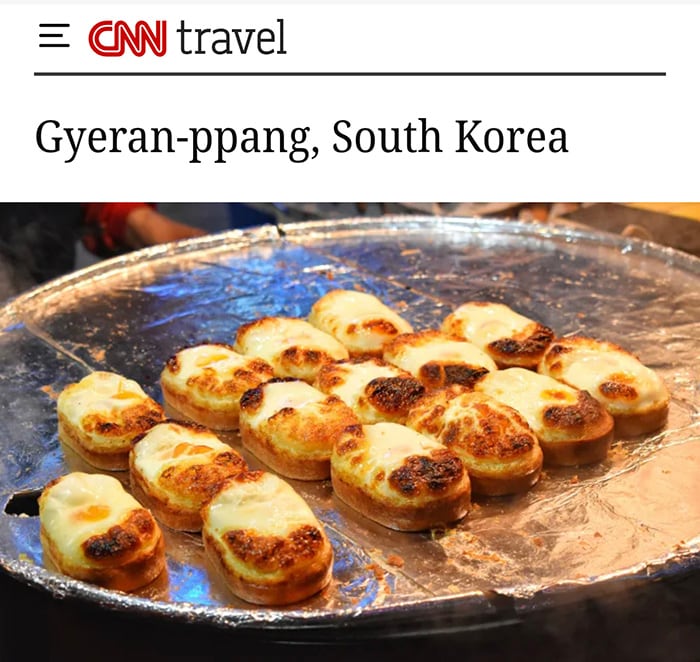
CNN recently unveiled its list of “World’s 50 Best Breads,” and among the many notable entries, one stood out: Korea’s gyeran-ppang. Unlike bungeoppang or kkochi-ppang, this bread made headlines as it was chosen as the representative bread of South Korea. The English name, written as “Gyeran-ppang,” reflects the phonetic spelling of the Korean term.
The list, which highlights the best breads from around the world, was organized alphabetically by country. However, no specific rankings were assigned. CNN described gyeran-ppang as a single-serving bread containing a whole egg inside, likening it to a hidden treasure. It also noted that the bread is a popular street food in Seoul, enjoyed by locals at any time of the day, whether for breakfast or as a quick snack.
Jen Rose Smith, a pastry chef-turned writer who curated the list, explained the selection criteria. She emphasized that the choices reflected each country’s diversity, memorable flavors, unique ingredients, symbolic meanings, and the simple joy of eating. Alongside gyeran-ppang, France’s baguette, Italy’s ciabatta, and Japan’s curry bread were also featured on the list.
A Winter Treat with Deep Roots
In reality, gyeran-ppang is more than just a street food—it is a beloved winter snack often sold alongside bungeoppang at street stalls. Kim, a 38-year-old office worker, has been enjoying gyeran-ppang since his school days. He recalls, “Twenty years ago, when I was a high school student, one piece cost 500 Korean won. Even one was filling, so after night self-study sessions, my friends and I would line up to buy it.” For him, the memory of gyeran-ppang brings back nostalgic feelings, and he makes sure to eat it every winter.
While CNN highlighted gyeran-ppang as a popular Seoul menu, its origins trace back to Incheon’s Michuhol-gu. According to the Michuhol-gu Local Culture Encyclopedia, the gyeran-ppang at Inha University’s rear gate was created as an alternative meal for hungry students. It first opened in November 1984, with a price of 100 Korean won.
A retired engineering professor from Inha University shared his own memories. “Not only during my student days over 30 years ago but also after returning as a professor at my alma mater, I frequently ate gyeran-ppang in front of the rear gate,” he said. “It was such a popular snack that I bought it often for students and even brought it home for my family.”
Challenges Facing a Beloved Street Food
Despite its popularity, the original gyeran-ppang shop run by an elderly couple has faced difficulties in recent years. Since last year, the shop has been operating intermittently, and this year, it has closed more frequently. When visited on the 3rd, the store had its shutter down, though the signage remained intact.
Kim, a 50-year-old Inha University staff member, expressed disappointment. “It was so delicious and affordable that students and I often ate it, but it’s disappointing that it’s frequently closed.”
After CNN’s report, domestic self-employed communities began discussing the challenges of selling gyeran-ppang. The bread requires a long baking time and has a short shelf life. Additionally, rising ingredient costs have made it difficult to increase prices, especially given the nature of street food, which leaves little room for profit. One self-employed individual noted, “Recently, meal-kit-style gyeran-ppang has emerged, making it even harder.”
A Cultural Icon Under Pressure
Gyeran-ppang has become more than just a snack—it is a cultural icon that represents the spirit of Korean street food. Its journey from a simple student meal to a globally recognized delicacy shows the deep connection between food and identity. However, as the industry faces new challenges, the future of this beloved bread remains uncertain. Whether it can continue to thrive in the face of modern pressures will depend on the support of both locals and global enthusiasts.