
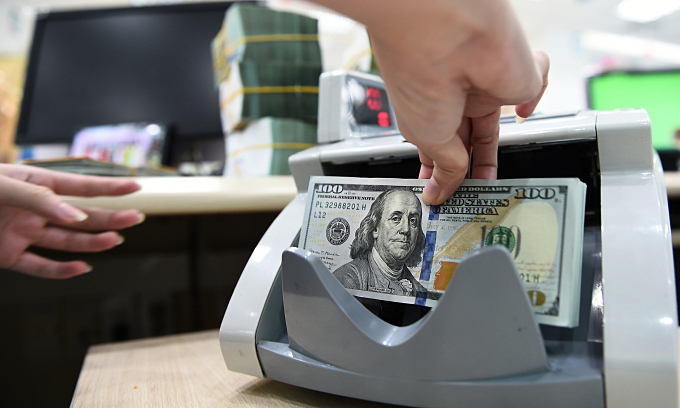
U.S. Dollar Gains Against Vietnamese Dong Amid Global Market Shifts
On Friday morning, the U.S. dollar showed strength against the Vietnamese dong, while it experienced a decline against several major currencies. This movement in exchange rates reflects broader trends in global financial markets and economic conditions.
At the commercial banks, Vietcombank set the selling rate for the U.S. dollar at VND26,358, marking a slight increase of 0.01% compared to Thursday’s rate. On the black market, the dollar saw a more significant rise, reaching approximately VND27,975, an increase of 0.26%.
The State Bank of Vietnam also adjusted its reference rate, raising it by 0.01% to VND25,103. This adjustment indicates the central bank’s efforts to manage currency stability amid shifting global dynamics.
Global Market Trends
Globally, the U.S. dollar faced a retreat during early Asia trade on Friday. This decline was part of a broader trend where major currencies fell as investors awaited official data on the U.S. labor market. In the absence of concrete figures, market participants focused on signals from private sector surveys, which suggested some weakness in the economy.
Recent private sector data revealed that the U.S. economy lost jobs in October, particularly in government and retail sectors. The situation was exacerbated by cost-cutting measures and the widespread adoption of artificial intelligence, which led to a surge in announced layoffs.
“U.S. Challenger jobs data indicated a spike in U.S. job cuts, suggesting a possible cooling in U.S. labor market conditions,” noted Westpac, a financial services firm, in a recent research report.
Dollar Index and Major Currency Performance
The dollar index, which tracks the greenback’s strength against a basket of six major currencies, fell by 0.5% to 99.674. This drop reversed earlier gains this month, as expectations grew that the Federal Reserve might cut interest rates at its next meeting on December 10.
Against the Japanese yen, the dollar traded at 153.17 yen, showing a 0.1% increase compared to late U.S. levels. The Australian dollar was valued at $0.6479, while the New Zealand dollar rose slightly to $0.5635.
In the European market, the British pound remained stable at $1.3135, with no significant changes observed throughout the day. The euro also showed minimal fluctuations, trading around a one-week high of $1.1550.
Implications for the Global Economy
These movements in currency values highlight the complex interplay between global economic indicators, investor sentiment, and central bank policies. As markets continue to react to new data and policy decisions, the U.S. dollar’s performance will remain a key focus for investors and analysts alike.
The ongoing adjustments in exchange rates underscore the importance of monitoring both domestic and international economic developments. For countries like Vietnam, where the local currency is closely tied to global market trends, these shifts can have significant implications for trade, investment, and overall economic stability.
As the week progresses, further developments in the U.S. labor market and central bank actions will likely influence currency movements and market confidence. Investors and policymakers will be watching closely for any signs of economic recovery or continued uncertainty.