
Key Findings from the Survey on Public Approval and Disapproval
When respondents who approved of the current administration were asked for their reasons, the top answers included a variety of factors. Out of 630 participants who provided free responses, 30% cited “diplomacy” as the main reason for their approval. Another 13% mentioned “economy/livelihood,” highlighting the importance of economic stability and job creation in public perception. Additionally, “APEC achievements” were noted as a significant factor, along with being described as “generally competent” by 7% of respondents. Other notable reasons included “job competence/ability,” “policies for the underprivileged/welfare,” “drive/execution speed,” and “stock market rise,” each receiving 3% or 4% of the responses.
On the other hand, those who disapproved of the administration had different concerns. With 288 respondents providing free-form answers, “moral issues/avoiding personal trial” was the most frequently mentioned reason, accounting for 14% of the responses. “Diplomacy” also featured prominently, with 11% of disapproval reasons citing this factor. Other common points included “pro-China policies/visa-free entry for Chinese,” “economy/livelihood,” “generally incompetent,” “authoritarianism,” “real estate policies/loan regulations,” and “excessive welfare/livelihood support funds.” Each of these issues received between 5% and 7% of the responses.
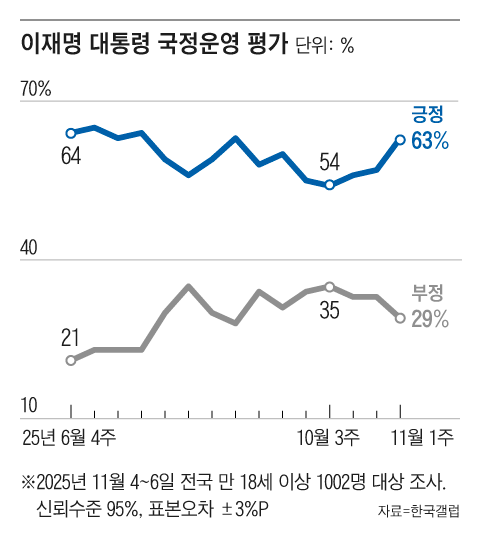
According to Korean Gallup’s analysis, there was a noticeable shift in the themes of approval and disapproval. The increased mention of “diplomacy” and “APEC achievements” in approval reasons suggests that the ruling party’s recent efforts and the suspension of the so-called “Trial Suspension Act” may have influenced public sentiment. Meanwhile, “moral issues/avoiding personal trial” remained the leading concern among those who disapproved of the government.
Party Approval Ratings
The survey also provided insights into the approval ratings of various political parties. The Democratic Party of Korea received the highest approval at 40%, followed by the People Power Party with 26%. The Rebuilding Korea Party and Reform Party each garnered 4% approval, while the Progressive Party had only 1%. An additional 1% of respondents supported other parties or groups, and 24% indicated they had no party affiliation.
Public Perception of International Summits
When asked about the benefits of the APEC summit held in Gyeongju last month, 49% of respondents said it was “very helpful” to South Korea’s national interests. Another 25% believed it was “somewhat helpful,” while 7% considered it “not very helpful,” and 6% stated it was “not helpful at all.” Twelve percent chose not to express an opinion.
Regarding the South Korea-U.S. summit held in the U.S. last August, 58% of respondents felt it benefited the country’s national interests, whereas 23% believed it did not.
Methodology and Additional Information
The survey was conducted by Korean Gallup through telephone interviews. The sample size consisted of 1,002 responses out of a total of 7,900 calls, resulting in a response rate of 12.7%. The margin of error for the survey is ±3.1 percentage points at a 95% confidence level. For more detailed information, interested parties can visit the Central Election Opinion Survey Deliberation Commission’s website.