
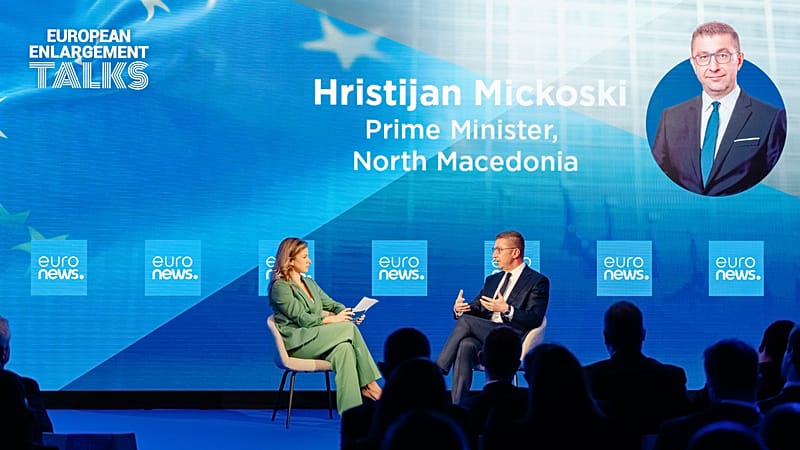
North Macedonia, one of the earliest Western Balkan nations to seek European Union membership, has faced significant challenges in its accession process over the past two decades. Despite its aspirations and efforts, the country has remained stuck in a prolonged state of limbo, with little tangible progress toward EU integration.
Hristijan Mickoski, the prime minister of North Macedonia, expressed his frustration during an interview with Euronews, stating that his country is “unfortunately in the same place where it was 25 years ago due to some artificial reasons.” He emphasized that the lack of progress is not due to failing to meet the Copenhagen criteria or achieving specific objectives, but rather because of “artificial disputes” such as the national flag, the country’s name, and constitutional changes.
These disputes have been central to the country’s struggles. One of the most prominent issues was the long-standing Greek veto, which led to the country changing its name from the Republic of Macedonia to the Republic of North Macedonia. This dispute was resolved in 2018 through the Prespa Agreement, in which Skopje accepted the new name, and Athens lifted its veto.
However, another major obstacle remains: Bulgaria’s ongoing veto on matters related to minority rights, history, and language. Sofia has accused North Macedonia of disrespecting its shared cultural and historical ties with Bulgarians. As a result, Bulgaria has imposed conditions, including constitutional and educational reforms, as prerequisites for progress in the EU accession talks.
Mickoski criticized these conditions, calling them “political pressure and unfair treatment.” He described the situation as a form of bullying, stating, “They are in, we are out. This is a bit of bullying… We would like to see ourselves at the table in Brussels and what is now the price and whether this is the last price that we should pay.”
The prime minister also warned that the current approach undermines the EU’s founding principles and could set a dangerous precedent for other countries seeking membership. He questioned why the EU expects unilateral concessions from North Macedonia while ignoring the treatment of Macedonians in Bulgaria.
“Why should we change our constitution then? Why are we not talking about the Macedonian community in Bulgaria? What about their human rights?” he asked. “They are not allowed to register a non-governmental organisation. We’re not talking [about a] change of the Bulgarian constitution. We’re talking about a sort of reciprocity.”
Mickoski argued that the imbalance between the expectations placed on North Macedonia and the lack of similar demands on Bulgaria undermines the EU’s own principles of fairness and equality between member states and candidate countries. However, despite these tensions and delays, he reaffirmed that joining the EU remains a strategic choice for North Macedonia.
“We do believe that our future is in the European Union. And we do believe that integration of Western Balkans in the EU means added value for the EU itself,” he said.
The prime minister also highlighted the growing disillusionment among ordinary Macedonians, who are frustrated by the lack of progress and questioning what the EU truly stands for today.
“Citizens of my country are full of frustration, are asking me, okay, Prime Minister, what is it now? If we do this, this will be the last one, or probably there will be some additional [ones] in the future?” he said.
Despite the challenges and disappointments, Mickoski emphasized that North Macedonia continues to share the Union’s founding ideals. “Despite all those humiliations and disappointments and despite the current frustration which is inside of our citizens, we do share the same values,” he concluded.