
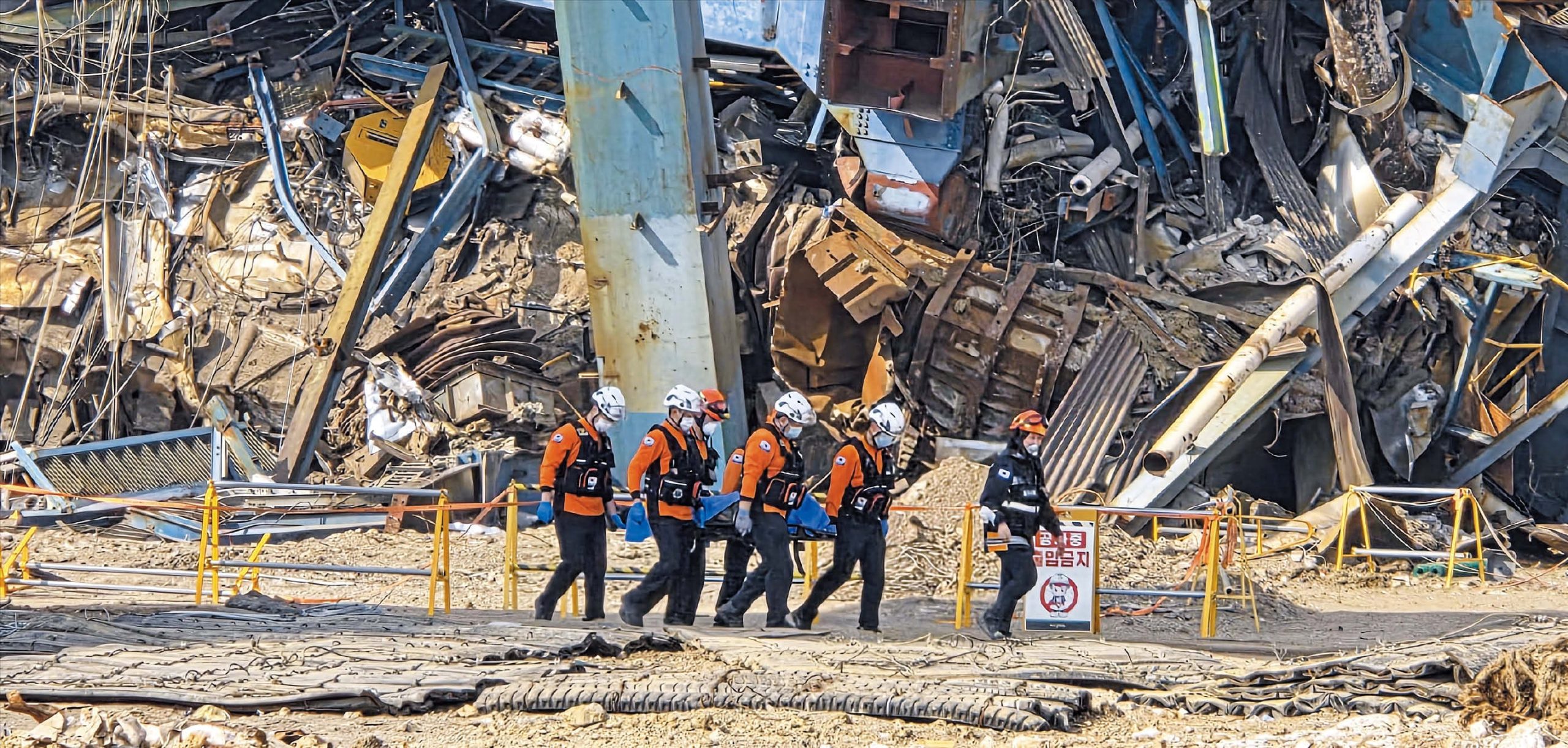
Rescue Efforts Continue Amid Tragic Losses
Around 7:30 a.m. on the 7th, at the collapse site of the Korea East-West Power Ulsan Thermal Power Plant, rescue operations faced both hope and heartbreak. Seventeen hours had passed since two of the nine workers buried when a boiler tower under demolition collapsed the previous day were saved. However, no further survivors had been found. “One person found!” shouted a rescue worker, prompting firefighters and police at the scene to rise simultaneously. By 8:54 a.m., a total of three individuals were discovered in the rubble. This was the limit of the day’s progress.
Two of the three individuals were barely extracted and transported to a hospital, but they succumbed to their injuries. The third remains unaccounted for, leaving families and rescuers in anguish. The situation highlights the urgency and danger of the ongoing search efforts.
A Life Lost in the Rubble
Earlier that day, around 4:53 a.m., Mr. Kim, 44, who had confirmed the burial site the previous day, died during rescue efforts. He was conscious when found, and rescue workers spent 13 hours cutting through the steel beams pinning him down. They kept talking to him to prevent him from giving up and gave him water. Painkillers were also administered. In the early morning, they wrapped his body in a blanket. However, Mr. Kim eventually lost consciousness. The situation had reached a point where only the steel beam crushing one of his arms needed to be removed. Cardiopulmonary resuscitation was attempted but failed.
The tragic loss underscores the immense challenges faced by the rescue teams. Each second counts, and every moment spent trying to save a life is a test of endurance and determination.
Hazardous Conditions at the Site
A fire department official stated, “Rescuers are crawling through narrow gaps under the collapsed structure to locate the buried individuals.” The site is hazardous not only due to steel frames but also sharp glass fibers and asbestos. Kim Jeong-sik, head of the Prevention and Safety Division at Ulsan Nambu Fire Station, said, “Rescue workers who entered to save Mr. Kim had so much glass fiber and asbestos powder on their faces and clothes that they had to use sprayers to remove it.” The accident site, near the coast, saw temperatures drop to around 10 degrees Celsius by dawn.
These conditions make the rescue mission even more perilous. Every step taken by the rescuers must be carefully planned to avoid further harm to themselves or the victims.
Strict Protocols for Rescuers
Each time the rescue team entered and exited the rubble for search operations, they repeated their ranks and names aloud. A fire official explained, “Since rescuers could be trapped at any moment, they confirm their survival every time they enter or exit.”
This protocol ensures that no rescuer is left behind and that the team can quickly respond if someone becomes trapped. It is a critical part of the safety measures in place during such high-risk operations.
Innovative Tools Used in the Search
Since the previous day, the rescue team has been digging tunnels under the collapsed tower. Due to difficulties in accessing the area because of steel beams and other structures, they are attempting to reach the buried individuals from underground. The fire department has deployed search dogs, drones, acoustic detectors, thermal imaging cameras, and endoscopic cameras.
These tools are essential in locating survivors and assessing the structural integrity of the site. They allow rescuers to cover more ground and increase the chances of finding those still missing.
Current Status of the Rescue Operation
As of 11 p.m. the same day, two of the nine buried workers had been rescued, three were confirmed dead, and two were being rescued after their locations were identified. The remaining two are still missing.
The rescue operation continues with unwavering resolve. Every effort made by the teams brings hope to the families of the missing and reinforces the commitment to saving lives, no matter how difficult the circumstances may be.