
Punjab’s Cities Face Severe Smog Crisis
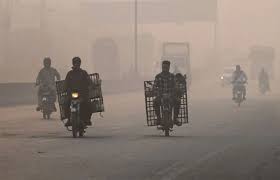
Punjab’s major cities were engulfed in dense smog on Saturday morning, with air quality reaching dangerously high levels across the province. The situation has raised serious concerns among residents and environmental experts alike.
According to data from the International Environmental Monitoring Agency IQAir, the Air Quality Index (AQI) reached alarming levels. In Dera Ghazi Khan and Kasur, the AQI peaked at 500 at 9 a.m., placing both cities among the most polluted globally. This surpassed even Lahore, which is traditionally known as the country’s smog hotspot.
During the early hours of the day, Lahore recorded an AQI of 385, while Sheikhupura had 313 and Gujranwala had 243. As the day progressed, the readings increased further. Gujranwala’s AQI climbed to 442, Lahore reached 400, and Faisalabad hit 337.
Within Lahore, pollution levels varied significantly by region. IQAir data showed extreme concentrations near key areas, including 1,018 AQI near the Civil Secretariat, 997 near Wildlife Parks, and 820 around the Forest Department. The Environment Protection Department (EPD) also reported severe readings, with 500 along Shahdara, Multan Road, and GT Road, and above 350 in several other localities.
Experts have identified multiple factors contributing to the worsening smog. These include polluted easterly winds from across the Indian border, falling temperatures, low wind speeds ranging from 1 to 4 km/h, and a lack of rainfall. All these conditions have caused pollutants to remain trapped near the surface. The EPD noted that a slight improvement was expected later in the afternoon as wind activity increased.
Environmental scientist Maryam Shah, a member of the Pakistan Air Quality Initiative, pointed out that while Punjab’s air quality was relatively better earlier in 2025, PM2.5 levels in October had already matched last year’s highs. She warned that November, typically the peak smog month, could bring another severe episode.
In response to the crisis, the Punjab government has intensified its anti-smog efforts across the province. The initiatives include traffic control, road sprinkling, and industrial emission checks. Continuous monitoring of PM2.5 and PM10 pollutants is being conducted through modern air quality stations.
Despite these measures, environmentalists have cautioned that without consistent enforcement and regional collaboration, Punjab’s residents will continue to face dangerously polluted air in the coming months.
Key Factors Contributing to the Smog Crisis
- Polluted Easterly Winds: Winds carrying pollutants from across the Indian border have significantly contributed to the smog.
- Falling Temperatures: Lower temperatures create conditions that trap pollutants closer to the ground.
- Low Wind Speeds: Wind speeds of 1-4 km/h have limited the dispersion of pollutants.
- Lack of Rainfall: The absence of rain has prevented the natural cleansing of the atmosphere.
Regional Variations in Pollution Levels
- Lahore: Extreme pollution levels were recorded in different parts of the city, with some areas reaching over 1,000 AQI.
- Gujranwala: The AQI rose sharply during the day, reaching 442.
- Faisalabad: Recorded an AQI of 337, indicating severe pollution levels.
Government Actions and Environmental Concerns
The Punjab government has taken several steps to combat the smog:
- Traffic Control: Measures have been implemented to reduce vehicular emissions.
- Road Sprinkling: Water sprinklers are used to suppress dust and pollutants on roads.
- Industrial Emission Checks: Regular inspections are being conducted to ensure compliance with environmental standards.
However, environmentalists emphasize that sustained efforts and cooperation between regions are essential to address the ongoing air quality issues effectively.