
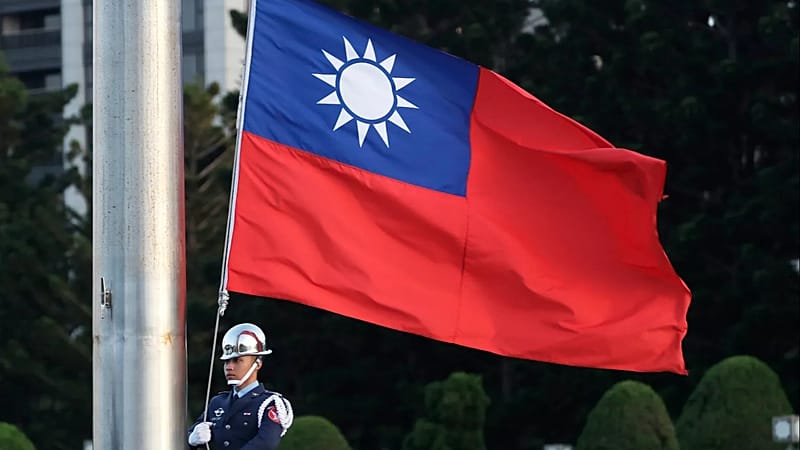
Taiwan’s Deputy Leader Calls for Stronger EU-Taiwan Ties
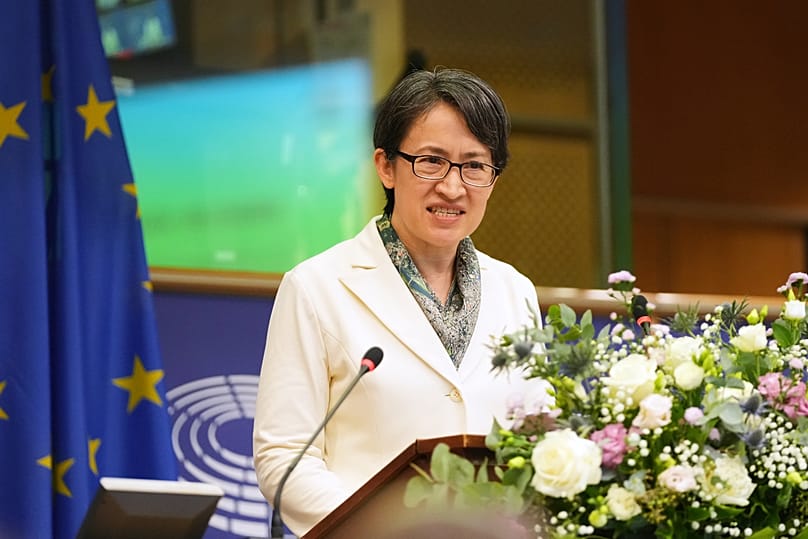
Taiwan’s deputy leader, Vice President Bi-Khim Hsiao, made a significant address to a group of international lawmakers in Brussels, urging the European Union (EU) to strengthen security and trade ties with the self-governing island. Her speech emphasized the importance of supporting Taiwan’s democracy amid growing threats from China.
“Peace in the Taiwan Strait is essential to global stability and economic continuity, and international opposition against unilateral changes to the status quo by force cannot be overstated,” Hsiao stated during her remarks at the European Parliament building.
Although Hsiao did not formally address the entire EU Parliament—due to the lack of formal diplomatic relations between the EU and Taiwan—her visit was still expected to provoke reactions from Beijing. She highlighted the significance of democratic collaboration among nations, even those geographically distant.
“In an era marked by increasing fragmentation, volatility, and rising authoritarianism, this gathering affirms something vital; that democracies, even when far apart, are not alone,” she said.
Hsiao also encouraged lawmakers from countries such as Germany and Spain to enhance cooperation on trusted supply chains and artificial intelligence (AI) technology with Taiwan. The island, located off China’s east coast, is claimed by Beijing as part of its territory and is expected to come under its rule.
Despite the absence of formal diplomatic ties between the EU and Taiwan, the two share common democratic values and have close trade relationships. The EU opposes any use of military force by China to resolve its dispute with Taiwan. Hsiao drew parallels between the challenges faced by Taiwan and those experienced by European nations since Russia’s full-scale invasion of Ukraine.
“Europe has defended freedom under fire, and Taiwan has built democracy under pressure,” she remarked.
She pointed out that disruptions of global supply chains by China, likely referencing Beijing’s throttling of rare earth exports to the EU earlier this year, should prompt Brussels to forge a “reliable technology ecosystem rooted in trust, transparency, and democratic values” with Taiwan.
China consistently asserts that Taiwan’s independence is a “dead end” and that annexation by Beijing is inevitable. The split between China and Taiwan occurred during the civil war that brought the Communist Party to power in 1949. The defeated Nationalist Party forces relocated to Taiwan, where they established their own government.
In recent years, China’s military has intensified its encircling of Taiwan’s skies and waters, conducting joint drills with warships and fighter jets near the island on a near-daily basis. Last month, Taiwan’s President Lai Ching-te pledged to accelerate the construction of the “T-Dome” air defense system and increase defense spending to reach 5% of Taiwan’s GDP by 2030 amid growing security concerns.
Related
China sends dozens of planes across central line in Taiwan Strait
Hong Kong police arrest four linked to group in Taiwan over alleged ‘subversion’
Hsiao’s visit was part of a conference organized by the Inter-Parliamentary Alliance on China, a global group of hundreds of lawmakers aiming to strengthen coordination on China-related policy and advocate for unified international action on key challenges posed by China.
Approximately 50 lawmakers from around two dozen countries attended the event in Brussels. The trip and speech were kept confidential due to high security concerns following reports that Chinese agents had plotted to ram Hsiao’s car during her visit to the Czech Republic in March 2024, when she was vice president-elect. Czech officials later confirmed that Chinese agents had followed Hsiao and planned to intimidate her physically.
Hsiao stated at the time that the Chinese Communist Party’s “unlawful activities” would not deter her from “voicing Taiwan’s interests in the international community.”
Ben Bland, director of the Asia-Pacific programme at the London-based think tank Chatham House, noted in an analysis last month that despite the lack of formal diplomatic relations, the EU and Taiwan can deepen ties for mutual benefit in the face of worsening US-China rivalry. He argued that any conflict over Taiwan could have more devastating consequences for Europe than Russia’s invasion of Ukraine, given Taiwan’s leading role in semiconductor and electronics supply chains.
“European nations cannot stop Beijing from squeezing Taiwan harder,” Bland wrote.
“But they can help to preserve and even increase Taiwan’s global connections and share lessons in how to stay resilient.”