
The Role of AI in Information Retrieval
As generative AI services like ChatGPT and Perplexity become more widespread, an increasing number of users are finding that “searching with AI is more convenient.” However, this convenience may not always translate to accuracy, especially when the information being sought is critical. This discrepancy becomes evident during high-stakes events such as the College Scholastic Ability Test (CSAT). In these cases, reliable and verified data is essential.
Naver, a leading domestic portal, has taken a different approach by separately displaying content based on verified data from authoritative sources such as the Korea Institute for Curriculum and Evaluation and admissions companies. According to an industry insider, “AI inherently does not guarantee correct answers.” They added that search portals have strengths in enhancing accuracy through their “data pipelines.”
Accuracy vs. AI: A Case Study
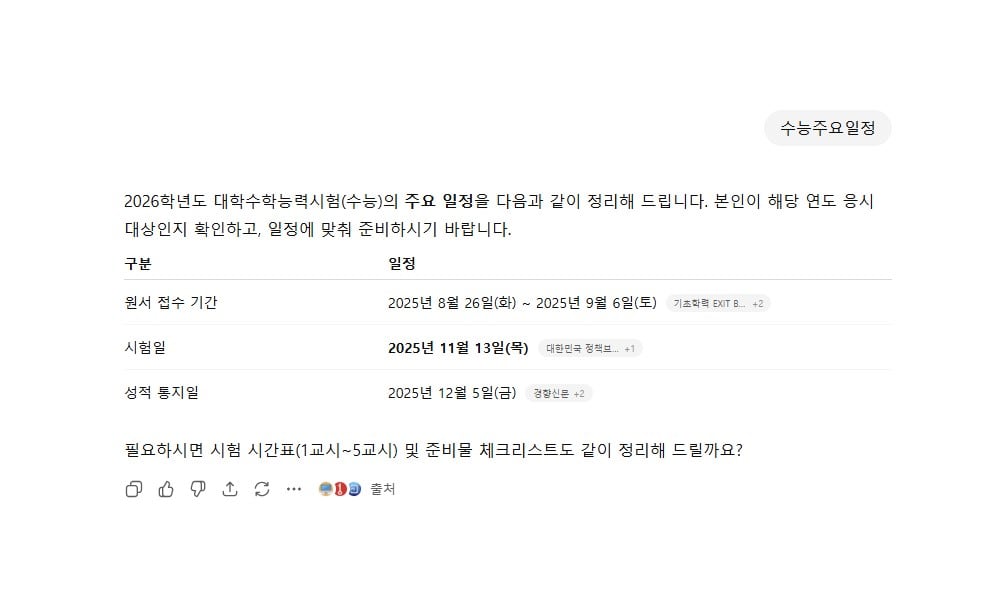
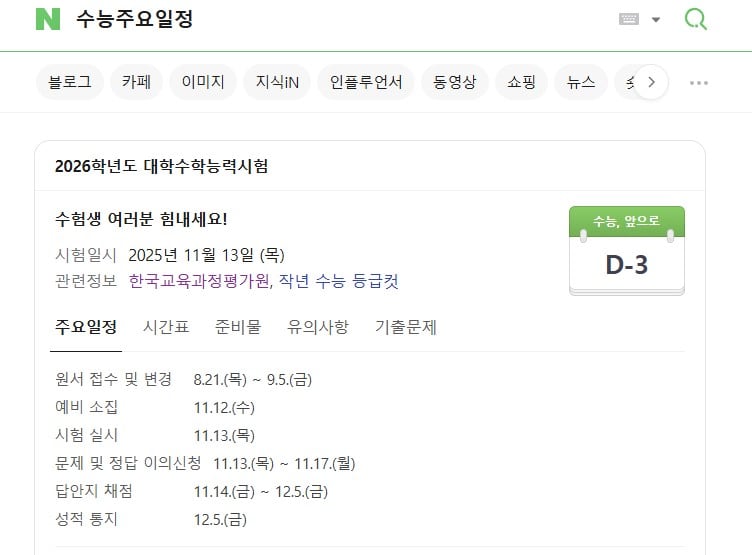
When testing the “CSAT key schedule” on Naver and ChatGPT, differences in accuracy were observed. For instance, ChatGPT provided an application period of “August 26 to September 6,” whereas the actual correct period is “August 21 to September 5.” This error occurred because ChatGPT relied on unofficial information published online. On the other hand, Naver’s response regarding the “2025 CSAT grade cutoffs” was more accurate.
Naver’s Data Pipeline Strategy
The difference in accuracy stems from Naver’s established “data pipeline.” For important domestic information like the CSAT, Naver collaborates with institutions such as the Korea Institute for Curriculum and Evaluation, EBSi, and major admissions companies like Daesung MyMac and Jongno Academy. These partnerships allow for manual verification of information before it is made available to users.
Starting 30 days before the CSAT each year, Naver displays separate search results and updates key schedules, timetables, preparation items, and precautions released by the Korea Institute for Curriculum and Evaluation until the day before the exam. On the exam day, they reflect question papers and answer keys immediately after each subject concludes. After the exam ends, they incorporate expected grade cutoffs and question trends from major admissions companies into the search results.
This structure is part of Naver’s “answer-type search” strategy. The same approach is applied to various categories such as broadcasts, movies, people, policies, and dictionaries. Broadcast information is received directly from broadcasters, movie information is partnered with film magazine Cine21, and person searches undergo self-participation and institutional verification. Naver currently has data partnerships with various professional institutions, including 21 top general hospitals, the Korean Legal Affairs Association, the Korean Architects Association, and the National Museum of Modern and Contemporary Art.
Generative AI: Strengths and Limitations
In contrast, generative AI has the strength of summarizing information from various sources and presenting it in an easy-to-understand manner. However, since it is based on web documents, it cannot guarantee correct answers. It may present outdated data or show links to non-existent information.
Hybrid Strategy for Effective Search
For this reason, Naver has adopted a “hybrid strategy” that customizes AI introduction according to search intent rather than applying it universally. For exploratory searches like “CSAT lunchbox menu” or “CSAT encouragement phrases,” they utilize AI briefings. However, for questions requiring correct answers, they maintain direct data verification. This approach ensures that users receive accurate and reliable information when it matters most.