
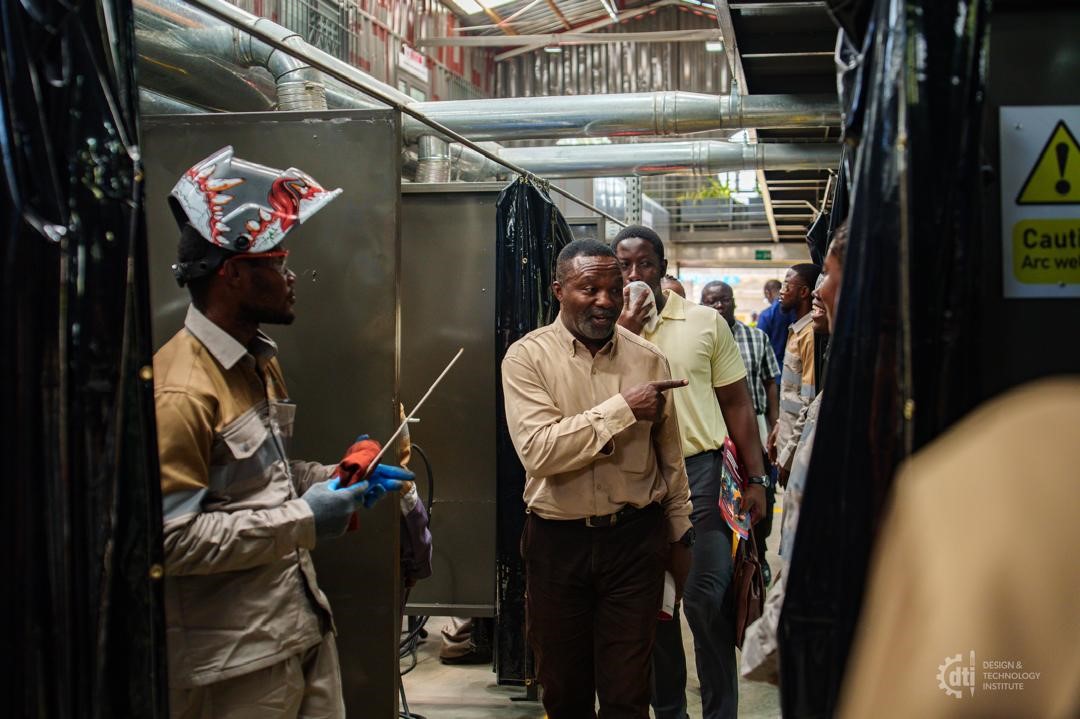
A New Era in Technical Education
Ghana marked a significant milestone in its technical and vocational education and training (TVET) journey on October 30, with the official commissioning of the Welder Training and Testing Centre at the Design and Technology Institute (DTI). This facility is Africa’s first American Welding Society (AWS) SENSE participating school, setting a new standard for technical skills development, global certification, and industrial competitiveness.
The state-of-the-art center features a 40-booth welding workshop, digital welding simulators, and a metallurgical testing laboratory working toward ISO/IEC 17025 standards. Built to AWS SENSE specifications, it represents a major step forward in aligning Ghana’s TVET system with international benchmarks.
A Catalyst for Transformation
From the outset of the commissioning ceremony, there was a palpable sense of pride and purpose. Ms. Constance Elizabeth Swaniker, Founder and President of DTI, described the facility as “a catalyst for transformation — where knowledge meets practice, innovation meets precision, and young Africans are empowered to shape the future of work.”
She emphasized that DTI’s five-year journey has been driven by a commitment to align training with industry demand, close the skills mismatch, and enhance employability among Ghanaian youth. The institute’s 70% employability score, validated by the IFC Vitae Assessment, underscores this dedication.
“This Centre sets a new benchmark for human capital development in Ghana’s TVET sector,” she said. “It creates dignified, well-paying job opportunities for our youth, reduces costs and delays for industry, and transforms petroleum revenues into human capital dividends for Ghana.”
Integration of Soft Skills
The Centre also integrates soft skills training, delivered by clinical psychologists and arts-in-education specialists. This ensures that graduates are not only technically skilled but also emotionally intelligent and workplace-ready.
Dr. Archibald Buah-Kwofie, Acting Director of the Nuclear Power Institute at the Ghana Atomic Energy Commission, hailed the Centre as a “strategic national asset” and a “catalyst for transforming Ghana’s TVET landscape.” He noted the critical role welding will play in Ghana’s emerging nuclear energy programme, emphasizing the need for certified welders to construct and maintain nuclear facilities.
He proposed a national welding dialogue to harmonize training standards, align curricula, and certify welders nationwide. “This commissioning must inspire us to do more,” he added. “Every region of Ghana should have access to a world-class TVET facility.”
Why This Facility Matters
The significance of this development can be distilled into three dimensions:
-
Aligning skills with industrial demand
Ghana’s economy is increasingly driven by sectors requiring high-precision technical skills — oil and gas, mining, manufacturing, and power generation. This facility directly supports the Petroleum Local Content Regulations (LI 2204), enabling local welders and companies to meet industry and regulatory standards. -
Raising standards, improving competitiveness
With AWS SENSE attestation and plans for ISO/IEC 17025 accreditation, DTI is signaling Ghana’s readiness to compete globally in welding and fabrication. It means Ghanaian welders can earn credentials recognized worldwide, giving industries access to certified competence locally while enhancing export potential. -
Empowering youth and inclusive growth
Beyond technical mastery, the centre offers pathways to dignity, employment, and independence. One young trainee, goggles on, prepared for his first virtual weld as his instructor said: “In five minutes, you’ll try your first virtual weld; in five hours, you’ll be in the real booth.” It was a vivid illustration of how digital simulation and hands-on training now coexist to prepare a confident, capable workforce.
Another student, a young woman, said she chose welding because she wanted the same opportunities her brothers had — “independence, skill, respect.” Through DTI, she and others are breaking barriers and redefining vocational careers as professions of prestige.
DTI’s Growing Legacy
Since its founding in 2019, DTI has earned acclaim as Ghana’s leading private TVET institution, promoting its “Precision Quality” ethos and partnering with industry leaders under the Mastercard Foundation’s Young Africa Works strategy. DTI’s model integrates industry co-design, entrepreneurship, and innovation, equipping learners for jobs in infrastructure, energy, manufacturing, and construction.
As Mr. Isaac Tetteh, Head of Welding and Fabrication at DTI, noted, the Centre will “produce globally competitive welders aligned with AWS, ASME, and ISO standards,” and provide training, inspection, and testing services to serve both local and global markets.
The Bigger Picture
This Centre is more than an academic achievement — it is a strategic investment in Ghana’s industrialization and workforce transformation agenda. It will:
- Support local content in major infrastructure and energy projects.
- Reduce capital flight by enabling local certification.
- Position Ghana as a hub for regional welding and fabrication expertise.
- Build a skilled youth workforce ready for Africa’s emerging industries.
For many, the commissioning represented more than the launch of a facility — it was a national declaration that Ghana’s youth are ready for the world of work and that technical skills matter as much as academic degrees.
Commendation and Call to Action
To DTI, its partners, and supporting agencies — the Mastercard Foundation, Ghana Standards Authority, GNPC, and the Commission for TVET — congratulations. You have raised the bar for technical education in Africa.
To industry leaders, this is your moment to engage, co-design programmes, and recruit from within this ecosystem. To policy makers, sustain funding and extend such facilities beyond Accra. To young Ghanaians, the message is clear: the future of work is not only digital — it is technical, skilled, and proudly local.
Final Thoughts
As we left the commissioning grounds, Ms. Swaniker’s words lingered: “Young Africans are empowered to shape the future of work.” Indeed, that future is being forged here — with sparks flying, simulators humming, and a new generation of welders rising.
The DTI Welder Training and Testing Centre is not just a building; it is a symbol of Ghana’s determination to compete globally through skills, standards, and innovation. It embodies the spirit of resilience and perseverance.
The forge is lit, the sparks fly — and Ghana’s future, brightened by skill and purpose, has never looked stronger.