
The Vision for a New Industrial Structure
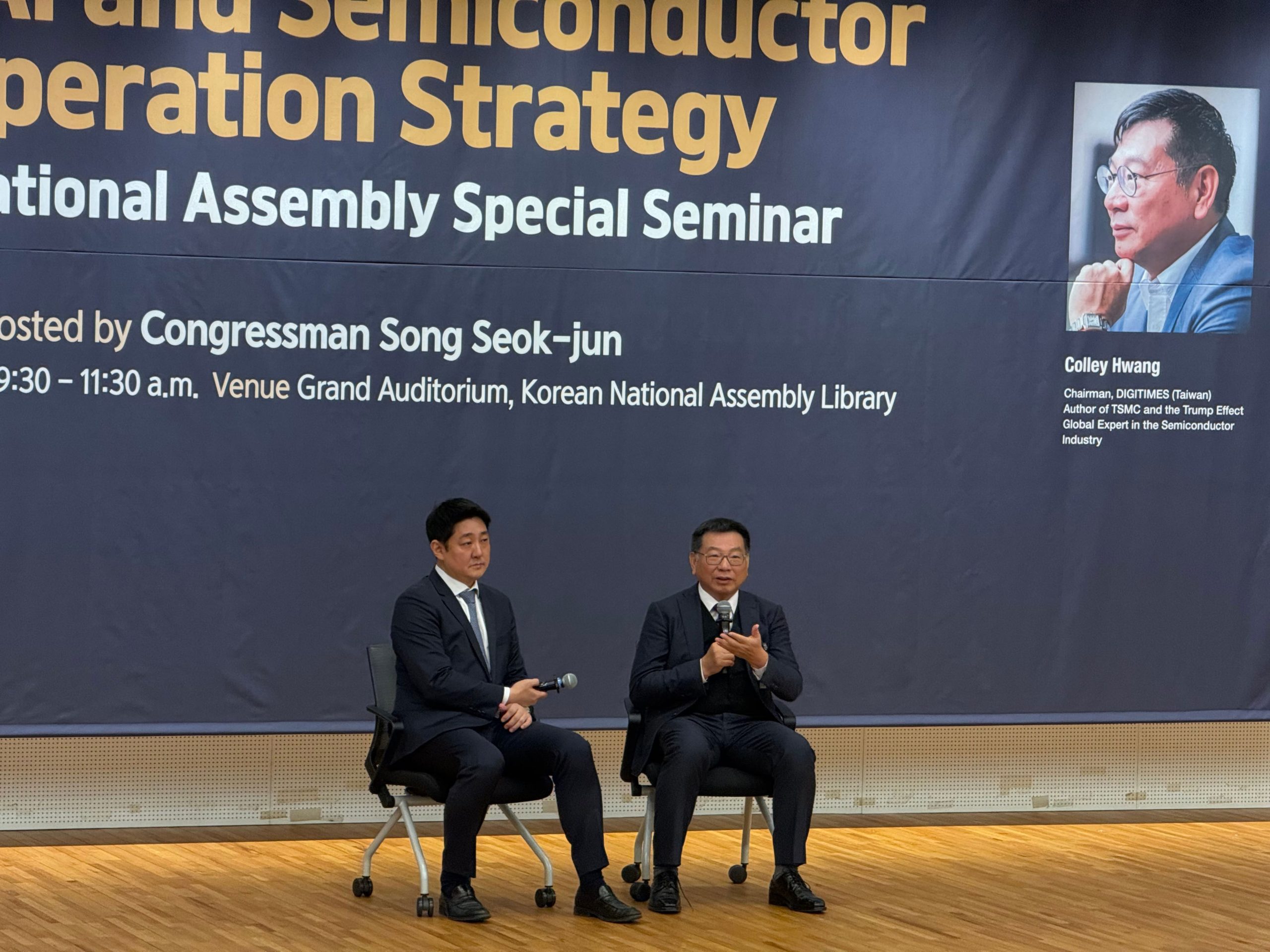
Colley Hwang, chairman of DIGITIMES, a global semiconductor industry media and research institution, emphasized the importance of collaboration between South Korea and Taiwan. He proposed that these two nations should establish a cooperative system to build a new industrial structure that surpasses the influence of the U.S. and China.
Hwang made these remarks during the ‘Global AI and Semiconductor Cooperation Strategy Seminar’ hosted by Representative Song Seok-jun’s office at the National Assembly Library’s main auditorium. He highlighted that both South Korea and Taiwan have independently developed their electronics and semiconductor industries over the past 50 years. His vision is to create a powerful alliance that could lead the global semiconductor market.
DIGITIMES, co-founded by TSMC founder Morris Chang and Acer founder Stan Shih, has been instrumental in shaping the semiconductor landscape. As the company’s founder, Hwang is recognized as a leading semiconductor strategist. He stressed the need for state-led infrastructure investment in the semiconductor industry, arguing that it is more effective than democratic market competition.
Divergent Paths to Semiconductor Success
South Korea and Taiwan have taken different approaches to developing their semiconductor industries. South Korea entered the sector through technology and capital-intensive brands such as Samsung. In contrast, Taiwan focused on manufacturing infrastructure and production ecosystems. This distinction has led to specialization: South Korea excels in memory semiconductors, while Taiwan leads in foundry (semiconductor contract manufacturing) and EMS (electronics manufacturing services).
The current AI semiconductor ecosystem involves key players like NVIDIA in the U.S., which designs chips, TSMC in Taiwan, which manufactures them, and SK Hynix in South Korea, which supplies high-bandwidth memory (HBM) to create AI accelerators. Hwang pointed out that over the past 30 to 40 years, South Korea and Taiwan were competing nations, but this year, South Korea became Taiwan’s largest trade deficit country, indicating that their supply chains are becoming intertwined.
Building a Strategic Connection
Hwang suggested creating a highway connecting South Korea’s semiconductor complex and Taiwan’s Hsinchu Science Park. This initiative would facilitate closer economic ties and foster innovation. He also proposed an ecosystem-level alliance model centered on South Korea and Taiwan. If given the opportunity, he would advise South Korean government decision-makers to consider strategies where Samsung or SK Hynix directly invest in Taiwanese IC design companies. This approach would allow for direct management of supply chain infrastructure.
Hwang emphasized that semiconductor hegemony is a competition of ecosystems, not individual nations. Efforts to build an Asian ecosystem centered on South Korea and Taiwan are crucial for long-term success.
Exploring New Opportunities
Kim Sung-soo, an adjunct professor at Yonsei University’s Graduate School of Business, who co-hosted the seminar, suggested that South Korea could secure a role in the semiconductor industry based on its small modular reactor (SMR) competitiveness. With global AI data center power supply emerging as a major issue, South Korea, which possesses nuclear power competitiveness, could secure demand.
He noted that while the semiconductor sector is highly competitive, South Korea’s capabilities in materials, parts, and equipment are not yet strong. However, he highlighted that nuclear power is one of the areas where South Korea currently excels globally, and they have already exported it.
Kim continued by stating that countries like the UAE and Saudi Arabia are issuing massive data center orders recently. He suggested that South Korea should explore collaboration opportunities based on its SMR competitiveness to strengthen its position in the global semiconductor market.
Conclusion
The discussions at the seminar underscored the importance of strategic cooperation between South Korea and Taiwan in the semiconductor industry. By leveraging their respective strengths and building a robust ecosystem, both nations can enhance their global standing and contribute to the advancement of AI and semiconductor technologies. The path forward requires innovative thinking, collaborative efforts, and a focus on long-term sustainability.