
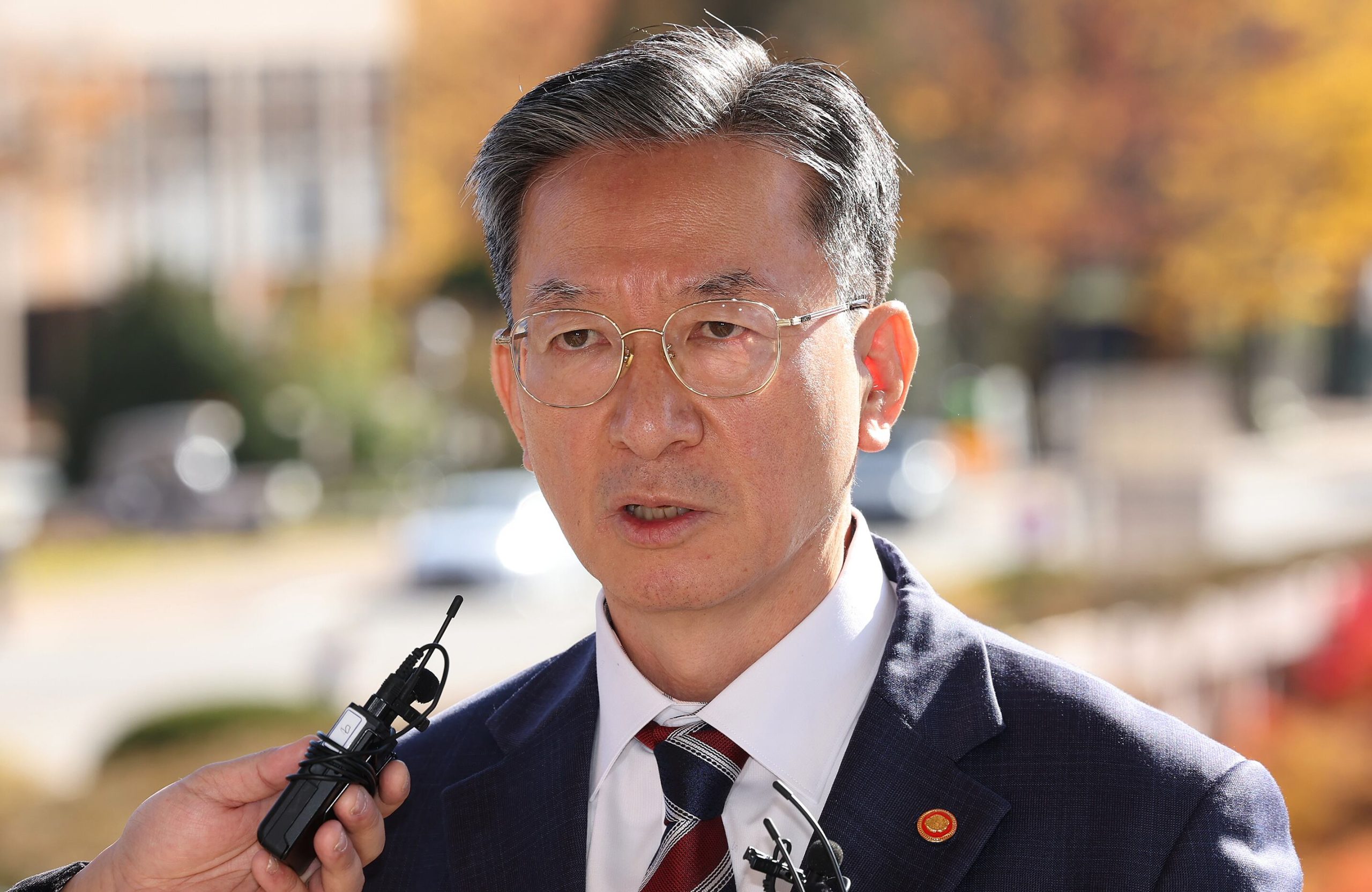
The Justice Minister’s Statement and the Daejang-dong Case
Justice Minister Jung Sung-ho made a statement on the 10th regarding the prosecution’s decision to abandon its appeal in the Daejang-dong private developer case. He mentioned that the court’s sentences were higher than what the prosecutors had recommended, which led to the conclusion that there was no need for an appeal. He also said that he had conveyed his opinion to the Supreme Prosecutors’ Office, urging them to make a careful decision considering all circumstances.
This marked a change from his previous position where he claimed “having no knowledge” of the matter, to now admitting that he had “conveyed an opinion.” His remarks effectively instructed the prosecution not to appeal, and it is unlikely that any public official would interpret this as just expressing an opinion. Among the five private developers involved in the Daejang-dong case, three received sentences lower than the prosecution’s recommendations, making Jung’s statement factually incorrect. It seems that he hastily changed his stance as the issue gained more attention.
Jung did not officially use his investigative command authority or follow legal procedures to direct Acting Prosecutor General Noh Man-seok to abandon the appeal. Instead, he issued investigative instructions behind the scenes, which could potentially violate the Prosecutors’ Office Act and constitute abuse of authority.
The Question of Sole Responsibility
The biggest question is whether Jung acted alone in issuing this directive. Abandoning the appeal in the Daejang-dong case would allow the Daejang-dong group to proceed with the trial while the prosecutors are restricted, leading to a one-sided trial. This could result in hundreds of billions of Korean won continuing to flow to the Daejang-dong group.
It was foreseeable that such a decision would provoke public backlash. Few would believe that a single minister could unilaterally decide such a major issue. Opposition parties questioned whether this was a request from President Lee Jae-myung and if it could happen without the president’s influence.
Currently, there is no evidence of President Lee’s involvement. However, circumstantially, it is hard to dismiss the possibility. Those who benefit from abandoning the appeal are the Daejang-dong group and President Lee. Jung is one of the president’s closest aides, and three out of four senior presidential secretaries for civil affairs—who oversee the prosecution—are former lawyers for President Lee. It would be unreasonable to claim the president was unaware of the appeal abandonment issue.
Legal Implications and Public Concerns
President Lee was separately indicted in the Daejang-dong case and was undergoing trial in the court of first instance before his inauguration, after which the trial process was suspended. Depending on how the private developers testify, the president’s future trial could be affected. Some speculate that President Lee sought to appease the private developers through the appeal abandonment to secure favorable testimony. If true, this would pose a serious legal issue.
The presidential office has not issued an official statement. However, a source from the office stated, “While we received a status report, the presidential office did not issue any directives.” If President Lee did not give instructions, he should come forward and clarify the matter before suspicions grow further. If that is insufficient, the Corruption Investigation Office for High-ranking Officials or a special counsel should swiftly investigate to uncover the facts.
The Corruption Investigation Office for High-ranking Officials was established to investigate corruption by high-ranking officials. Now is the time to prove its purpose.