
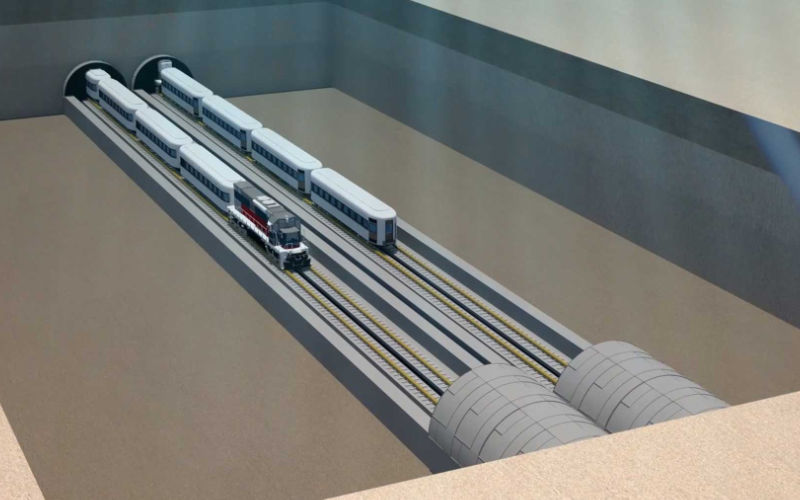
Overview of the Morocco-Spain Tunnel Project
A recent study commissioned by the Spanish government, conducted by Herrenknecht—a German leader in tunnel-boring technology—has confirmed that the proposed Morocco-Spain tunnel is technically feasible, though it presents significant challenges. The research focused on the most complex sections of the project, particularly under the Camarinal Threshold, an area known for its difficult geological conditions.
Herrenknecht’s findings indicate that the necessary technology to construct the tunnel already exists, which could pave the way for the first exploratory tunnel. Spain and Morocco are reportedly aiming to make a final decision on a tender for this initial tunnel by 2027.
Construction Timeline and Scope
Officials estimate that constructing the exploratory tunnel, which would be part of a twin-tube design, could take between six to nine years. The Spanish section alone would stretch approximately 40 kilometers, with the total length of the tunnel estimated at around 65 kilometers.
Plans suggest that the Spanish terminal would be located near Vejer de la Frontera, connecting to the Cádiz-Seville railway line. The overall cost for Spain’s portion, including tunnels, terminals, facilities, and contingencies, is estimated at over €8.5 billion. Part of the funding is likely to come from European Union support.
Historical Background and Recent Developments
The project has a long history, dating back to the 19th century, with the first official Spain-Morocco agreement signed in 1979. Decades of studies and public investment followed, although funding slowed in the 2010s. Since 2021, European Recovery Funds have helped revive the initiative, and the government under Pedro Sánchez has actively accelerated it, especially after recent political shifts regarding the Moroccan Sahara.
Secegsa, the Spanish agency overseeing the project, and its Moroccan counterpart have been studying similar large-scale tunnels, such as Norway’s Rogfast, to learn lessons for this venture. Parallel research on seismic activity and the seabed is underway with the U.S. Geological Survey.
Strategic Importance and Future Prospects
Beyond the engineering challenge, the tunnel is seen as a historic opportunity to strengthen the Iberian Peninsula’s role as a transport hub between Europe and Africa. It could enhance freight, passenger, and energy connections across the Mediterranean.
If all goes as planned, early construction could begin by 2030, coinciding with the Spain-Morocco FIFA World Cup. However, realistic milestones may stretch into the 2035–2040 timeframe.
Key Considerations and Challenges
- Technical Feasibility: The feasibility study confirms that existing technology can support the tunnel’s construction.
- Geological Challenges: The Camarinal Threshold presents unique difficulties due to its complex geology.
- Funding Sources: A significant portion of the funding is expected to come from the European Union.
- Historical Context: The project has been discussed for over a century, with various agreements and studies conducted over the years.
- Political Factors: Recent political developments have influenced the acceleration of the project.
- International Collaboration: Lessons are being drawn from other large-scale tunnel projects, such as Norway’s Rogfast.
- Seismic Research: Ongoing studies with the U.S. Geological Survey aim to better understand seismic risks and seabed conditions.
- Strategic Impact: The tunnel could significantly enhance transportation and economic ties between Europe and Africa.