

The Controversy Over Statistical Distortion in Real Estate Measures
A growing controversy has emerged over what is being called “statistical distortion” related to the government’s real estate measures announced on October 15. These measures designated all of Seoul and 12 cities and districts in Gyeonggi Province as regulated zones, including speculative overheating zones and adjustment target zones. Critics argue that the government selectively used data from June–August rather than September, leading to the inclusion of certain areas in the regulations.
The opposition parties, including the People Power Party and the Reform Party, have accused the government of engaging in a “politics of statistical manipulation,” a practice they claim began during the Moon Jae-in administration. They assert that if favorable statistics were selectively used, it constitutes clear statistical manipulation. The Ministry of Land, Infrastructure and Transport (MOLIT) has denied these claims, stating that the designation of regulated zones was based on legally valid statistics.
Understanding the Core Dispute
The central issue revolves around the interpretation of the “previous three months’ statistics.” According to the Enforcement Decree of the Housing Act, adjustment target zones can be designated if the housing price increase rate over the previous three months exceeds 1.3 times the consumer price increase rate (1.5 times for speculative overheating zones). For the October 15 measures, the “previous three months” refers to July–September. However, the opposition argues that the government violated regulations by using June–August statistics instead.
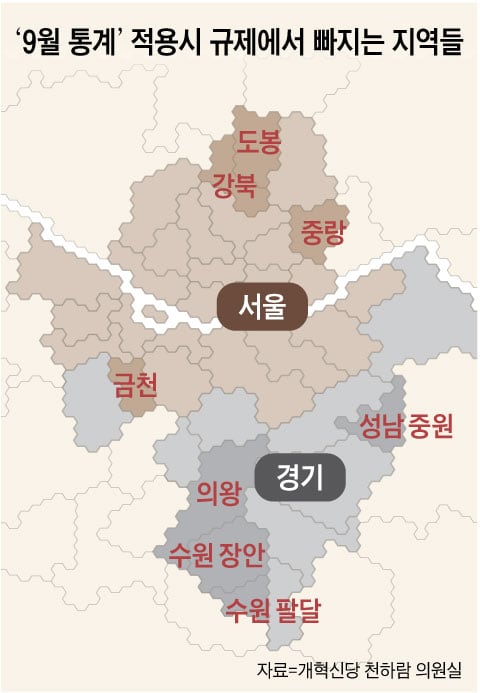
If July–September data had been applied, eight areas—Seoul’s Jungnang, Gangbuk, Dobong, and Geumcheon districts, as well as Gyeonggi’s Uiwang, Seongnam Jungwon District, Suwon Jangan, and Paldal districts—would not have been included in the regulated zones. The opposition claims that due to the government’s “statistical manipulation,” these areas now face stricter loan limits and bans on transferring redevelopment project membership rights.
Opposition Demands Legal Action and Accountability
At a press briefing on the 9th, the People Power Party floor leader Song Eon-seog stated, “The suspicion of statistical manipulation related to the October 15 real estate measures has fundamentally shaken public trust in the government.” He added, “We will take legal action to uncover the truth.” He also urged Minister Kim Yun-duk to resign, stating, “The minister must take responsibility for the situation.”
A Seoul city council member from the People Power Party filed a complaint with the Seoul Metropolitan Police Agency, accusing Minister Kim of fabricating official documents and abusing authority. Rep. Chun Ha-ram of the Reform Party, who first raised the issue during a National Assembly audit on the 30th of last month, has demanded the policy’s withdrawal and hinted at administrative litigation.
Criticism of the Government’s Data Handling
The People Power Party specifically criticized the government for receiving September statistics before announcing the October 15 measures but failing to reflect them. They described this as a “distorted selection of statistics aimed at expanding regulations.” According to Rep. Yoo Sang-beom, MOLIT received the September housing price trend survey data from the Korea Real Estate Board at 4 p.m. on October 13. The Office of the President obtained the same data the following day, around 11:30 p.m. The Housing Policy Deliberation Committee, which discussed the October 15 measures, met on October 13–14.
In response, MOLIT argued that since the September statistics had not been officially released, there was no legal basis to use them in deliberations. While acknowledging receipt of the September data from the Korea Real Estate Board, MOLIT maintained that the statistics could not be applied, as their official release date was the 15th. Indeed, the Korea Real Estate Board publicly disclosed the September data at 2 p.m. on the 15th, shortly after the measures were announced.
Justification and Legal Arguments
MOLIT explained, based on the current Enforcement Decree of the Housing Act, that “if statistics for the relevant period are unavailable, the closest available monthly or annual data are to be used.” A MOLIT official stated, “At the time of drafting the committee agenda, August statistics were the most recent.” They added, “Even if September data had been secured during deliberations, disclosing it to civilian committee members would have violated the Statistics Act, and delaying the schedule was impractical given the urgency of the measures.”
Regarding this, Minister Kim Yun-duk testified at a National Assembly budget committee meeting on the 7th, stating, “(The October 15 measures) were prepared well before Chuseok, prior to the release of September statistics.” Democratic Party spokesperson Kim Hyun-jung criticized, “If the government missed the golden time for policy implementation by waiting for September statistics while ignoring already confirmed risk signals, that would be a clear dereliction of duty,” urging the opposition to “stop spouting nonsense.”
Expert Commentary on the Situation
However, Prof. Jeong Soo-yeon of Jeju National University’s Economics Department commented, “Even if the measures were urgent and procedurally sound, the result has caused harm to too many people,” adding, “It is clear that the government has provoked unnecessary controversy.” This highlights the broader implications of the dispute, as the controversy continues to affect public trust and policy effectiveness.