
Political Protests Erupt in Madhesh Province Over Chief Minister Appointment
In a dramatic turn of events, leaders and cadres from seven political parties, including the Nepali Congress and the CPN (Maoist Centre), staged a protest outside the Madhesh Bhawan on Monday. The demonstration was a direct response to the appointment of a new chief minister in Madhesh Province, which sparked widespread dissatisfaction among the opposition parties.
The unrest began after former Chief Minister Jitendra Sonal resigned on Sunday. His decision came after he realized that he might not be able to secure a majority in the provincial assembly. Following his resignation, the Nepali Congress, Maoist Centre, CPN (Unified Socialist), Loktantrik Samajbadi Party, Janamat Party, Janata Samajbadi Party, and Nagarik Unmukti Party called for the formation of a new government under Article 168(2) of the constitution. This provision mandates that the province head should invite the parties to take initiatives in forming a coalition government.
However, Province Head Sumitra Devi Bhandari took a different approach. On Monday morning, she appointed Saroj Kumar Yadav, the leader of the UML parliamentary party, as the new chief minister under Article 168(3). This move bypassed the coalition-building process and led to immediate protests from the seven parties involved.
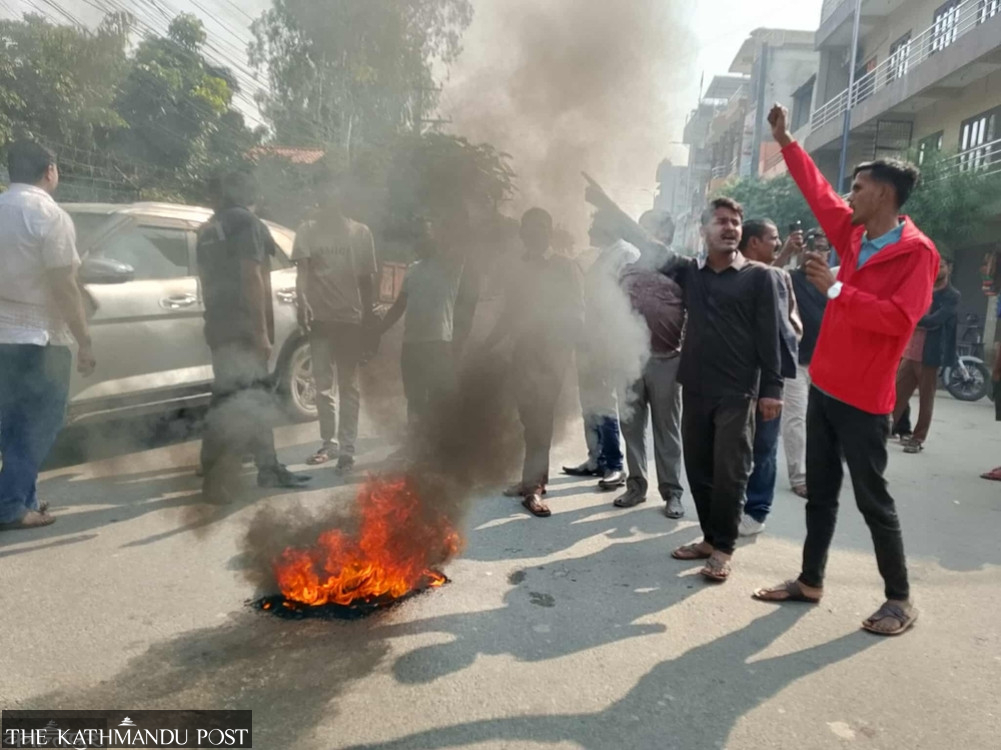
The appointment was made under Article 168(3), which allows the province head to form a government under the leadership of the parliamentary party leader of the largest party in the assembly. As news of the appointment spread, lawmakers and cadres from the seven parties gathered outside the Madhesh Bhawan, chanting slogans and burning tyres. Security personnel were deployed in large numbers around the building as the number of protesters continued to grow.
Earlier in the morning, Bhandari had administered the oath of office to Yadav at a hotel in Bardibas. There, she officially appointed him as the chief minister. Following this, Yadav expanded his Cabinet, including members from the UML, Rastriya Prajatantra Party (RPP), and Sangiya Samajbadi Party.
The move by the RPP to withdraw its participation from the government further escalated tensions. Party chair Rajendra Lingden directed its ministers to leave the government, citing the “midnight appointment” made in a Bardibas hotel as being against the party’s policy.
Key Developments
- Resignation of Jitendra Sonal: The former chief minister stepped down after realizing he could not secure a majority in the provincial assembly.
- Constitutional Provision 168(2): The seven parties demanded a coalition government under this article, but it was not followed.
- Appointment Under 168(3): Province Head Sumitra Devi Bhandari chose Saroj Kumar Yadav as the new chief minister, leading to widespread protests.
- Protest Actions: Demonstrators gathered outside the Madhesh Bhawan, chanting slogans and burning tyres, with heavy security presence.
- Cabinet Expansion: Yadav added members from multiple parties, including the UML, RPP, and Sangiya Samajbadi Party.
- RPP Withdrawal: The RPP withdrew from the government, with its chair criticizing the appointment as against party policy.
Impact on Political Tensions
The actions taken by the provincial head have deepened political tensions in Madhesh Province. The lack of proper consultation and the abrupt nature of the appointment have raised concerns about the democratic process and the stability of the government.
As the situation continues to unfold, it remains to be seen how the opposition parties will respond and whether a resolution can be reached that satisfies all stakeholders. The events in Madhesh Province highlight the delicate balance of power and the importance of constitutional procedures in maintaining political stability.