
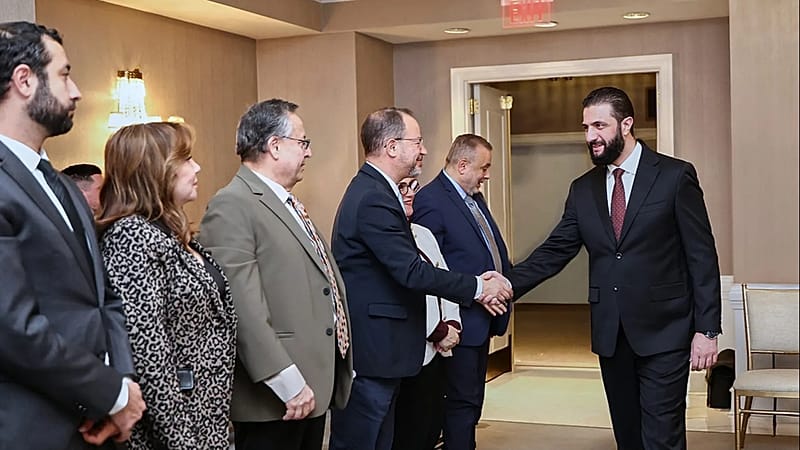
A Historic Meeting at the White House
US President Donald Trump met with Syria’s interim President Ahmad al-Sharaa at the White House on Monday, marking the first visit by a Syrian head of state since the country gained independence in 1946. This significant diplomatic encounter comes as Damascus is expected to formally join the US-led coalition against the so-called Islamic State group. The meeting highlights Trump’s ongoing efforts to engage with world leaders in pursuit of peace and stability.
White House press secretary Karoline Leavitt described the visit as part of the president’s broader diplomatic strategy. “Part of the president’s efforts in diplomacy to meet with anyone around the world in the pursuit of peace,” she said. This meeting follows a previous encounter between Trump and al-Sharaa in Saudi Arabia in May, which was the first official US-Syria contact since Bill Clinton met Hafez Assad in 2000.
During their Riyadh meeting, Trump praised al-Sharaa, describing him as a “young, attractive guy. Tough guy. Strong past, very strong past. Fighter.” He also expressed confidence in al-Sharaa’s leadership, stating that “a lot of progress has been made with Syria” since Washington eased sanctions. This positive assessment suggests a shift in the US stance towards Syria under the new leadership.
Strategic Cooperation Against the Islamic State
The talks are expected to result in Damascus officially joining the US-led coalition against the Islamic State (IS). This move would allow Syria to work more closely with US armed forces, potentially enhancing regional security and counterterrorism efforts. The inclusion of Syria in the coalition could also signal a broader realignment of alliances in the Middle East, especially following the fall of former President Bashar al-Assad in December 2024.
Al-Sharaa has been actively seeking an end to sanctions imposed on Syria, which were primarily targeted at the previous government for human rights abuses. The UN Security Council recently voted to lift sanctions on al-Sharaa and other government officials. US UN ambassador Mike Waltz stated that this vote marks the beginning of a new era for Damascus, reflecting the changing dynamics in the region.
Sanctions and Their Impact
Despite the lifting of some sanctions, al-Sharaa continues to push for the permanent repeal of penalties that have hindered economic recovery and foreign investment. While Trump has waived Caesar Act sanctions, Congress must take further action to abolish them permanently. Advocates argue that an unconditional repeal is crucial to attract business and investment to Syria, as potential sanction fears continue to deter international companies.
Mouaz Moustafa, executive director of the Syrian Emergency Task Force, emphasized the need for a complete removal of sanctions. “Repealing sanctions with conditions is like a hanging shadow that paralyses any initiatives for our country,” he said. This perspective underscores the challenges faced by Syria in rebuilding its economy and restoring international trust.
A New Era for Syria
Al-Sharaa, who led rebel forces that toppled al-Assad in December, has taken steps to establish ties with countries that had previously distanced themselves from the Assad regime. His government has sought to rebuild relationships and foster cooperation, despite the complex legacy of the civil war that lasted over a decade.
Notably, al-Sharaa was once held in a US-run Iraq detention center after joining al-Qaida militants in fighting US forces. However, he has since cut ties with the group and focused on stabilizing Syria. His journey from a controversial figure to a leader seeking international recognition reflects the evolving landscape of the region.
Conclusion
The historic visit between Trump and al-Sharaa signifies a pivotal moment in US-Syria relations. As Damascus moves toward joining the US-led coalition against the Islamic State and seeks an end to sanctions, the future of Syria remains uncertain but filled with potential. The coming months will be critical in determining how these developments shape the political and economic trajectory of the country.