
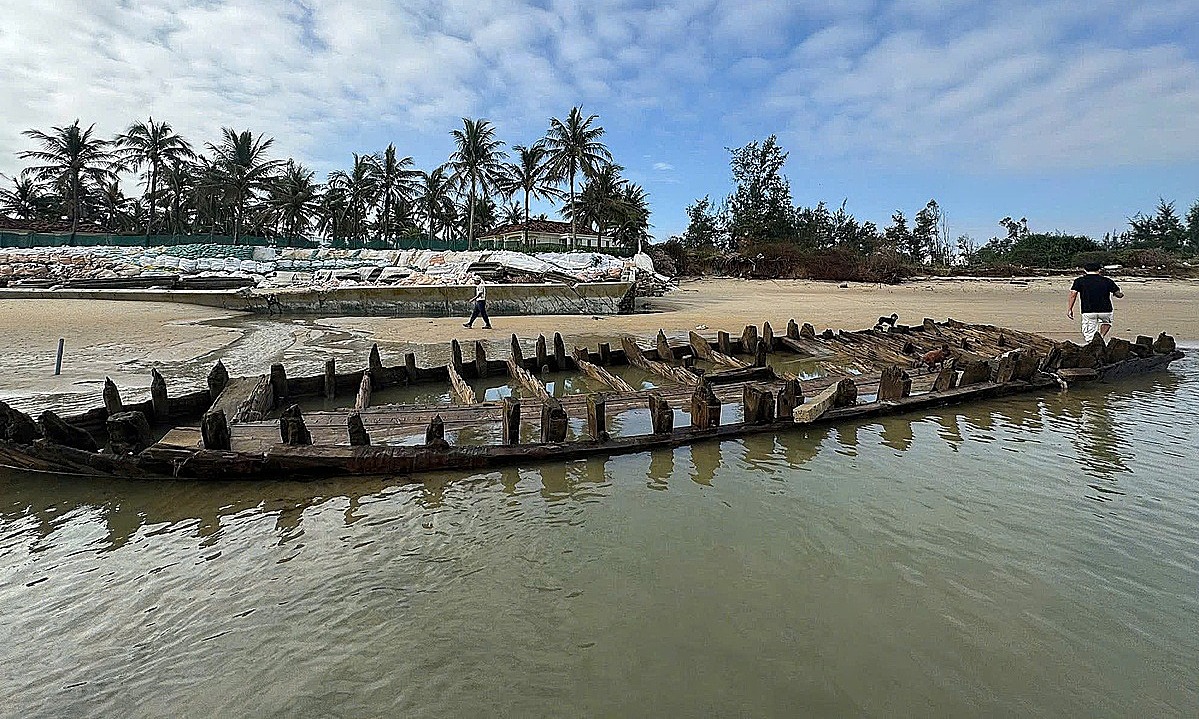
Heavy erosion caused by flooding and Typhoon Kalmaegi has revealed an uncovered shipwreck on the beach of Tan Thanh in Hoi An, Da Nang. This discovery, located just a short walk from the beach, presents a clear opportunity for salvage efforts after a two-year delay. The shipwreck, which was previously hidden beneath layers of sand and sediment, has now become visible due to the intense weather conditions that have affected the area.
Pham Ngoc Phu, the director of the Hoi An Center for Cultural Heritage Management and Preservation, has announced that a field survey will be scheduled for next week. The purpose of this survey is to assess the situation and identify potential solutions for moving the shipwreck to a more stable location on the shore. This step is crucial to ensure the preservation of the historical site and prevent further damage from natural elements.
The shipwreck was first discovered on the beach in 2023. However, the challenging sea conditions and unfavorable climate have made it difficult to conduct any excavation work. The rough waters and unpredictable weather have delayed efforts to study and document the site, leaving the shipwreck vulnerable to further erosion.
Initial surveys conducted in late 2023 provided some insights into the structure of the ship. According to the Hoi An Center, the vessel measures approximately 15 meters in length and 3 meters in width. Its design closely resembles that of merchant ships used by the people of Hoi An in previous centuries. This similarity suggests that the ship may have played a significant role in the region’s maritime trade history.
In addition to the shipwreck, ancient ceramic fragments were found in the surrounding area. These artifacts are believed to date back to the 17th and 18th centuries. The presence of such items indicates that the area may have been a hub of activity during that time, possibly related to trade or daily life in the region.
The Hoi An Center has also noted that over 20 shipwrecks have been identified in the East Sea, with many of them dating from the 14th to 16th centuries. This information highlights the historical significance of the region as a key point of maritime activity. The discovery of the latest shipwreck adds to the growing body of evidence about the seafaring traditions of the area.
Hoi An, a UNESCO-recognized world heritage site, has a rich history as a bustling trading port in central Vietnam, dating back to the 14th century. The city’s strategic location made it a vital center for commerce and cultural exchange, attracting traders from various parts of Asia.
One notable example of a salvaged shipwreck near Hoi An is the one located near the Cham Islands, off the coast of the city. This shipwreck was recovered between 1997 and 1999. The remains of the vessel measured 29.4 meters in length and 7.2 meters in width. The recovery of this ship provided valuable insights into the maritime practices of the time and contributed to the understanding of Hoi An’s historical role as a trading hub.
The recent discovery of the new shipwreck underscores the importance of continued exploration and preservation efforts in the region. As the Hoi An Center prepares for its upcoming field survey, there is hope that the site can be properly documented and protected for future generations. The combination of historical significance, archaeological value, and environmental challenges makes this discovery a critical moment for the preservation of Hoi An’s cultural heritage.