
Market Reaction to Dividend Tax Reform
On the 10th, news of the government’s decision to ease separate taxation on dividend income sent ripples through the stock market. Major holding companies such as SK, Hyosung, Kolon, Hanwha, and GS, along with traditional high-dividend stocks like banks, securities, and insurance companies, saw significant gains. The market’s reaction was swift, with some stocks rising nearly 10% during trading. This surge was driven by expectations of reduced tax burdens, leading to increased investor confidence. As foreign and institutional investors showed strong buying momentum, the KOSPI closed 3% higher at 4,073.24, reclaiming the “4,000-point” mark.
Future Implications for the Stock Market
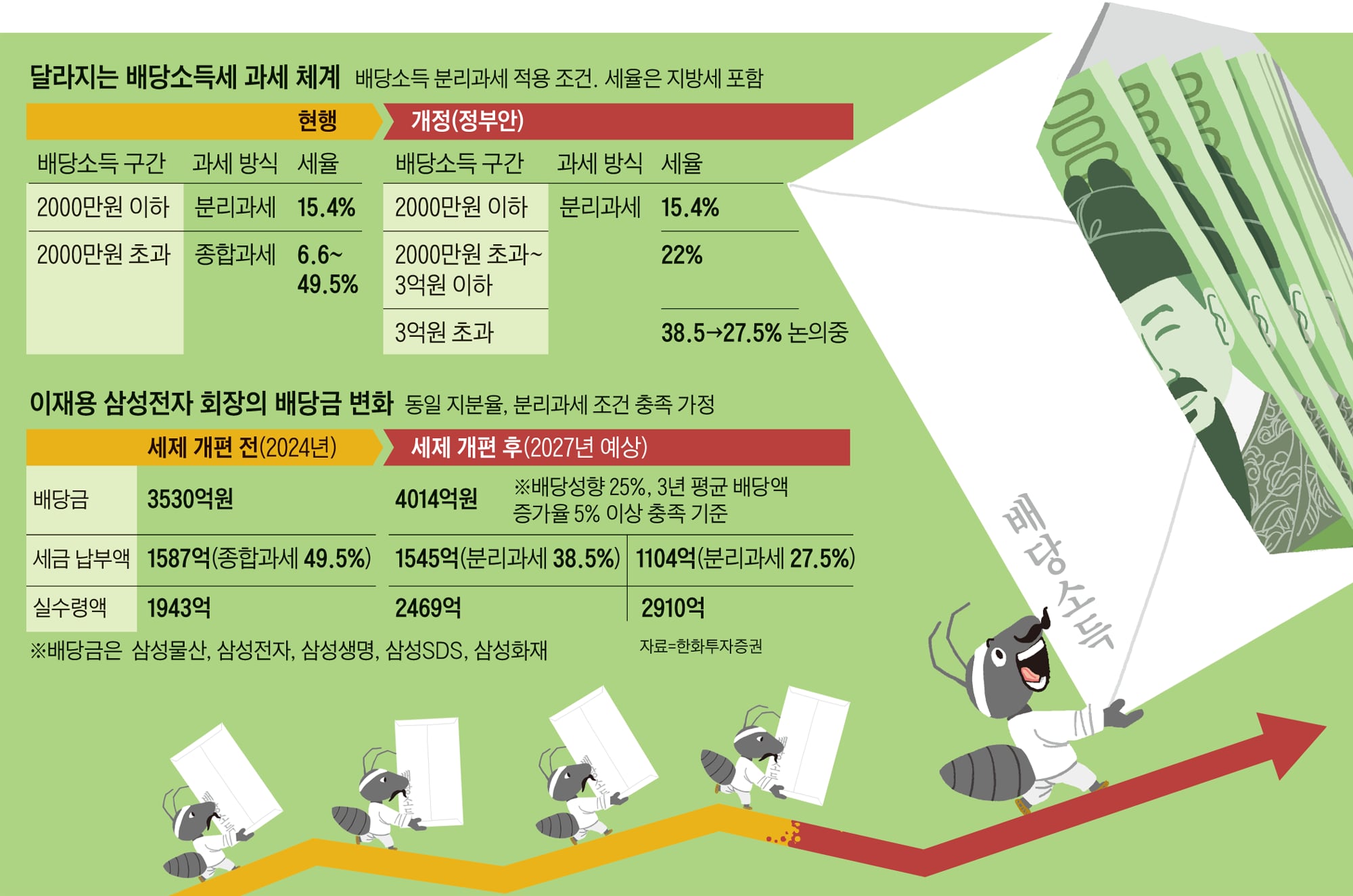
Investors are now closely watching how the stock market landscape will evolve after the implementation of separate taxation on dividend income next year. Currently, dividend income is combined with other income and taxed at a maximum rate of 49.5%. However, starting next year, if certain conditions are met, dividend income will be taxed separately. This shift could have far-reaching implications for individual investors and major shareholders alike.
If tax burdens decrease, individual investors are likely to show increased “accumulation demand,” treating dividend stocks as a core part of their retirement assets. They may hold onto stocks for longer periods and in larger quantities. Additionally, major shareholders will have stronger incentives to consider expanding dividends, further influencing market dynamics.
Park Seung-young, a researcher at Hanwha Investment & Securities, noted that once separate taxation on dividend income is implemented, dividends will transition from being considered “unearned income” subject to punitive high tax rates to becoming a “asset-building tool” for stable profit generation. He added that this change could become a catalyst that reshapes the structure of South Korea’s asset market in the medium to long term.
The Shift in Financial Investment Preferences
Until now, real estate has been South Korea’s primary financial investment method. Homeowners benefit from various tax advantages, such as exemptions on transfer value up to 1.2 billion Korean won when selling a single home, and tax-free rental income up to 200 million Korean won per year. These benefits have made real estate an attractive option compared to stocks.
However, if dividend income is not combined with comprehensive income and is taxed separately, changes could occur in the real estate-dominated financial investment structure. As tax savings and stable cash flow become more prominent, the appeal of dividend investments will grow, increasing the likelihood that surplus funds will shift from real estate to stocks.
Potential Benefits for Minority Shareholders
From the perspective of major shareholders, the ‘trickle-down effect’ for minority shareholders will only materialize if there is sufficient incentive to expand dividends. Stock market experts are closely monitoring the actions of Samsung Electronics Chairman Lee Jae-yong, given the significant portion of KOSPI dividends attributed to the Samsung Group.
According to Hanwha Investment & Securities, the total dividends of KOSPI-listed companies last year amounted to 50 trillion Korean won. Of this, Samsung Group’s total dividends were 13.7 trillion Korean won, accounting for approximately 27%. In 2024, Chairman Lee received a total of 353 billion Korean won in dividends. After paying 158.7 billion Korean won in comprehensive income tax (49.5%), the estimated amount he actually received was 194.3 billion Korean won.
The government’s tax reform could provide significant tax-saving incentives for Chairman Lee. The listed companies in which he holds shares include five entities: Samsung C&T, Samsung Electronics, Samsung Life Insurance, Samsung SDS, and Samsung Fire & Marine Insurance.
Hanwha Investment & Securities calculated that if these five companies meet the conditions for separate taxation (dividend payout ratio of 25%, average annual dividend growth rate of over 5% for three years) and Chairman Lee’s shareholding ratio remains the same as in 2024, the total expected dividends he would receive in 2027 would amount to 401.4 billion Korean won.
If the government applies the initially proposed maximum separate tax rate of 38.5% (including local taxes), the tax would be 154.5 billion Korean won, and the post-tax dividend receipt would be 246.9 billion Korean won. This would increase the actual dividends received by 52.6 billion Korean won. If the maximum separate tax rate is further lowered to 27.5%, Chairman Lee’s post-tax receipt would increase to 291 billion Korean won, a rise of approximately 100 billion Korean won from the current amount. What decision will Chairman Lee make after the government’s tax reform?
The 25% separate taxation on dividend income could become a ‘litmus test’ that brings long-term changes to the structure of South Korea’s asset market beyond tax reform.