
A Journey Through History and Legacy
In a heartfelt reflection, a descendant shared, “My grandfather risked his life to protect Korea. Seeing the ROK Navy personnel guarding Korea’s seas, following in my grandfather’s footsteps, brings a mix of emotions.” This sentiment was echoed by many during an event that brought together descendants of Korean War veterans from various countries.
On the 7th, in the afternoon, 17 foreigners entered the submarineJangbogo(1,200-ton class) docked at the Jinhae Naval Base in Changwon, South Gyeongsang Province. These visitors came from France, Canada, Ethiopia, and other countries, either as descendants of Korean War veterans or from participating nations. As they descended into the warship via a ladder approximately 4 meters long, they gazed in wonder at the cylindrical torpedo launch tubes. Questions like “How many days can it stay submerged?” and “How many torpedoes can it launch?” followed for some time.
This event, jointly hosted by the Korea War Participating Countries Memorial Association and the Republic of Korea Maritime League, and organized by the ROK Navy, included descendants from combat-supporting countries such as the U.S., Colombia, and Türkiye, as well as medical and supply-supporting nations like Sweden. KEPCOMCS, Korea Neulsarang Association, and Hesed Korea sponsored the event. The descendants remarked, “Witnessing the ROK Navy safeguarding Korea and its surrounding waters, which our ancestors defended, feels deeply personal. The blood our forebears shed resonates vividly.”
Personal Stories and Emotional Reflections
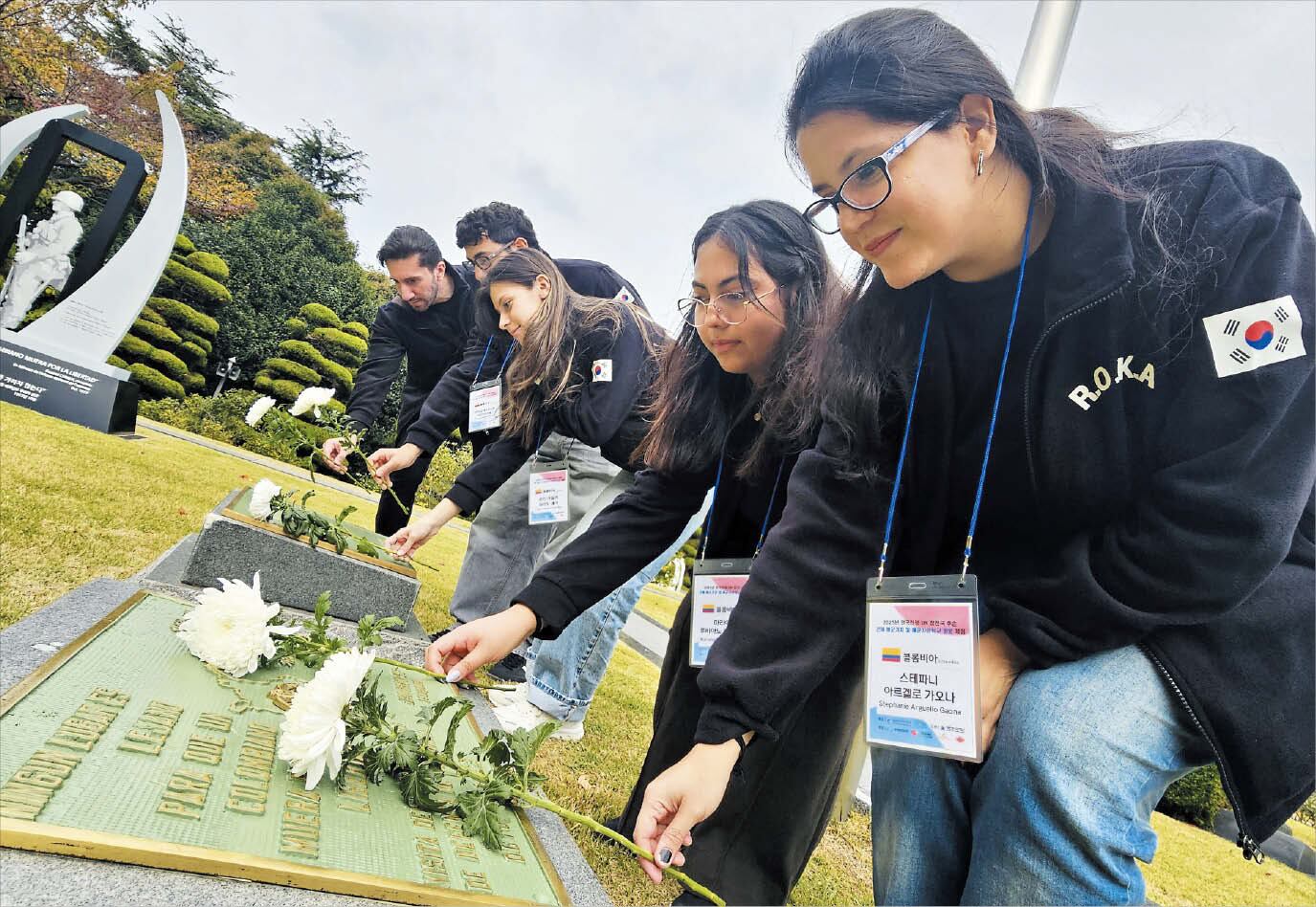
Stephanie Arguello Gaona, 33, a Colombian studying an English education specialist program at Sookmyung Women’s University Graduate School, said, “The submarine looked massive from the outside, but inside it was surprisingly cramped. I felt profound respect for the ROK Navy personnel dedicating themselves to protect the nation despite such harsh conditions.” Her grandfather, Santiago Gaona Cadena, 91, served in Korea from June 1951 for about a year, including the Kimhwa 400 Hill Battle. Injured by a grenade fragment in his right leg in October 1952, he returned to Colombia in December of the same year. Gaona added, “My grandfather still remembers and sings ‘Arirang’ perfectly. Like him, I want to leave meaningful footprints in Korea.”
Honoring the Fallen
The following afternoon, they visited the UN Memorial Cemetery in Busan and observed a moment of silence at the graves of fallen soldiers from various nations. White chrysanthemums were placed on the tombstones of young soldiers who died in their 20s. Petros Hailemariam Bizune, 44, the son of an Ethiopian veteran working at a factory in Incheon, bowed his head solemnly upon seeing the memorial plaque listing the names of 40,896 fallen soldiers. “Thinking that some of these names might be my father’s comrades overwhelmed me with emotion,” he said. “I realized how immense their sacrifice and courage were and how crucial it is to remember them.”
A Lasting Impact
These events not only provided a glimpse into the historical significance of the Korean War but also highlighted the ongoing legacy of those who served. For many, it was a deeply emotional experience, connecting them to their ancestors’ sacrifices and the enduring spirit of the ROK Navy. The descendants expressed a desire to carry forward the stories of their forebears, ensuring that their contributions are never forgotten.
Through these visits and reflections, the participants gained a deeper understanding of the sacrifices made during the Korean War and the importance of preserving this history for future generations. The event served as a powerful reminder of the shared humanity and mutual respect among nations, united by the memory of those who fought for peace and freedom.