
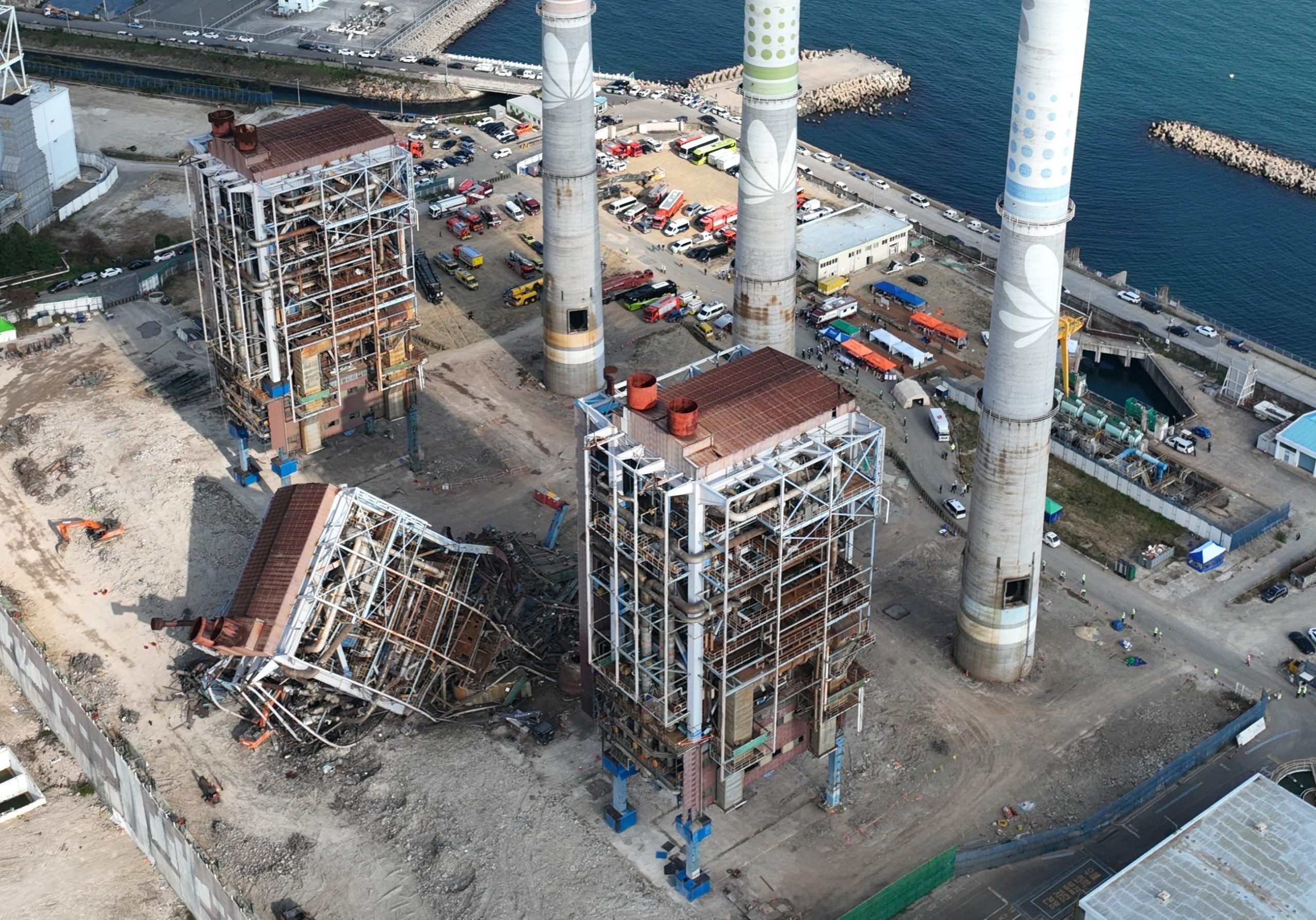
Understanding the Cause of the Boiler Tower Collapse
The collapse of a boiler tower at the Ulsan Thermal Power Plant has raised significant concerns about the adherence to proper demolition procedures. The incident has sparked questions about whether the demolition plan was followed correctly, particularly in light of the classification of the structure involved.
On the 7th, according to sources familiar with the matter, it was revealed that the collapsed boiler tower is categorized as a “structure” rather than a general building. This distinction has important implications, as structures are not required to submit demolition plans or obtain permits from local governments. As a result, the responsible local government, Ulsan Nam-gu, did not receive the necessary demolition plan that would have ensured safety during the process.
An official from Ulsan Nam-gu explained, “In the case of power generators, since they are classified as structures rather than buildings, the local government cannot be aware of the entire process, including blasting, dismantling, or demolition.” This lack of oversight raises concerns about how such projects are managed and monitored.
Legal Requirements for Demolition
Under the Current Building Management Act, any demolition of a building must involve submitting a detailed demolition plan. This plan typically includes information such as the construction overview, organizational chart, work sequence, dismantling method, and structural safety plan. These documents are usually reviewed by local governments, especially when blasting is involved. However, in this particular case, the structure in question was classified as a “structure” under the Building Management Act, not a general building. Therefore, no demolition report or permit application was submitted to Ulsan Nam-gu.
Experts suggest that while the construction company, HJ Shipbuilding & Construction Co., may have developed its own structural safety review and demolition plan, there is still uncertainty about whether these plans were properly implemented during the demolition process.
Ongoing Investigations
The police, who are currently investigating the accident, have stated, “We have heard from the construction company that they prepared a demolition plan and conducted a safety review, but we have not yet confirmed the specific documents.” They added, “We will need to conduct the investigation to verify the exact details.”
This highlights the importance of transparency and accountability in large-scale demolition projects. The classification of structures as non-buildings can create loopholes in the regulatory framework, potentially leading to safety risks if not properly addressed.
Key Takeaways
- Classification of Structures:The boiler tower was classified as a “structure,” which means it does not fall under the same regulations as general buildings.
- Lack of Oversight:Local governments, such as Ulsan Nam-gu, may not be aware of the entire demolition process when dealing with structures.
- Legal Requirements:The Building Management Act requires detailed demolition plans for buildings, but not for structures.
- Uncertainty in Implementation:While the construction company may have had its own plans, it remains unclear whether they were fully followed.
- Need for Investigation:Authorities are working to confirm the details of the demolition plan and ensure that all safety measures were properly implemented.
The incident underscores the need for clearer regulations and better communication between construction companies and local authorities, especially when dealing with complex structures that may not be subject to the same scrutiny as traditional buildings.