
Innovative Use of Kirigami in Parachute Design
In Tokyo, a groundbreaking development has emerged from the intersection of traditional Japanese paper art and modern engineering. A parachute designed using techniques from kirigami, a form of paper art that involves cutting and folding to create three-dimensional structures, is being explored for use in humanitarian airdrops. This innovative approach has the potential to revolutionize how emergency supplies are delivered in times of conflict and disaster.
A research team comprising members from Canada and other countries has been investigating the possibilities of kirigami, which allows for the creation of diverse 3D models from a single sheet of material. Their work has led to the successful development of a highly functional parachute. The design’s key advantage lies in its mass-produceability at a low cost, making it an attractive option for distributing essential supplies in critical situations.
Traditional parachutes often face challenges due to their complex design and assembly processes. Additionally, they can be susceptible to wind, leading to items landing far from their intended target. To address these issues, the team turned to the principles of origami and kirigami, which have already been used in the development of stretchable devices and everyday objects. These art forms offer unique structural advantages that could enhance parachute performance.
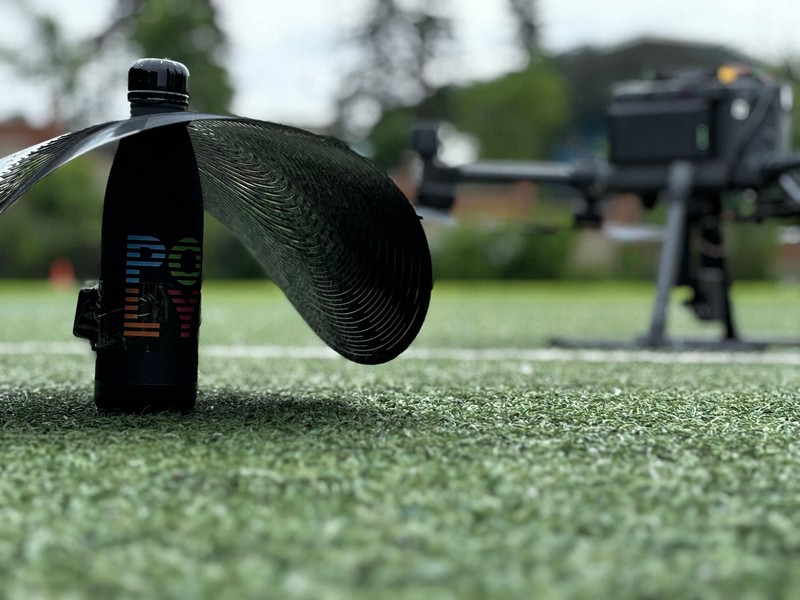
Inspired by wind-dispersed seeds, the team conducted simulations and experiments in a wind tunnel to refine the parachute’s structure. They created a prototype with a diameter of several dozen centimeters using PETG (polyethylene terephthalate glycol), a type of plastic. The prototype was attached to a water bottle and dropped from a drone at a height of approximately 60 meters, successfully landing in a predetermined target area.
The research revealed that the pattern of the kirigami design played a crucial role in ensuring that objects fell straight down, rather than being affected by the material or angle immediately after release. This finding highlights the importance of the design’s geometry in achieving precise landings.
Currently, one such parachute costs around CA$50 (approximately 5,300 yen) to produce. However, the team has already developed a more affordable version using cardboard. They believe that with the use of a commercially available press, the production cost can be reduced to less than a dollar. This potential cost reduction makes the design even more viable for large-scale implementation.
Looking ahead, the team envisions future applications that include designing larger parachutes for efficient humanitarian aid and deploying numerous weather sensors during typhoons. Frederick Gosselin, a professor at Polytechnique Montreal, emphasized that kirigami serves as a valuable source of inspiration in the field of materials science.
The findings of the research were published in the British scientific journalNatureon October 1. This development marks a significant step forward in leveraging traditional art forms to solve modern challenges, particularly in the realm of disaster response and humanitarian efforts.