

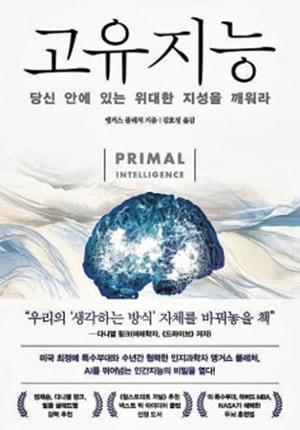
Primal Intelligence
By Angus Fletcher | Translated by Kim Hyo-jung | Influenctial | 392 pages | 21,000 Korean won
In the early 2000s, the U.S. Army Special Forces observed a concerning pattern. Young recruits, despite having high IQs, were struggling with decision-making, strategic planning, and leadership. Their mental resilience was particularly weak. More and more recruits could “solve math problems but not life problems.” In 2021, the U.S. Army sought advice from a cognitive scientist: “What guidance can you offer our recruits?”
The Cognitive Scientist Collaborating with the U.S. Army
The scientist who responded to this call was Angus Fletcher, the author of this book. He has scientifically explored how stories influence human thinking, emotion, and creativity. In 2021, Fletcher synthesized his research into the concept of “Primal Intelligence.” He argued that humans have a unique mode of thinking that artificial intelligence (AI) cannot replicate. Fletcher combined his academic work with the special forces’ long-standing unconventional training system. He developed a method to train the brain to act wisely in VUCA situations—volatility, uncertainty, complexity, and ambiguity.
The results were impressive. Operatives began navigating chaos with greater agility. After a year of joint research, the training method was passed on to the Green Berets, the Army’s special operations unit. It was later adopted by the Command and General Staff College, the Army’s leadership program. Over 150 senior officers participated in a scientific experiment. According to Army evaluation metrics, the training elevated creative problem-solving scores from average to excellent, excellent to outstanding, and outstanding to exceptional. Fletcher was awarded a medal by the U.S. Army in 2023 for his contributions.
At this point, one might wonder what this training method entails. Instead of revealing it in detail (which could risk exposing state secrets), Fletcher elaborates on the theory behind it—Primal Intelligence—and how to reactivate and apply it in daily life. This book is a practical guide to awakening the primal intelligence within.

What Is Needed in an Uncertain Era
Fletcher argues that modern society has misdefined “intelligence.” IQ tests and 21st-century education prioritize logic. But he asks: “Without studying logic, how does our brain think? What is the original way humans think?” According to Fletcher, the human brain possesses non-logical intelligence: four innate abilities—intuition, imagination, emotion, and common sense.
In data-scarce scenarios where AI falters, human primal intelligence shines. “Flashes of insight” often arise from exceptional information. The habit of asking “when, where, and what” systematically cultivates the intuition needed to gain insights from such information. Fletcher also learned from special forces instructors that “trained imagination” enables meticulous planning. A good plan involves setting a goal and envisioning multiple pathways to achieve it. In this sense, imagination is a weapon that enables “definite strategies and infinite tactics.”
Emotions anchor us and prevent us from losing direction. In crises, emotions like fear, anger, or shame are critical signals. For instance, irritation or anger warns that a plan is unraveling, while fear signals that a plan has already failed. How to act on these signals depends on the individual.
AI is not infallible. ChatGPT sometimes lies because it does not recognize its own ignorance. AI fills knowledge gaps by extrapolating from past data or trends. However, humans know from experience that admitting ignorance leads to greater learning. This is human common sense. In an era of uncertainty, where accurate data is scarce and logic collapses, Fletcher’s argument for focusing on primal intelligence—rooted in humanity’s ancient survival mechanisms—is compelling.