
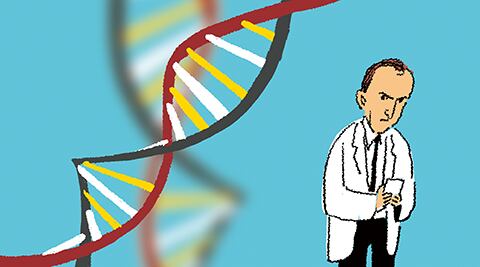
The Discovery of DNA’s Double-Helix Structure
In 1953, James Watson, a 25-year-old researcher at the University of Cambridge, visited Maurice Wilkins, a researcher at King’s College. During this meeting, Watson carried a preprint of a paper claiming that a researcher at the California Institute of Technology had determined the DNA structure. He persuaded Wilkins that they could not fall behind the U.S. Eventually, Wilkins secretly showed Watson an X-ray diffraction photo of DNA taken by his colleague Rosalind Franklin. This so-called “Photo 51” became the decisive evidence that gave Watson confidence.
Using this hint, Watson and his colleague Francis Crick created a 3D model of DNA using wires and metal plates, discovering a double-helix structure that satisfied chemical constraints. They ran through school corridors and pubs shouting, “We’ve figured out the structure of DNA!” About two months later, a paper revealing the double-helix structure of DNA was published inNature. The short 900-word paper, starting with “We wish to propose a structure for DNA,” stated that the DNA structure is a double helix composed of two strands.
The Controversial Legacy of Rosalind Franklin
In his autobiography, Watson recalled that upon seeing Franklin’s photo, he immediately intuited that DNA was a structure of two intertwined strands. However, his paper only vaguely mentioned in one line, “stimulated by unpublished experimental results of Wilkins, Dr. Franklin, and others.” It is said that Franklin was unaware until her death from ovarian cancer at 37 that Watson had secretly viewed her DNA photo. In his memoir published after Franklin’s death, Watson described her as “an average scientist who couldn’t properly interpret her own data and hoarded it.”
This controversial portrayal of Franklin has sparked significant debate among historians and scientists. Many argue that her contributions were overlooked and undervalued during her lifetime, and that her work was instrumental in the discovery of the DNA structure.
The Complex Character of James Watson
Watson, who gained great fame at a young age by receiving the Nobel Prize for achievements comparable to Darwin and Mendel, was also evaluated in academia as “like the Roman tyrant Emperor Caligula.” Even after becoming a professor at Harvard University, he dismissed the research of fellow professors in evolution, taxonomy, and ecology as “stamp collecting.” He did not hesitate to make racist remarks, such as “the darker the skin, the stronger the sexual drive” or “people who have dealt with Black employees know that it’s not true that our intelligence is equal to that of Africans,” implying that Black people’s intelligence is lower.
These statements have led to widespread condemnation and have overshadowed his scientific achievements. Despite his groundbreaking work in genetics, Watson’s personal views have been widely criticized, leading to the loss of many honorary positions.
The Final Years and Legacy
Watson faced financial difficulties and in 2014 became the first Nobel laureate to auction his medal. He continued to hold racist views and eventually lost all his honorary positions. He unraveled the secret of DNA and presented the blueprint of life to the world, but in the end, his own genes were not free from prejudice. He passed away a few days ago, embodying both the glory of science and human arrogance, its light and shadow.