
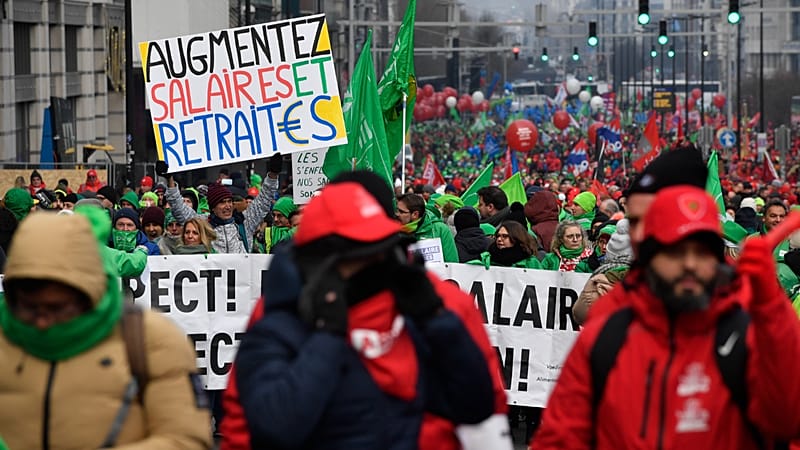
European Court of Justice Upholds EU Minimum Wage Directive
The European Court of Justice (ECJ) delivered a significant ruling on Tuesday, affirming the validity of an EU directive aimed at establishing a “adequate” minimum wage across all 27 member states. This decision came after Denmark challenged the directive, arguing that it overstepped the EU’s authority by attempting to regulate wages.
Denmark, supported by Sweden, had taken the EU institutions to court over the directive adopted in October 2022. The country maintained that member states should have the autonomy to determine wage levels through collective agreements between trade unions and employers. They argued that the EU was not authorized to create legislation on pay matters.
However, the ECJ confirmed that “most of the directive in question is valid,” stating that it “does not amount to direct interference by EU law with the right of association.” The court also dismissed Denmark’s claim that the directive was based on an incorrect legal foundation.
Despite this, the court annulled two specific provisions of the directive. These provisions were found to “amount to direct interference by EU law in the determination of pay.” One provision sought to establish criteria for setting an adequate minimum wage, while the other aimed to prevent the reduction of statutory minimum wages in countries where they are automatically indexed.
This ruling contrasts with the opinion provided by the Advocate General in January, who had recommended that the directive be annulled due to its perceived overreach of EU powers.
Support from Political Groups
The Socialists and Democrats (S&D) group in the European Parliament welcomed the ECJ’s decision. In a statement, they emphasized that the ruling serves as a “powerful signal of hope and social justice” during a time of rising living costs and housing crises. They urged member states and the Commission to accelerate the implementation of the directive, stating, “No excuses for delay anymore.”
Similarly, the European Trade Union Confederation (ETUC) called on member states to move beyond a “wait and see” approach and fully implement the directive. Esther Lynch, the organization’s general secretary, highlighted the importance of ensuring that workers receive fair wages and effective bargaining power. She warned against using legal loopholes to undermine the directive’s goals.
Despite the positive reception, the ETUC expressed concern over the removal of the provision that prevented automatic indexation of minimum wages. They fear this could lead to reductions in statutory minimum wages in certain countries.
Implementation Challenges
As of now, only eight EU member states have implemented the directive. The European Minimum Wage Directive aims to ensure adequate statutory minimum wages, promote collective bargaining, and improve workers’ access to minimum wage protection across the bloc.
Under the directive, EU countries must establish procedures to guarantee that minimum wages provide a decent standard of living. This includes reducing in-work poverty, promoting social cohesion, and narrowing the gender pay gap.
The directive was approved with the support of all member states except Hungary, which chose to abstain. As of January 2025, gross monthly minimum wages in the EU ranged from €551 in Bulgaria to €2,638 in Luxembourg, according to Eurostat.
Euronews has reached out to Denmark’s Ministry of Employment for comment but has not received a response by the time of publication.