

Decline in Corporate Profitability Over Two Decades
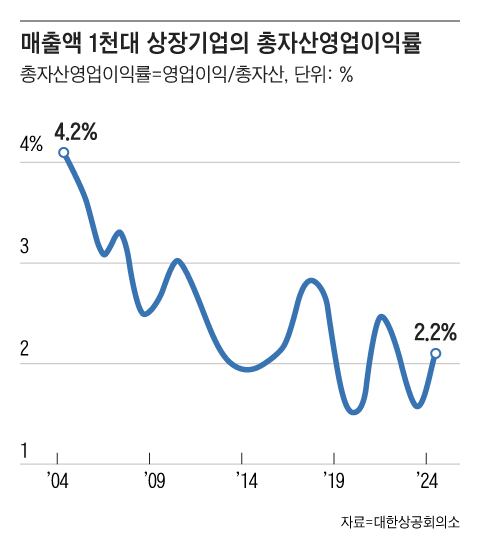
Over the past 20 years, the profitability of major domestic companies has significantly declined. According to a recent report, the total asset operating profit margin of the top 1,000 domestic listed companies by revenue has nearly halved. This decline highlights a growing concern for corporate efficiency and economic growth.
The Korea Chamber of Commerce and Industry recently released data showing that the total asset operating profit margin fell from 4.2% in 2004 to 2.2% last year. This metric, calculated by dividing operating profit by total assets, reflects how effectively a company generates profits from its assets. In 2004, these companies generated 4.2 million Korean won in profit from 100 million Korean won in assets. However, this figure dropped to 2.2 million Korean won in the most recent year.
The Korea Chamber of Commerce and Industry emphasized the need for a system that rewards companies—regardless of size—that achieve growth and profitability. A representative from the chamber stated, “If the top 100 small and medium-sized listed companies by total asset operating profit margin grow into mid-sized enterprises, a simple calculation suggests they could create 5.4 trillion Korean won in added value. This would account for 0.24% of last year’s domestic GDP, which is a meaningful contribution amid a low-growth trend.”
Lee Jong-myung, head of the Korea Chamber of Commerce and Industry’s Industry Innovation Headquarters, highlighted the importance of encouraging companies with increasing profits rather than protecting those with declining profits. He said, “Encouraging companies with increasing profits, rather than protecting those with declining profits, is the path to improving growth rates. It is time to shift the corporate growth policy paradigm so that companies do not halt their own growth due to stepwise regulations.”
Key Challenges Facing Domestic Companies
Several factors contribute to the decline in corporate profitability:
- Economic Slowdown: The overall economic environment has become increasingly challenging, with slow growth affecting business performance.
- Regulatory Pressures: Companies often face complex and restrictive regulations that hinder their ability to innovate and expand.
- Global Competition: Increased competition from international markets has forced domestic companies to adapt and improve their operations.
- Technological Changes: Rapid technological advancements require continuous investment, which can strain financial resources.
These challenges underscore the need for a strategic approach to corporate growth and profitability. The Korea Chamber of Commerce and Industry’s recommendations suggest that fostering a supportive environment for profitable businesses could lead to significant economic benefits.
Potential Solutions and Strategies
To address the decline in corporate profitability, several strategies can be considered:
- Incentivizing Growth: Implementing policies that reward companies achieving growth and profitability can encourage innovation and efficiency.
- Simplifying Regulations: Reducing bureaucratic hurdles can help companies operate more smoothly and focus on expansion.
- Investing in Technology: Encouraging investment in new technologies can enhance productivity and competitiveness.
- Supporting SMEs: Providing targeted support to small and medium-sized enterprises (SMEs) can help them scale up and contribute more to the economy.
By focusing on these areas, companies can better navigate the current economic landscape and work towards sustainable growth.
The Role of Policy in Economic Growth
Government policies play a crucial role in shaping the business environment. The Korea Chamber of Commerce and Industry advocates for a shift in corporate growth policies to prioritize companies that demonstrate growth and profitability. This approach can lead to a more dynamic and resilient economy.
The chamber’s findings highlight the importance of creating a system that supports and rewards successful businesses. By doing so, the country can foster an environment where companies are motivated to innovate and grow, ultimately contributing to national economic development.
As the business landscape continues to evolve, it is essential for companies and policymakers to work together to address the challenges and opportunities ahead.